Wang Changyin, Shen Ying, Zhu Shaobo
Department of Nuclear Medicine, Zhongnan Hospital of Wuhan University, Wuhan Hubei 430071, People's Republic of China.
Department of Osteology, Zhongnan Hospital of Wuhan University, Wuhan Hubei, 430071, People's Republic of China.
PLoS One. 2015 Nov 23;10(11):e0143437. doi: 10.1371/journal.pone.0143437. eCollection 2015.
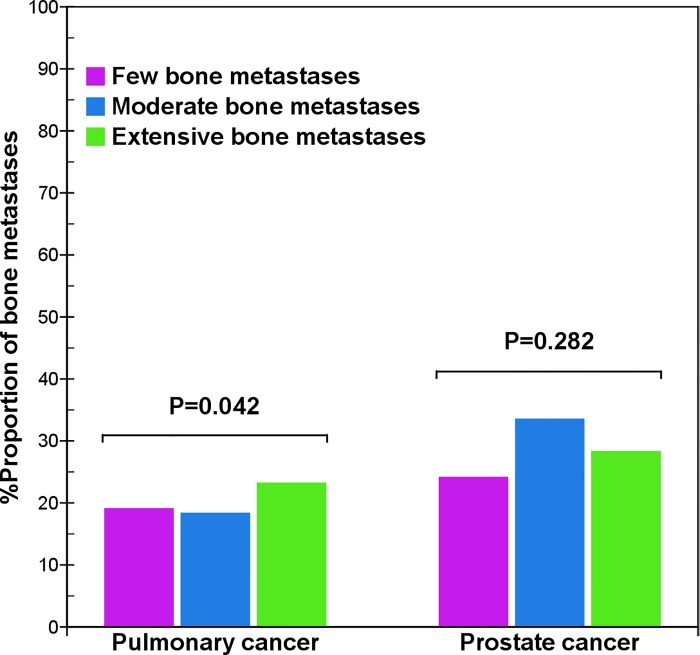
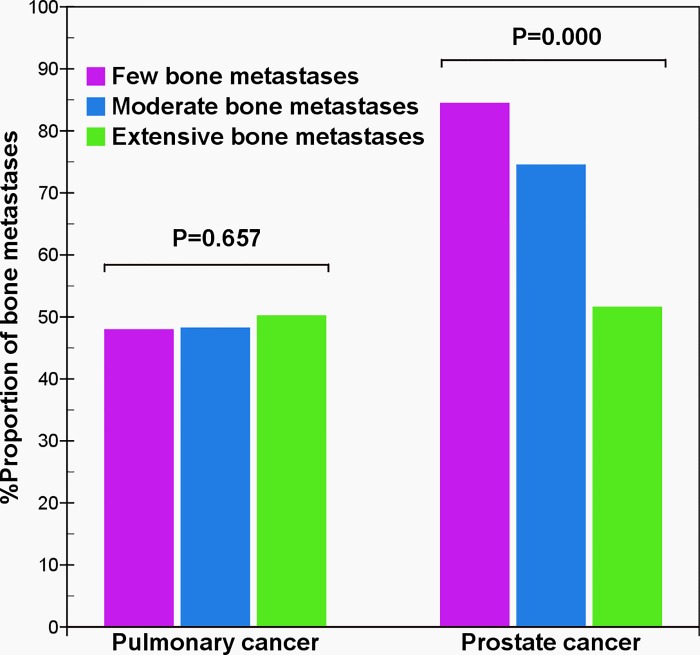
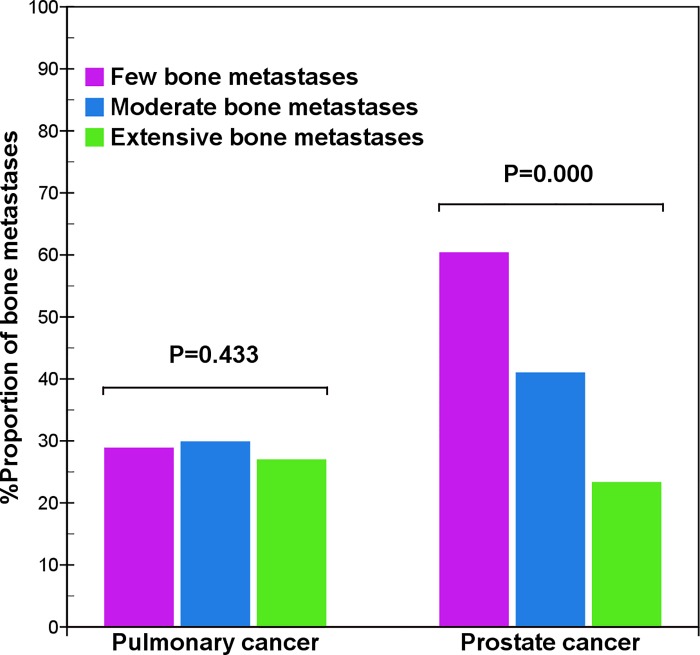
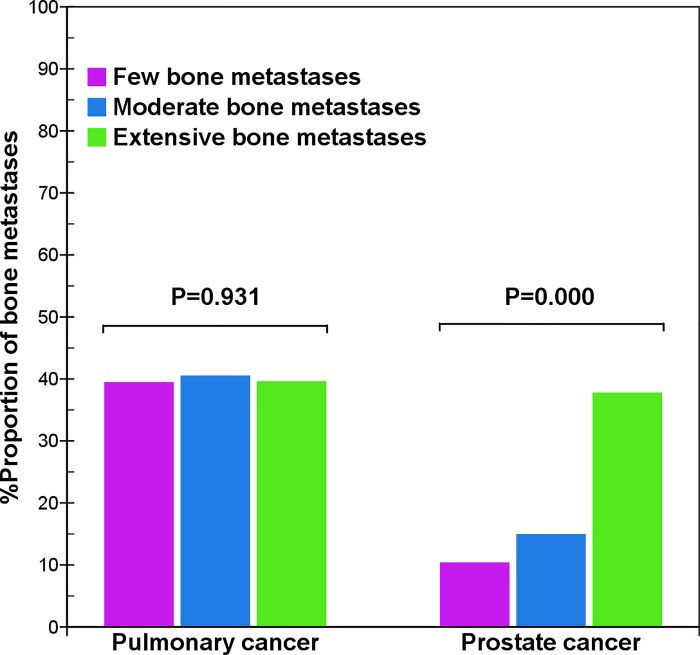
Bone scintigraphies are widely applied for detecting bone metastases. The aim of this study was to investigate distribution features of bone metastases in pulmonary and prostate cancers. Bone scintigraphies were performed in 460 patients with pulmonary cancer and 144 patients with prostate cancer. Patients were divided into three groups according to the total number of bone metastases: few bone metastases, moderate bone metastases, and extensive bone metastases. We compared the distribution of bone metastases in the two cancers, and analyzed the relationship between the distribution of metastatic lesions and their metastatic patterns. A total of 2279 and 2000 lesions of bone metastases were detected in 258 patients with pulmonary cancer and 102 patients with prostate cancer, respectively. In patients with few bone metastases, the distributions of metastatic lesions in the vertebrae (χ2 = 16.0, P = 0.000) and thoracic bones (χ2 = 20.7, P = 0.002) were significantly different between pulmonary and prostate cancers. In cases with moderate bone metastases, the distributions in the vertebrae (χ2 = 6.6, P = 0.010), pelvis (χ2 = 15.1 P = 0.000), and thoracic bones (χ2 = 38.8, P = 0.000) were also significantly different between the two cancers. However, in patients with extensive bone metastases, the distributions were very similar. As the total number of bone metastases increased, their distribution in pulmonary cancer did not noticeably change, but the distribution in the vertebrae and thoracic bones of prostate cancer patients significantly changed. Accordingly, the distribution characteristics of bone metastases differed in pulmonary and prostate cancers, mainly in the early stages of metastasis.
骨闪烁扫描术被广泛应用于检测骨转移瘤。本研究的目的是调查肺癌和前列腺癌骨转移瘤的分布特征。对460例肺癌患者和144例前列腺癌患者进行了骨闪烁扫描术。根据骨转移瘤的总数将患者分为三组:少量骨转移瘤、中度骨转移瘤和广泛骨转移瘤。我们比较了两种癌症中骨转移瘤的分布情况,并分析了转移灶分布与其转移模式之间的关系。在258例肺癌患者和102例前列腺癌患者中,分别检测到2279个和2000个骨转移瘤病灶。在骨转移瘤较少的患者中,肺癌和前列腺癌在椎骨(χ2 = 16.0,P = 0.000)和胸骨(χ2 = 20.7,P = 0.002)的转移灶分布存在显著差异。在中度骨转移瘤的病例中,两种癌症在椎骨(χ2 = 6.6,P = 0.010)、骨盆(χ2 = 15.1,P = 0.000)和胸骨(χ2 = 38.8,P = 0.000)的分布也存在显著差异。然而,在广泛骨转移瘤的患者中,分布非常相似。随着骨转移瘤总数的增加,其在肺癌中的分布没有明显变化,但前列腺癌患者在椎骨和胸骨中的分布发生了显著变化。因此,肺癌和前列腺癌骨转移瘤的分布特征不同,主要在转移的早期阶段。