• 文献检索
  • 文档翻译
  • 深度研究
  • 学术资讯
  • Suppr Zotero 插件Zotero 插件
  • 邀请有礼
  • 套餐&价格
  • 历史记录
应用&插件
Suppr Zotero 插件Zotero 插件浏览器插件Mac 客户端Windows 客户端微信小程序
定价
高级版会员购买积分包购买API积分包
服务
文献检索文档翻译深度研究API 文档MCP 服务
关于我们
关于 Suppr公司介绍联系我们用户协议隐私条款
关注我们

Suppr 超能文献

核心技术专利:CN118964589B侵权必究
粤ICP备2023148730 号-1Suppr @ 2026

文献检索

告别复杂PubMed语法,用中文像聊天一样搜索,搜遍4000万医学文献。AI智能推荐,让科研检索更轻松。

立即免费搜索

文件翻译

保留排版,准确专业,支持PDF/Word/PPT等文件格式,支持 12+语言互译。

免费翻译文档

深度研究

AI帮你快速写综述,25分钟生成高质量综述,智能提取关键信息,辅助科研写作。

立即免费体验

利用卷积神经网络自动识别骨闪烁扫描中的可疑骨转移病灶。

Automatic identification of suspicious bone metastatic lesions in bone scintigraphy using convolutional neural network.

机构信息

Laboratory of Clinical Nuclear Medicine, Department of Nuclear Medicine, West China Hospital, Sichuan University, No. 37 Guo Xue Alley, Chengdu, 610041, China.

Machine Intelligence Laboratory, College of Computer Science, Sichuan University, Chengdu, 610065, China.

出版信息

BMC Med Imaging. 2021 Sep 4;21(1):131. doi: 10.1186/s12880-021-00662-9.

DOI:10.1186/s12880-021-00662-9
PMID:34481459
原文链接:https://pmc.ncbi.nlm.nih.gov/articles/PMC8417997/
Abstract

BACKGROUND

We aimed to construct an artificial intelligence (AI) guided identification of suspicious bone metastatic lesions from the whole-body bone scintigraphy (WBS) images by convolutional neural networks (CNNs).

METHODS

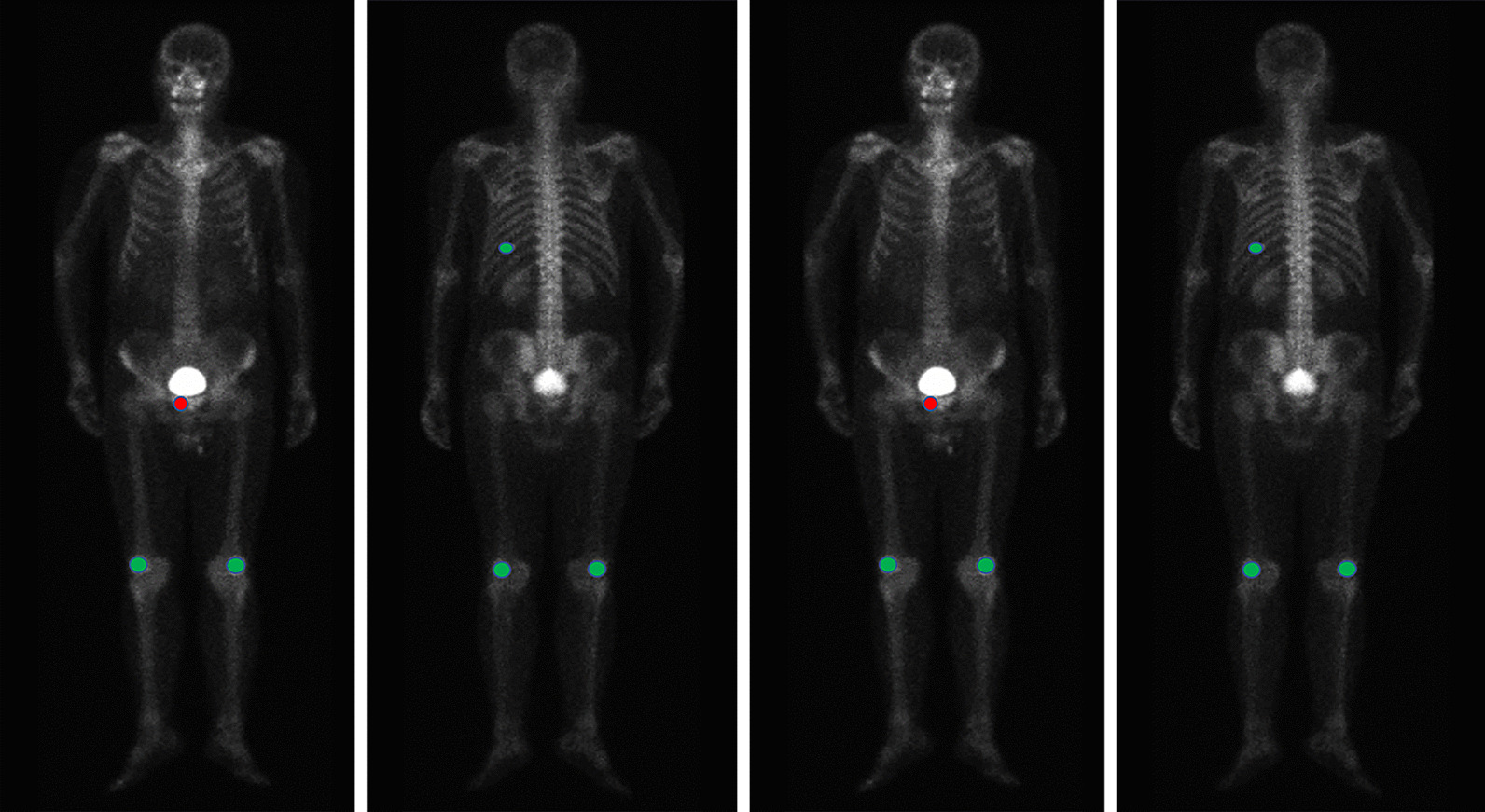
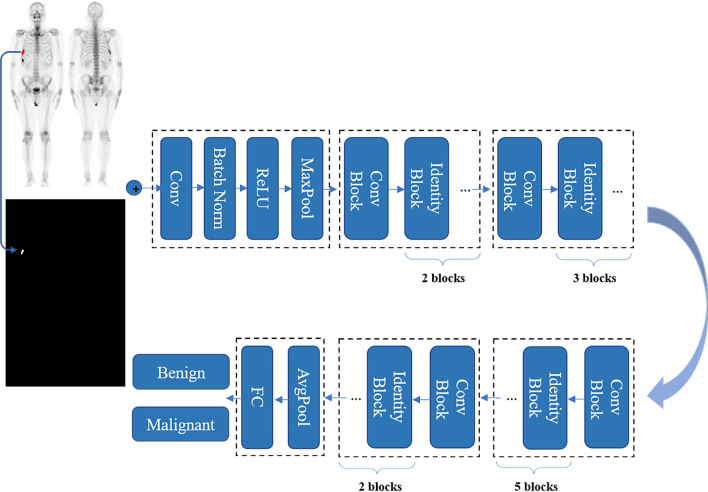
We retrospectively collected the Tc-MDP WBS images with confirmed bone lesions from 3352 patients with malignancy. 14,972 bone lesions were delineated manually by physicians and annotated as benign and malignant. The lesion-based differentiating performance of the proposed network was evaluated by fivefold cross validation, and compared with the other three popular CNN architectures for medical imaging. The average sensitivity, specificity, accuracy and the area under receiver operating characteristic curve (AUC) were calculated. To delve the outcomes of this study, we conducted subgroup analyses, including lesion burden number and tumor type for the classifying ability of the CNN.

RESULTS

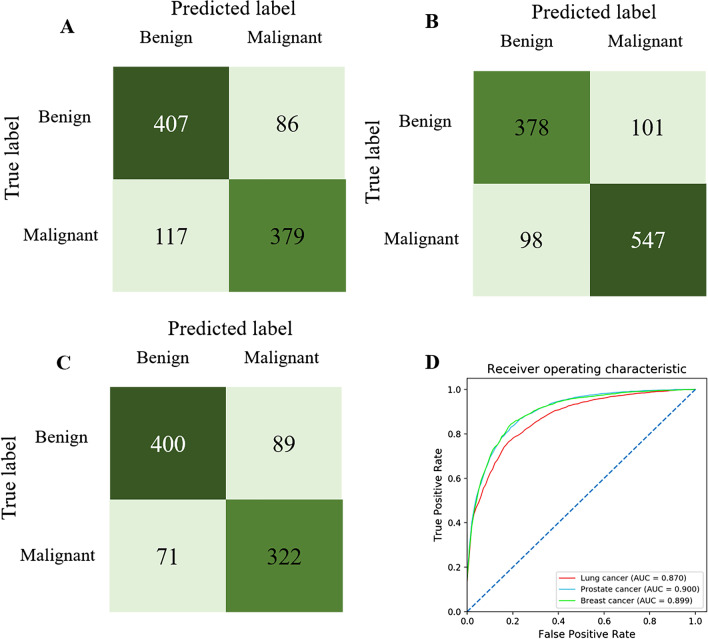
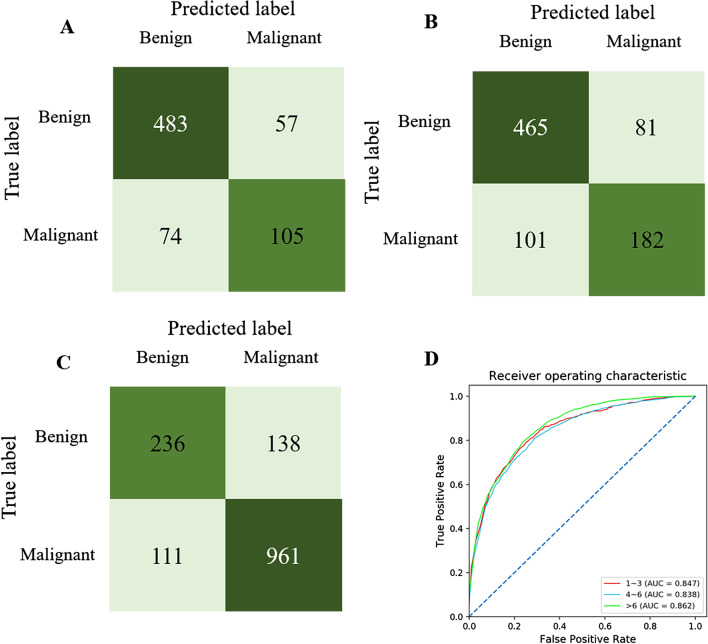
In the fivefold cross validation, our proposed network reached the best average accuracy (81.23%) in identifying suspicious bone lesions compared with InceptionV3 (80.61%), VGG16 (81.13%) and DenseNet169 (76.71%). Additionally, the CNN model's lesion-based average sensitivity and specificity were 81.30% and 81.14%, respectively. Based on the lesion burden numbers of each image, the area under the receiver operating characteristic curve (AUC) was 0.847 in the few group (lesion number n ≤ 3), 0.838 in the medium group (n = 4-6), and 0.862 in the extensive group (n > 6). For the three major primary tumor types, the CNN-based lesion identifying AUC value was 0.870 for lung cancer, 0.900 for prostate cancer, and 0.899 for breast cancer.

CONCLUSION

The CNN model suggests potential in identifying suspicious benign and malignant bone lesions from whole-body bone scintigraphic images.

摘要

背景

我们旨在通过卷积神经网络(CNN)构建一种从全身骨闪烁显像(WBS)图像中识别可疑骨转移病变的人工智能(AI)引导方法。

方法

我们回顾性收集了 3352 例恶性肿瘤患者经 Tc-MDP WBS 图像证实的骨病变。由医师手动描绘 14972 个骨病变,并将其标注为良性和恶性。通过五重交叉验证评估所提出的网络的基于病变的区分性能,并与其他三种用于医学成像的流行 CNN 架构进行比较。计算平均灵敏度、特异性、准确性和受试者工作特征曲线(ROC)下的面积(AUC)。为深入研究本研究的结果,我们进行了亚组分析,包括病变负担数量和肿瘤类型,以评估 CNN 的分类能力。

结果

在五重交叉验证中,与 InceptionV3(80.61%)、VGG16(81.13%)和 DenseNet169(76.71%)相比,我们提出的网络在识别可疑骨病变方面达到了最佳的平均准确性(81.23%)。此外,CNN 模型的基于病变的平均灵敏度和特异性分别为 81.30%和 81.14%。基于每个图像的病变负担数量,ROC 曲线下的面积(AUC)在病变数量较少的组(病变数量 n≤3)中为 0.847,在病变数量中等的组(n=4-6)中为 0.838,在病变数量较多的组(n>6)中为 0.862。对于三种主要的原发性肿瘤类型,基于 CNN 的病变识别 AUC 值分别为肺癌 0.870、前列腺癌 0.900 和乳腺癌 0.899。

结论

CNN 模型有望从全身骨闪烁显像图像中识别可疑的良性和恶性骨病变。

https://cdn.ncbi.nlm.nih.gov/pmc/blobs/a182/8417997/4510ddddaad5/12880_2021_662_Fig4_HTML.jpg
https://cdn.ncbi.nlm.nih.gov/pmc/blobs/a182/8417997/2b185481b278/12880_2021_662_Fig1_HTML.jpg
https://cdn.ncbi.nlm.nih.gov/pmc/blobs/a182/8417997/26d9782f38a5/12880_2021_662_Fig2_HTML.jpg
https://cdn.ncbi.nlm.nih.gov/pmc/blobs/a182/8417997/8bbd9717cb36/12880_2021_662_Fig3_HTML.jpg
https://cdn.ncbi.nlm.nih.gov/pmc/blobs/a182/8417997/4510ddddaad5/12880_2021_662_Fig4_HTML.jpg
https://cdn.ncbi.nlm.nih.gov/pmc/blobs/a182/8417997/2b185481b278/12880_2021_662_Fig1_HTML.jpg
https://cdn.ncbi.nlm.nih.gov/pmc/blobs/a182/8417997/26d9782f38a5/12880_2021_662_Fig2_HTML.jpg
https://cdn.ncbi.nlm.nih.gov/pmc/blobs/a182/8417997/8bbd9717cb36/12880_2021_662_Fig3_HTML.jpg
https://cdn.ncbi.nlm.nih.gov/pmc/blobs/a182/8417997/4510ddddaad5/12880_2021_662_Fig4_HTML.jpg

相似文献

1
Automatic identification of suspicious bone metastatic lesions in bone scintigraphy using convolutional neural network.利用卷积神经网络自动识别骨闪烁扫描中的可疑骨转移病灶。
BMC Med Imaging. 2021 Sep 4;21(1):131. doi: 10.1186/s12880-021-00662-9.
2
Deep neural network based artificial intelligence assisted diagnosis of bone scintigraphy for cancer bone metastasis.基于深度神经网络的人工智能辅助诊断癌症骨转移骨闪烁扫描。
Sci Rep. 2020 Oct 12;10(1):17046. doi: 10.1038/s41598-020-74135-4.
3
Development of Convolutional Neural Networks to identify bone metastasis for prostate cancer patients in bone scintigraphy.开发卷积神经网络以识别骨扫描中前列腺癌患者的骨转移。
Ann Nucl Med. 2020 Nov;34(11):824-832. doi: 10.1007/s12149-020-01510-6. Epub 2020 Aug 24.
4
Bone metastasis classification using whole body images from prostate cancer patients based on convolutional neural networks application.基于卷积神经网络应用的前列腺癌患者全身图像的骨转移分类。
PLoS One. 2020 Aug 14;15(8):e0237213. doi: 10.1371/journal.pone.0237213. eCollection 2020.
5
Artificial intelligence-based analysis of whole-body bone scintigraphy: The quest for the optimal deep learning algorithm and comparison with human observer performance.基于人工智能的全身骨闪烁扫描分析:最优深度学习算法的探索及与人类观察者表现的比较。
Z Med Phys. 2024 May;34(2):242-257. doi: 10.1016/j.zemedi.2023.01.008. Epub 2023 Mar 15.
6
Development and Validation of a Convolutional Neural Network Model to Predict a Pathologic Fracture in the Proximal Femur Using Abdomen and Pelvis CT Images of Patients With Advanced Cancer.利用晚期癌症患者腹部和骨盆 CT 图像建立卷积神经网络模型预测股骨近端病理性骨折的研究
Clin Orthop Relat Res. 2023 Nov 1;481(11):2247-2256. doi: 10.1097/CORR.0000000000002771. Epub 2023 Aug 23.
7
Automatic differentiation of thyroid scintigram by deep convolutional neural network: a dual center study.基于深度卷积神经网络的甲状腺闪烁显像自动分类:一项双中心研究。
BMC Med Imaging. 2021 Nov 25;21(1):179. doi: 10.1186/s12880-021-00710-4.
8
Efficient Bone Metastasis Diagnosis in Bone Scintigraphy Using a Fast Convolutional Neural Network Architecture.使用快速卷积神经网络架构在骨闪烁显像中进行高效骨转移诊断
Diagnostics (Basel). 2020 Jul 30;10(8):532. doi: 10.3390/diagnostics10080532.
9
Deep-learning approach with convolutional neural network for classification of maximum intensity projections of dynamic contrast-enhanced breast magnetic resonance imaging.基于卷积神经网络的深度学习方法在动态对比增强乳腺磁共振成像最大强度投影中的分类。
Magn Reson Imaging. 2021 Jan;75:1-8. doi: 10.1016/j.mri.2020.10.003. Epub 2020 Oct 10.
10
Diagnostic performance of bone scintigraphy analyzed by three artificial neural network systems.三种人工神经网络系统分析骨闪烁显像的诊断性能
Ann Nucl Med. 2015 Feb;29(2):125-31. doi: 10.1007/s12149-014-0919-5. Epub 2014 Oct 28.

引用本文的文献

1
Artificial Intelligence and Radiomics Applied to Prostate Cancer Bone Metastasis Imaging: A Review.人工智能与放射组学在前列腺癌骨转移成像中的应用:综述
iRadiology. 2024 Dec;2(6):527-538. doi: 10.1002/ird3.99. Epub 2024 Sep 26.
2
Bibliometric analysis of the application of artificial intelligence in orthopedic imaging.人工智能在骨科影像学应用中的文献计量分析
Quant Imaging Med Surg. 2025 May 1;15(5):3993-4013. doi: 10.21037/qims-24-1384. Epub 2025 Apr 28.
3
Artificial Intelligence in bone Metastases: A systematic review in guideline adherence of 92 studies.

本文引用的文献

1
Lesion-Based Bone Metastasis Detection in Chest Bone Scintigraphy Images of Prostate Cancer Patients Using Pre-Train, Negative Mining, and Deep Learning.利用预训练、负样本挖掘和深度学习在前列腺癌患者胸部骨闪烁显像图像中基于病变的骨转移检测
Diagnostics (Basel). 2021 Mar 15;11(3):518. doi: 10.3390/diagnostics11030518.
2
Deep learning based automatic segmentation of metastasis hotspots in thorax bone SPECT images.基于深度学习的胸部骨骼 SPECT 图像转移热点自动分割。
PLoS One. 2020 Dec 3;15(12):e0243253. doi: 10.1371/journal.pone.0243253. eCollection 2020.
3
Early palliative radiation versus observation for high-risk asymptomatic or minimally symptomatic bone metastases: study protocol for a randomized controlled trial.
人工智能在骨转移中的应用:对92项研究指南依从性的系统评价
J Bone Oncol. 2025 Apr 24;52:100682. doi: 10.1016/j.jbo.2025.100682. eCollection 2025 Jun.
4
Usefulness of the Automated Bone Scan Index in Arthritis: A Quantitative Approach for Evaluating Synovitis, Acne, Pustulosis, Hyperostosis, and Osteitis (SAPHO) Syndrome.自动骨扫描指数在关节炎中的应用:一种评估滑膜炎、痤疮、脓疱病、骨肥厚和骨炎(SAPHO)综合征的定量方法
Nucl Med Mol Imaging. 2025 Apr;59(2):147-153. doi: 10.1007/s13139-024-00883-0. Epub 2024 Sep 19.
5
A Thorough Review of the Clinical Applications of Artificial Intelligence in Lung Cancer.人工智能在肺癌临床应用的全面综述
Cancers (Basel). 2025 Mar 4;17(5):882. doi: 10.3390/cancers17050882.
6
Artificial Intelligence in Detection, Management, and Prognosis of Bone Metastasis: A Systematic Review.人工智能在骨转移瘤的检测、管理及预后评估中的应用:一项系统综述
Cancers (Basel). 2024 Jul 29;16(15):2700. doi: 10.3390/cancers16152700.
7
Application of Nuclear Medicine Techniques in Musculoskeletal Infection: Current Trends and Future Prospects.核医学技术在肌肉骨骼感染中的应用:当前趋势与未来展望
J Clin Med. 2024 Feb 13;13(4):1058. doi: 10.3390/jcm13041058.
8
Diagnostic Performance of Artificial Intelligence in Detection of Primary Malignant Bone Tumors: a Meta-Analysis.人工智能在原发性骨恶性肿瘤检测中的诊断性能:一项荟萃分析。
J Imaging Inform Med. 2024 Apr;37(2):766-777. doi: 10.1007/s10278-023-00945-3. Epub 2024 Jan 12.
9
Artificial intelligence-aided lytic spinal bone metastasis classification on CT scans.人工智能辅助 CT 扫描下溶骨性脊柱骨转移分类。
Int J Comput Assist Radiol Surg. 2023 Oct;18(10):1867-1874. doi: 10.1007/s11548-023-02880-8. Epub 2023 Mar 29.
10
Emerging Applications of Deep Learning in Bone Tumors: Current Advances and Challenges.深度学习在骨肿瘤中的新兴应用:当前进展与挑战
Front Oncol. 2022 Jul 19;12:908873. doi: 10.3389/fonc.2022.908873. eCollection 2022.
早期姑息性放疗与观察治疗高危无症状或轻度症状骨转移:一项随机对照试验的研究方案。
BMC Cancer. 2020 Nov 17;20(1):1115. doi: 10.1186/s12885-020-07591-w.
4
Deep neural network based artificial intelligence assisted diagnosis of bone scintigraphy for cancer bone metastasis.基于深度神经网络的人工智能辅助诊断癌症骨转移骨闪烁扫描。
Sci Rep. 2020 Oct 12;10(1):17046. doi: 10.1038/s41598-020-74135-4.
5
Molecular mechanisms and clinical management of cancer bone metastasis.癌症骨转移的分子机制与临床管理
Bone Res. 2020 Jul 29;8(1):30. doi: 10.1038/s41413-020-00105-1. eCollection 2020.
6
Automated diagnosis of bone metastasis based on multi-view bone scans using attention-augmented deep neural networks.基于注意力增强的深度神经网络的多视图骨扫描骨转移自动诊断。
Med Image Anal. 2020 Oct;65:101784. doi: 10.1016/j.media.2020.101784. Epub 2020 Jul 18.
7
Early detection of bone metastases of hepatocellular carcinoma reduces bone fracture and paralysis.早期发现肝细胞癌的骨转移可减少骨折和瘫痪。
Jpn J Clin Oncol. 2019 Jun 1;49(6):529-536. doi: 10.1093/jjco/hyz028.
8
Clinical benefit of early treatment with bone-modifying agents for preventing skeletal-related events in patients with genitourinary cancer with bone metastasis: A multi-institutional retrospective study.骨修饰剂早期治疗对有骨转移的泌尿生殖系癌症患者预防骨骼相关事件的临床获益:一项多机构回顾性研究。
Int J Urol. 2019 Jun;26(6):630-637. doi: 10.1111/iju.13939. Epub 2019 Mar 18.
9
Bone-Modifying Agents in Early-Stage and Advanced Breast Cancer.早期和晚期乳腺癌中的骨修饰剂
Curr Breast Cancer Rep. 2018;10(4):241-250. doi: 10.1007/s12609-018-0295-6. Epub 2018 Oct 25.
10
The EANM practice guidelines for bone scintigraphy.欧洲核医学与分子影像学会骨闪烁扫描实践指南。
Eur J Nucl Med Mol Imaging. 2016 Aug;43(9):1723-38. doi: 10.1007/s00259-016-3415-4. Epub 2016 Jun 4.