Yoo Seungmin, Kim Jung-Hwan, Shin Myoungsoo, Park Hyungmin, Kim Jeong-Hoon, Lee Sang-Young, Park Soojin
Department of Energy Engineering, School of Energy and Chemical Engineering, Ulsan National Institute of Science and Technology (UNIST), UNIST-gil 50, Ulsan 689-798, Republic of Korea.
Sci Adv. 2015 Jul 24;1(6):e1500101. doi: 10.1126/sciadv.1500101. eCollection 2015 Jul.
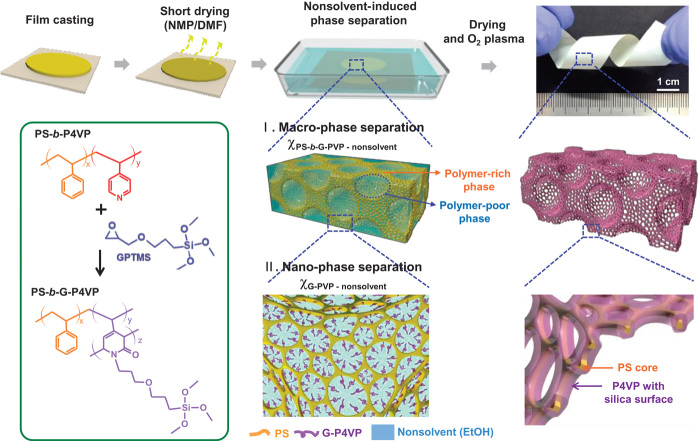
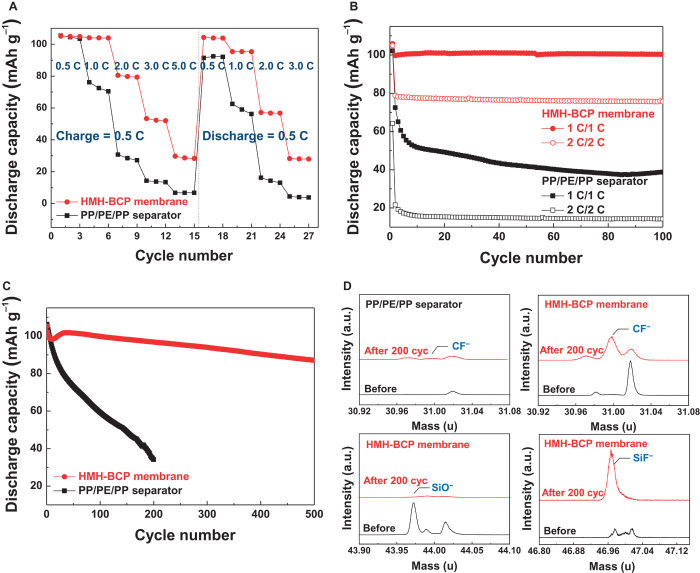
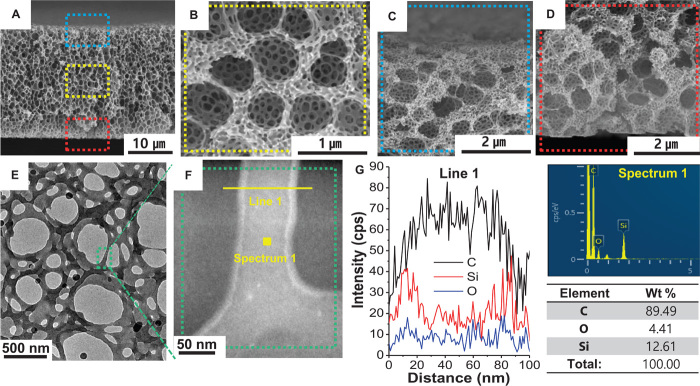
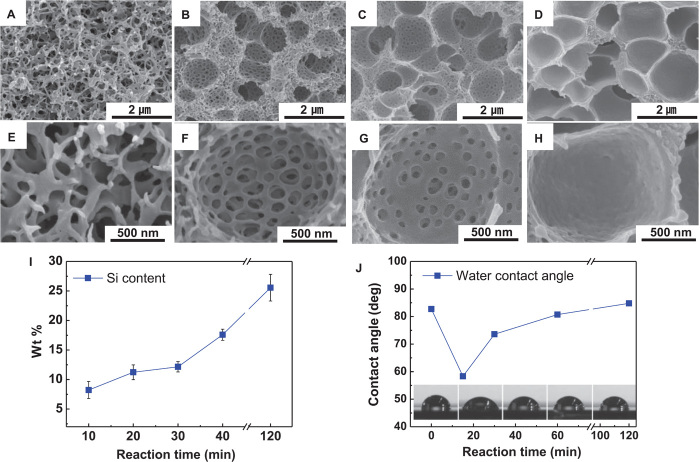
The rational design and realization of revolutionary porous structures have been long-standing challenges in membrane science. We demonstrate a new class of amphiphilic polystyrene-block-poly(4-vinylpyridine) block copolymer (BCP)-based porous membranes featuring hierarchical multiscale hyperporous structures. The introduction of surface energy-modifying agents and the control of major phase separation parameters (such as nonsolvent polarity and solvent drying time) enable tunable dual-phase separation of BCPs, eventually leading to macro/nanoscale porous structures and chemical functionalities far beyond those accessible with conventional approaches. Application of this BCP membrane to a lithium-ion battery separator affords exceptional improvement in electrochemical performance. The dual-phase separation-driven macro/nanopore construction strategy, owing to its simplicity and tunability, is expected to be readily applicable to a rich variety of membrane fields including molecular separation, water purification, and energy-related devices.
在膜科学领域,合理设计并实现具有革命性的多孔结构长期以来一直是一项挑战。我们展示了一类新型的基于两亲性聚苯乙烯-嵌段-聚(4-乙烯基吡啶)嵌段共聚物(BCP)的多孔膜,其具有分级多尺度超多孔结构。引入表面能改性剂并控制主要相分离参数(如非溶剂极性和溶剂干燥时间)能够实现BCP的可调双相分离,最终形成宏观/纳米尺度的多孔结构和化学功能,这远远超出了传统方法所能达到的范围。将这种BCP膜应用于锂离子电池隔膜可显著提高电化学性能。由于其简单性和可调性,双相分离驱动的宏观/纳米孔构建策略有望很容易地应用于包括分子分离、水净化和能源相关装置在内的多种膜领域。