Holthaus Karin Brigit, Strasser Bettina, Sipos Wolfgang, Schmidt Heiko A, Mlitz Veronika, Sukseree Supawadee, Weissenbacher Anton, Tschachler Erwin, Alibardi Lorenzo, Eckhart Leopold
Research Division of Biology and Pathobiology of the Skin, Department of Dermatology, Medical University of Vienna, Vienna, Austria Dipartimento di Scienze Biologiche, Geologiche ed Ambientali (BiGeA), University of Bologna, Bologna, Italy.
Research Division of Biology and Pathobiology of the Skin, Department of Dermatology, Medical University of Vienna, Vienna, Austria.
Mol Biol Evol. 2016 Mar;33(3):726-37. doi: 10.1093/molbev/msv265. Epub 2015 Nov 24.
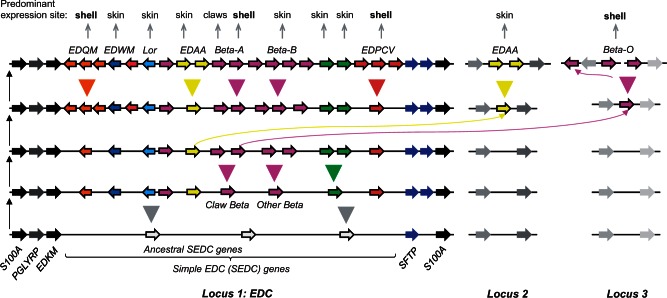
The evolution of reptiles, birds, and mammals was associated with the origin of unique integumentary structures. Studies on lizards, chicken, and humans have suggested that the evolution of major structural proteins of the outermost, cornified layers of the epidermis was driven by the diversification of a gene cluster called Epidermal Differentiation Complex (EDC). Turtles have evolved unique defense mechanisms that depend on mechanically resilient modifications of the epidermis. To investigate whether the evolution of the integument in these reptiles was associated with specific adaptations of the sequences and expression patterns of EDC-related genes, we utilized newly available genome sequences to determine the epidermal differentiation gene complement of turtles. The EDC of the western painted turtle (Chrysemys picta bellii) comprises more than 100 genes, including at least 48 genes that encode proteins referred to as beta-keratins or corneous beta-proteins. Several EDC proteins have evolved cysteine/proline contents beyond 50% of total amino acid residues. Comparative genomics suggests that distinct subfamilies of EDC genes have been expanded and partly translocated to loci outside of the EDC in turtles. Gene expression analysis in the European pond turtle (Emys orbicularis) showed that EDC genes are differentially expressed in the skin of the various body sites and that a subset of beta-keratin genes within the EDC as well as those located outside of the EDC are expressed predominantly in the shell. Our findings give strong support to the hypothesis that the evolutionary innovation of the turtle shell involved specific molecular adaptations of epidermal differentiation.
爬行动物、鸟类和哺乳动物的进化与独特的皮肤结构的起源有关。对蜥蜴、鸡和人类的研究表明,表皮最外层角质化层主要结构蛋白的进化是由一个名为表皮分化复合体(EDC)的基因簇的多样化驱动的。海龟进化出了独特的防御机制,这种机制依赖于表皮的机械弹性修饰。为了研究这些爬行动物皮肤的进化是否与EDC相关基因的序列和表达模式的特定适应性有关,我们利用新获得的基因组序列来确定海龟的表皮分化基因组成。西部锦龟(Chrysemys picta bellii)的EDC包含100多个基因,其中至少有48个基因编码被称为β-角蛋白或角质β-蛋白的蛋白质。几种EDC蛋白进化出的半胱氨酸/脯氨酸含量超过了总氨基酸残基的50%。比较基因组学表明,EDC基因的不同亚家族在海龟中已经扩展,并且部分转移到了EDC之外的位点。对欧洲池龟(Emys orbicularis)的基因表达分析表明,EDC基因在身体各个部位的皮肤中差异表达,并且EDC内的一部分β-角蛋白基因以及位于EDC之外的那些基因主要在龟壳中表达。我们的研究结果有力地支持了这样一种假说,即龟壳的进化创新涉及表皮分化的特定分子适应性。