Hoogendijk Arie J, Wiewel Maryse A, van Vught Lonneke A, Scicluna Brendon P, Belkasim-Bohoudi Hakima, Horn Janneke, Zwinderman Aeilko H, Klein Klouwenberg Peter M C, Cremer Olaf L, Bonten Marc J, Schultz Marcus J, van der Poll Tom
Center for Experimental and Molecular Medicine, Academic Medical Center, University of Amsterdam, Meibergdreef 9, G2-130, 1105 AZ, Amsterdam, The Netherlands.
Department of Intensive Care, Academic Medical Center, University of Amsterdam, Amsterdam, The Netherlands.
Crit Care. 2015 Nov 25;19:412. doi: 10.1186/s13054-015-1125-0.
Fractalkine is a chemokine implicated as a mediator in a variety of inflammatory conditions. Knowledge of fractalkine release in patients presenting with infection to the Intensive Care Unit (ICU) is highly limited. The primary objective of this study was to establish whether plasma fractalkine levels are elevated in sepsis and associate with outcome. The secondary objective was to determine whether fractalkine can assist in the diagnosis of infection upon ICU admission.
Fractalkine was measured in 1103 consecutive sepsis patients (including 271 patients with community-acquired pneumonia (CAP)) upon ICU admission and at days 2 and 4 thereafter; in 73 ICU patients treated for suspected CAP in whom this diagnosis was refuted in retrospect; and in 5 healthy humans intravenously injected with endotoxin.
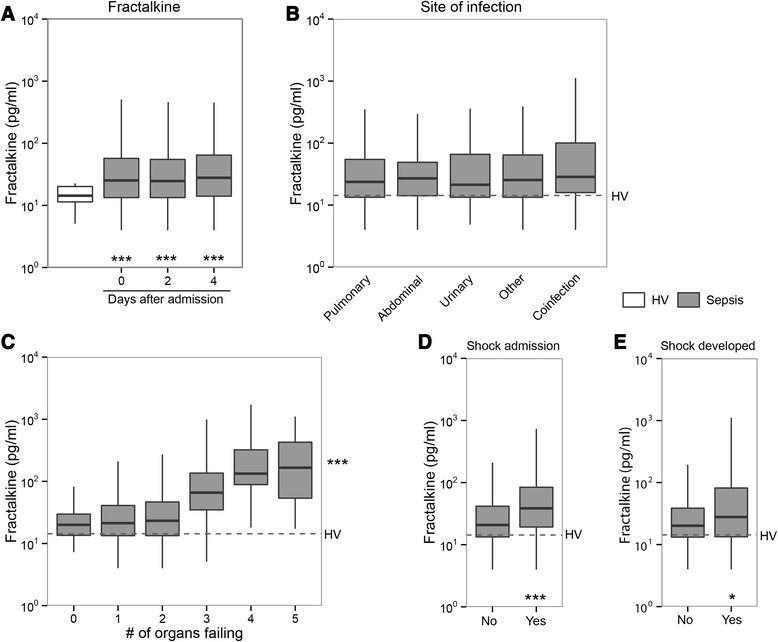
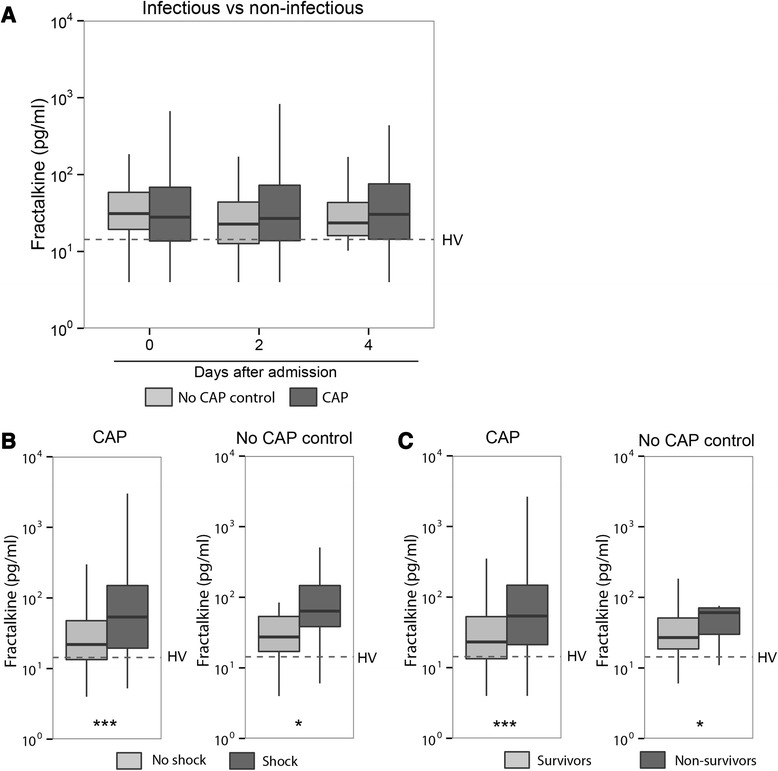
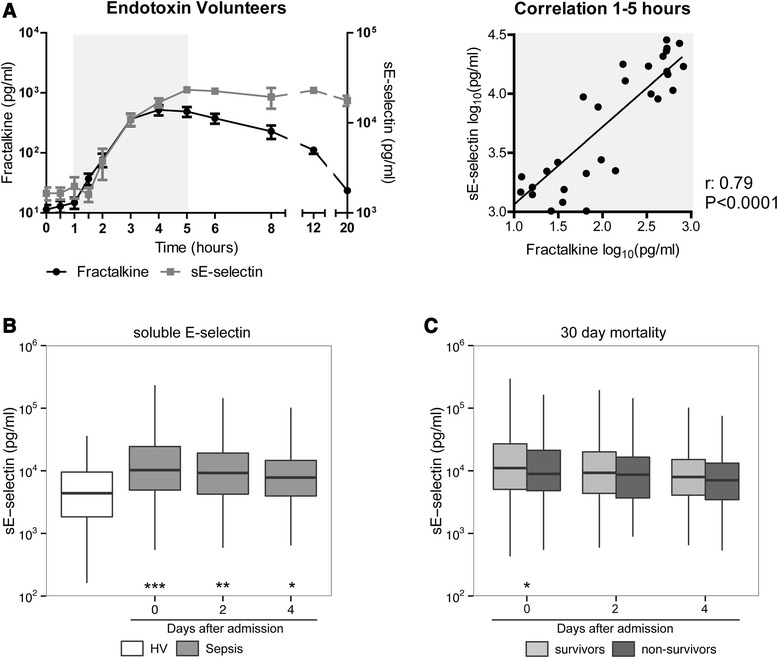
Compared to healthy volunteers, sepsis patients had strongly elevated fractalkine levels. Fractalkine levels increased with the number of organs failing, were higher in patients presenting with shock, but did not vary by site of infection. Non-survivors had sustained elevated fractalkine levels when compared to survivors. Fractalkine was equally elevated in CAP patients and patients treated for CAP but in whom the diagnosis was retrospectively refuted. Fractalkine release induced by intravenous endotoxin followed highly similar kinetics as the endothelial cell marker E-selectin.
Plasma fractalkine is an endothelial cell derived biomarker that, while not specific for infection, correlates with disease severity in sepsis patients admitted to the ICU.
趋化因子是一种趋化因子,被认为是多种炎症状态的介质。对于入住重症监护病房(ICU)的感染患者,趋化因子释放的相关知识非常有限。本研究的主要目的是确定脓毒症患者血浆趋化因子水平是否升高及其与预后的关系。次要目的是确定趋化因子在ICU入院时是否有助于感染的诊断。
对1103例连续入住ICU的脓毒症患者(包括271例社区获得性肺炎(CAP)患者)在入院时以及之后第2天和第4天测量趋化因子水平;对73例因疑似CAP接受治疗但事后回顾诊断被推翻的ICU患者测量趋化因子水平;对5名静脉注射内毒素的健康人测量趋化因子水平。
与健康志愿者相比,脓毒症患者的趋化因子水平显著升高。趋化因子水平随衰竭器官数量增加而升高,休克患者的趋化因子水平更高,但不受感染部位影响。与幸存者相比,非幸存者的趋化因子水平持续升高。CAP患者和因CAP接受治疗但事后回顾诊断被推翻的患者的趋化因子水平同样升高。静脉内毒素诱导的趋化因子释放动力学与内皮细胞标志物E选择素高度相似。
血浆趋化因子是一种内皮细胞衍生的生物标志物,虽然对感染不具有特异性,但与入住ICU的脓毒症患者的疾病严重程度相关。