
濒危的虎头海雕主要组织相容性复合体IIB类基因的时空变异
Spatial and temporal variation at major histocompatibility complex class IIB genes in the endangered Blakiston's fish owl.
作者信息
Kohyama Tetsuo I, Omote Keita, Nishida Chizuko, Takenaka Takeshi, Saito Keisuke, Fujimoto Satoshi, Masuda Ryuichi
机构信息
Department of Natural History Sciences, Faculty of Science, Hokkaido University, Sapporo, 060-0810 Japan.
Department of Natural History Sciences, Graduate School of Science, Hokkaido University, Sapporo, 060-0810 Japan.
出版信息
Zoological Lett. 2015 Mar 25;1:13. doi: 10.1186/s40851-015-0013-4. eCollection 2015.
INTRODUCTION
Quantifying intraspecific genetic variation in functionally important genes, such as those of the major histocompatibility complex (MHC), is important in the establishment of conservation plans for endangered species. The MHC genes play a crucial role in the vertebrate immune system and generally show high levels of diversity, which is likely due to pathogen-driven balancing selection. The endangered Blakiston's fish owl (Bubo blakistoni) has suffered marked population declines on Hokkaido Island, Japan, during the past several decades due to human-induced habitat loss and fragmentation. We investigated the spatial and temporal patterns of genetic diversity in MHC class IIβ genes in Blakiston's fish owl, using massively parallel pyrosequencing.
RESULTS
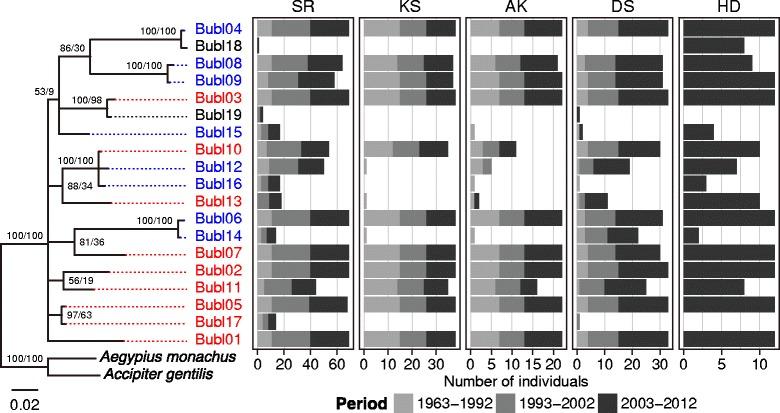
We found that the Blakiston's fish owl genome contains at least eight MHC class IIβ loci, indicating recent gene duplications. An analysis of sequence polymorphism provided evidence that balancing selection acted in the past. The level of MHC variation, however, was low in the current fish owl populations in Hokkaido: only 19 alleles were identified from 174 individuals. We detected considerable spatial differences in MHC diversity among the geographically isolated populations. We also detected a decline of MHC diversity in some local populations during the past decades.
CONCLUSIONS
Our study demonstrated that the current spatial patterns of MHC variation in Blakiston's fish owl populations have been shaped by loss of variation due to the decline and fragmentation of populations, and that the short-term effects of genetic drift have counteracted the long-term effects of balancing selection.
引言
量化功能重要基因(如主要组织相容性复合体(MHC)基因)的种内遗传变异,对于制定濒危物种的保护计划至关重要。MHC基因在脊椎动物免疫系统中发挥着关键作用,通常表现出高度的多样性,这可能是由病原体驱动的平衡选择所致。在过去几十年中,由于人为导致的栖息地丧失和破碎化,濒危的乌林鸮(Bubo blakistoni)在日本北海道岛的种群数量显著下降。我们使用大规模平行焦磷酸测序技术,研究了乌林鸮MHC IIβ基因遗传多样性的时空模式。
结果
我们发现乌林鸮基因组中至少包含八个MHC IIβ基因座,表明近期发生了基因复制。序列多态性分析提供了过去平衡选择作用的证据。然而,北海道目前的乌林鸮种群中MHC变异水平较低:从174个个体中仅鉴定出19个等位基因。我们在地理隔离的种群中检测到MHC多样性存在显著的空间差异。我们还检测到在过去几十年中,一些当地种群的MHC多样性有所下降。
结论
我们的研究表明,当前乌林鸮种群中MHC变异的空间模式是由种群数量下降和破碎化导致的变异丧失所塑造的,并且遗传漂变的短期影响抵消了平衡选择的长期影响。



 Zotero 插件