Yang Chin-Lung, Zheng Gou-Tsun
Department of Electrical Engineering, National Cheng-Kung University, Tainan 70101, Taiwan.
Sensors (Basel). 2015 Nov 20;15(11):29467-77. doi: 10.3390/s151129467.
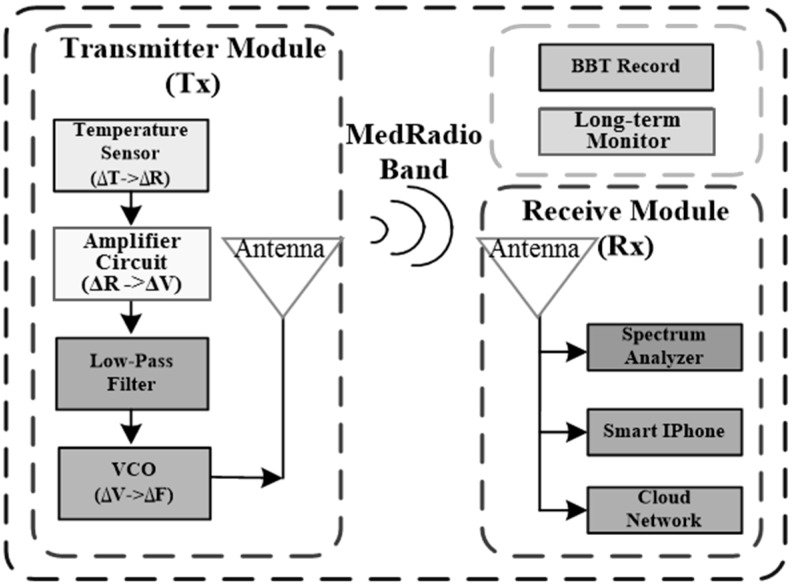
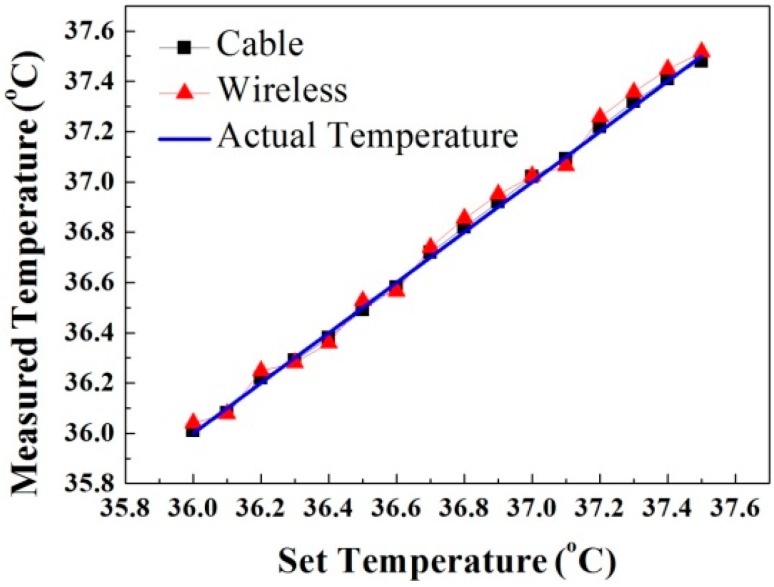
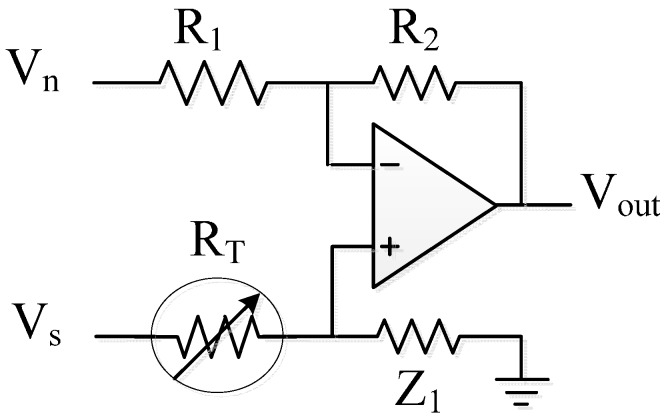
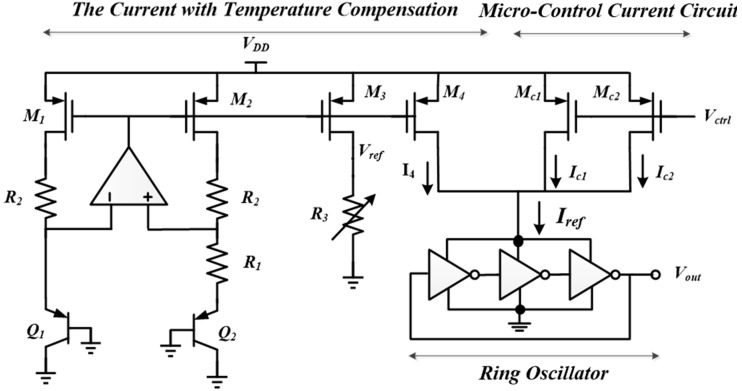
This study proposes using wireless low power thermal sensors for basal-body-temperature detection using frequency modulated telemetry devices. A long-term monitoring sensor requires low-power circuits including a sampling circuit and oscillator. Moreover, temperature compensated technologies are necessary because the modulated frequency might have additional frequency deviations caused by the varying temperature. The temperature compensated oscillator is composed of a ring oscillator and a controlled-steering current source with temperature compensation, so the output frequency of the oscillator does not drift with temperature variations. The chip is fabricated in a standard Taiwan Semiconductor Manufacturing Company (TSMC) 0.18-μm complementary metal oxide semiconductor (CMOS) process, and the chip area is 0.9 mm². The power consumption of the sampling amplifier is 128 µW. The power consumption of the voltage controlled oscillator (VCO) core is less than 40 µW, and the output is -3.04 dBm with a buffer stage. The output voltage of the bandgap reference circuit is 1 V. For temperature measurements, the maximum error is 0.18 °C with a standard deviation of ±0.061 °C, which is superior to the required specification of 0.1 °C.
本研究提出使用无线低功耗热传感器,通过调频遥测设备进行基础体温检测。长期监测传感器需要包括采样电路和振荡器在内的低功耗电路。此外,由于调制频率可能会因温度变化而产生额外的频率偏差,因此温度补偿技术是必要的。温度补偿振荡器由环形振荡器和具有温度补偿的可控转向电流源组成,因此振荡器的输出频率不会随温度变化而漂移。该芯片采用标准的台积电(TSMC)0.18μm互补金属氧化物半导体(CMOS)工艺制造,芯片面积为0.9mm²。采样放大器的功耗为128µW。压控振荡器(VCO)核心的功耗小于40µW,带缓冲级时输出为-3.04dBm。带隙基准电路的输出电压为1V。对于温度测量,最大误差为0.18°C,标准偏差为±0.061°C,优于所需的0.1°C规格。