Tieland Michael, Borgonjen-Van den Berg Karin J, Van Loon Luc J C, de Groot Lisette C P G M
Top Institute Food and Nutrition, P.O. Box 557, Wageningen 6700 AN, The Netherlands.
Division of Human Nutrition, Wageningen University, P.O. Box 17, Wageningen 6700 AA, The Netherlands.
Nutrients. 2015 Nov 25;7(12):9697-706. doi: 10.3390/nu7125496.
Sufficient high quality dietary protein intake is required to prevent or treat sarcopenia in elderly people. Therefore, the intake of specific protein sources as well as their timing of intake are important to improve dietary protein intake in elderly people.
to assess the consumption of protein sources as well as the distribution of protein sources over the day in community-dwelling, frail and institutionalized elderly people.
Habitual dietary intake was evaluated using 2- and 3-day food records collected from various studies involving 739 community-dwelling, 321 frail and 219 institutionalized elderly people.
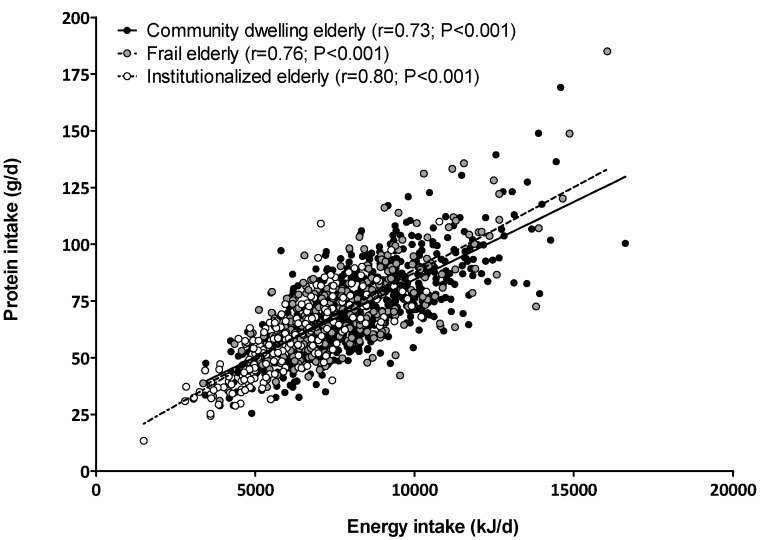
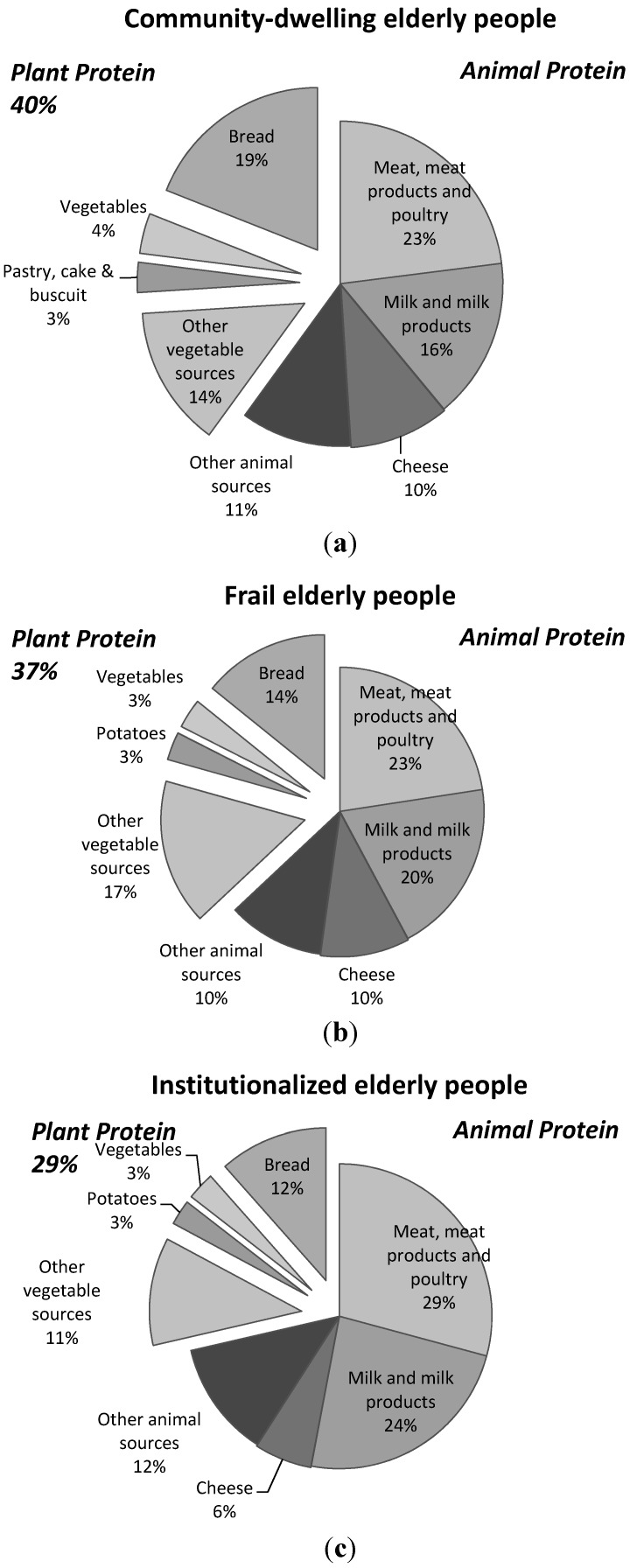
Daily protein intake averaged 71 ± 18 g/day in community-dwelling, 71 ± 20 g/day in frail and 58 ± 16 g/day in institutionalized elderly people and accounted for 16% ± 3%, 16% ± 3% and 17% ± 3% of their energy intake, respectively. Dietary protein intake ranged from 10 to 12 g at breakfast, 15 to 23 g at lunch and 24 to 31 g at dinner contributing together over 80% of daily protein intake. The majority of dietary protein consumed originated from animal sources (≥60%) with meat and dairy as dominant sources. Thus, 40% of the protein intake in community-dwelling, 37% in frail and 29% in institutionalized elderly originated from plant based protein sources with bread as the principle source. Plant based proteins contributed for >50% of protein intake at breakfast and between 34% and 37% at lunch, with bread as the main source. During dinner, >70% of the protein intake originated from animal protein, with meat as the dominant source.
Daily protein intake in these older populations is mainly (>80%) provided by the three main meals, with most protein consumed during dinner. More than 60% of daily protein intake consumed is of animal origin, with plant based protein sources representing nearly 40% of total protein consumed. During dinner, >70% of the protein intake originated from animal protein, while during breakfast and lunch a large proportion of protein is derived from plant based protein sources.
老年人预防或治疗肌肉减少症需要充足的高质量膳食蛋白质摄入。因此,特定蛋白质来源的摄入及其摄入时间对于提高老年人的膳食蛋白质摄入量很重要。
评估社区居住、体弱和机构养老的老年人蛋白质来源的消耗量以及一天中蛋白质来源的分布情况。
使用从涉及739名社区居住、321名体弱和219名机构养老老年人的各种研究中收集的2至3天食物记录来评估习惯性膳食摄入量。
社区居住老年人的每日蛋白质摄入量平均为71±18克/天,体弱老年人为71±20克/天,机构养老老年人为58±16克/天,分别占其能量摄入的16%±3%、16%±3%和17%±3%。膳食蛋白质摄入量早餐为10至12克,午餐为15至23克,晚餐为24至31克,三者合计占每日蛋白质摄入量的80%以上。摄入的大部分膳食蛋白质来自动物来源(≥60%),以肉类和奶制品为主要来源。因此,社区居住老年人蛋白质摄入量的40%、体弱老年人的37%和机构养老老年人的29%来自植物性蛋白质来源,以面包为主要来源。植物性蛋白质在早餐时占蛋白质摄入量的>50%,午餐时占34%至37%,以面包为主要来源。晚餐时,>70%的蛋白质摄入量来自动物蛋白,以肉类为主要来源。
这些老年人群的每日蛋白质摄入量主要(>80%)由三餐提供,晚餐时摄入的蛋白质最多。每日摄入的蛋白质中超过60%来自动物来源,植物性蛋白质来源占总蛋白质摄入量的近40%。晚餐时,>70%的蛋白质摄入量来自动物蛋白,而早餐和午餐时很大一部分蛋白质来自植物性蛋白质来源。