L Reed Richard, Isherwood Linda, Ben-Tovim David
Discipline of General Practice, Flinders University, GPO Box 2100, Adelaide, 5001, South Australia.
National Institute of Labour Studies, Flinders University, GPO Box 2100, Adelaide, 5001, South Australia.
BMC Health Serv Res. 2015 Nov 27;15:525. doi: 10.1186/s12913-015-1170-z.
Increasing demand for hospital services by older people is a major concern for Australian health care providers. To date there has been little in-depth research that encompasses contextual and systems factors contributing to hospital admissions. The objective of this study was to determine the reasons why older patients experienced unplanned hospital admissions to a major public hospital.
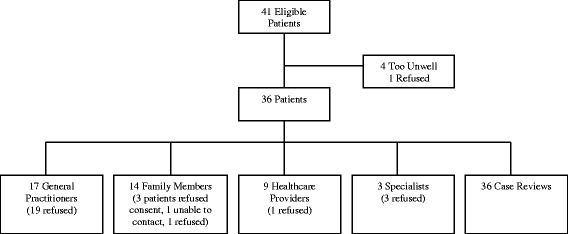
A retrospective qualitative study using a Root Cause Analysis (RCA) methodology was conducted in a major public hospital in Adelaide, South Australia and surrounding community. Community dwelling older people admitted to the hospital who were well enough to give informed consent and be interviewed were invited to take part in the study. With patients consent, family members, general practitioners (GPs) and specialists were also interviewed and patient hospital records reviewed. Using a purposive sampling technique to obtain maximum variability, thirty-six older people (aged 70 years and older) participated in the study. GPs (n = 17), family members (n = 14), and other healthcare providers (n = 12) involved in their care were also interviewed. Cases were then analysed according to a standardized protocol to determine the root cause of admission. Root causes were then assigned to broader categories using thematic analysis.
The root causes of unplanned admissions were identified and categorised into six causal groups: a consequence of minimal care, progression of disease, home care accessibility, high complexity, clinical error, and delayed care-seeking by the patient.
RCA can be effectively applied to determine the causes of unplanned hospital admissions although the process is time consuming. Four categories of admission (minimal care, clinical error, home care access, delayed care-seeking) were deemed potentially preventable. This methodology and classification approach may assist in designing interventions to prevent future hospitalisations in this high-risk population.
老年人对医院服务需求的不断增加是澳大利亚医疗服务提供者主要关注的问题。迄今为止,几乎没有深入研究涵盖导致住院的背景和系统因素。本研究的目的是确定老年患者意外入住一家大型公立医院的原因。
在南澳大利亚阿德莱德的一家大型公立医院及其周边社区进行了一项采用根本原因分析(RCA)方法的回顾性定性研究。邀请入住该医院且身体状况足以给予知情同意并接受访谈的社区老年居民参与研究。在患者同意的情况下,还对其家庭成员、全科医生(GP)和专科医生进行了访谈,并查阅了患者的医院记录。采用目的抽样技术以获得最大程度的变异性,36名70岁及以上的老年人参与了该研究。还对参与其护理的全科医生(n = 17)、家庭成员(n = 14)和其他医疗服务提供者(n = 12)进行了访谈。然后根据标准化方案对病例进行分析,以确定入院的根本原因。随后使用主题分析将根本原因归为更广泛的类别。
确定了意外入院的根本原因,并将其分为六个因果组:护理不足的后果、疾病进展、家庭护理可及性、高复杂性、临床失误以及患者寻求护理延迟。
尽管过程耗时,但RCA可有效应用于确定意外住院的原因。四类入院原因(护理不足、临床失误、家庭护理可及性、寻求护理延迟)被认为具有潜在可预防性。这种方法和分类方法可能有助于设计干预措施,以防止这一高危人群未来住院。