Yang Haiyan, Cai Ying, Liu Qi, Zhao Xiao, Wang Qiang, Chen Chuansheng, Xue Gui
State Key Laboratory of Cognitive Neuroscience and Learning and IDG/McGovern Institute for Brain Research, Beijing Normal University Beijing, China ; Center for Collaboration and Innovation in Brain and Learning Sciences, Beijing Normal University Beijing, China.
Department of Psychology and Social Behavior, University of California, Irvine, Irvine CA, USA.
Front Psychol. 2015 Nov 9;6:1699. doi: 10.3389/fpsyg.2015.01699. eCollection 2015.
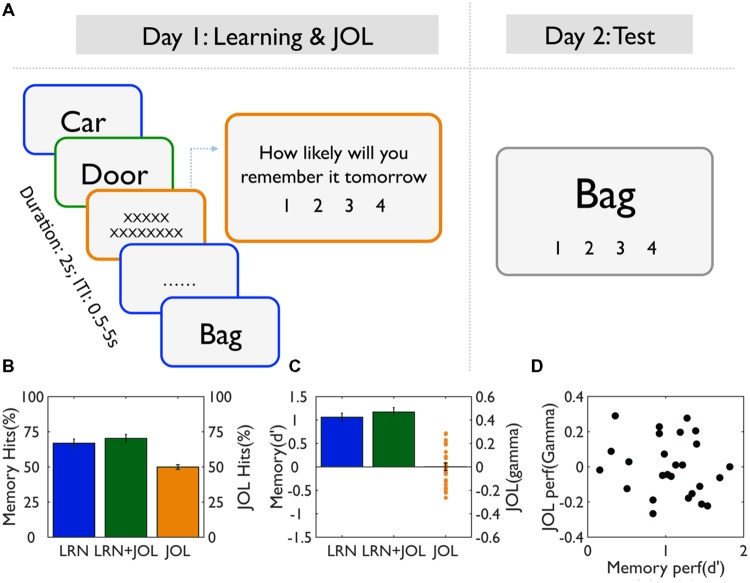
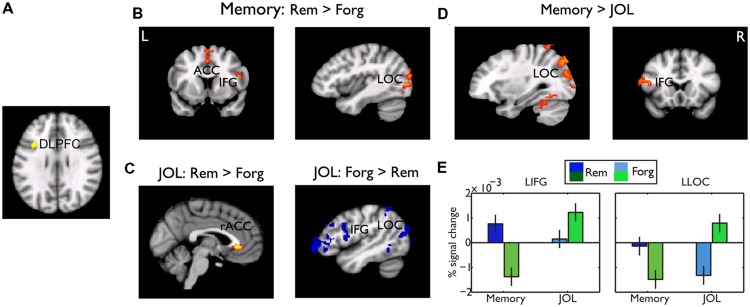
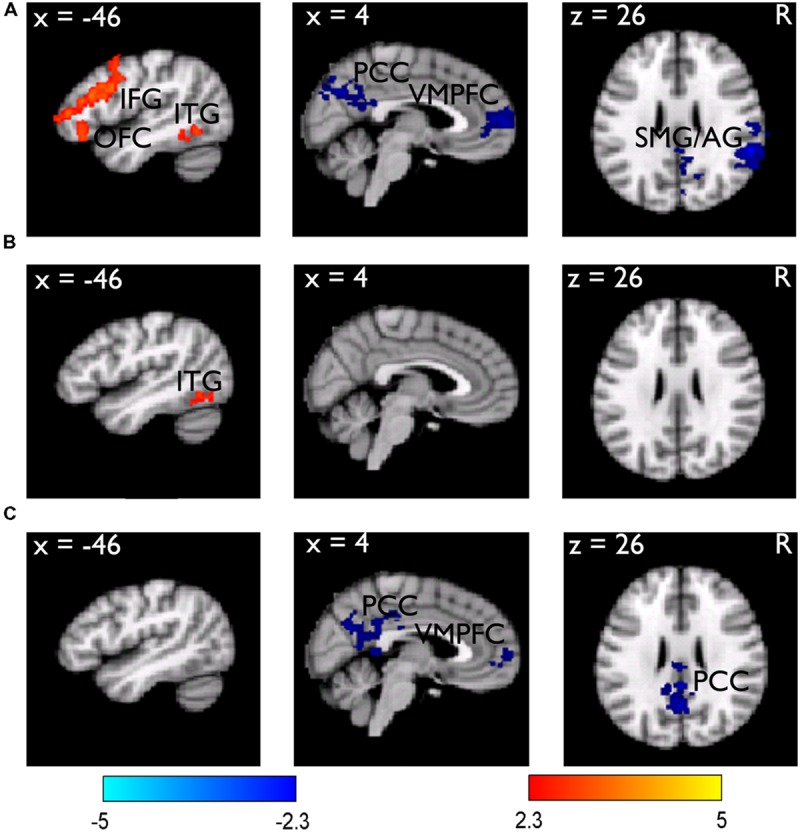
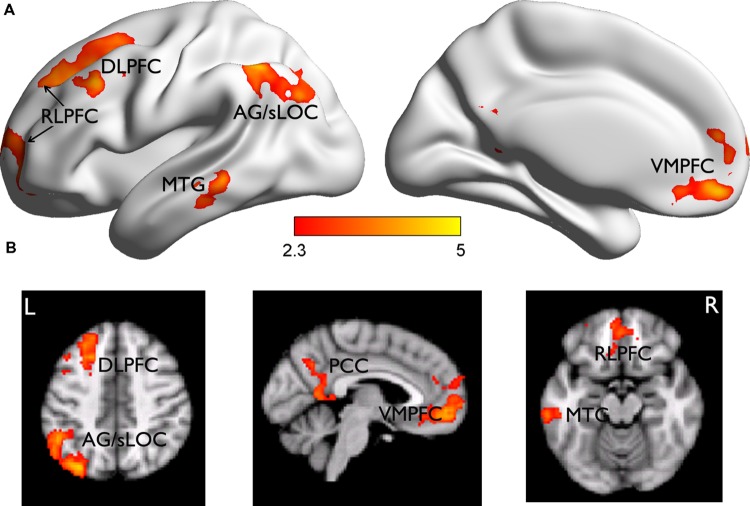
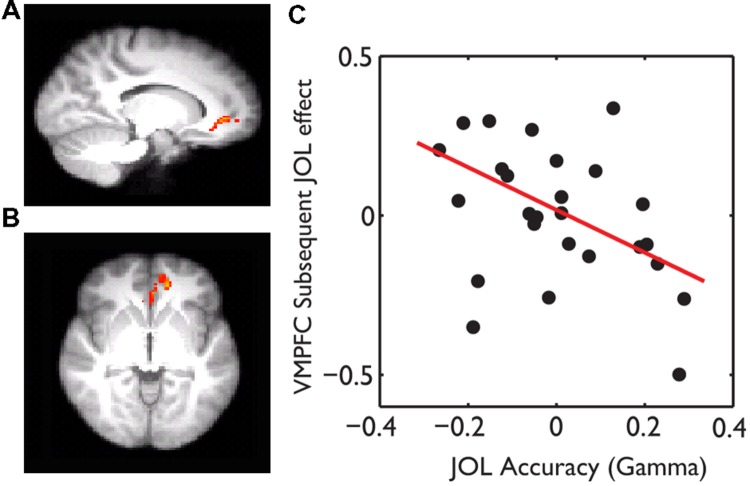
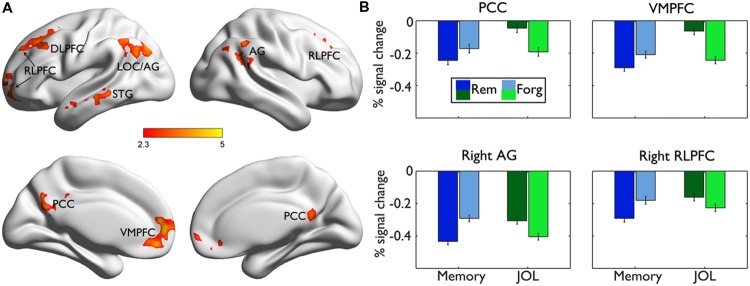
Judgment of learning (JOL) plays a pivotal role in self-regulated learning. Although the JOLs are in general accurate, important deviations from memory performance are often reported, especially when the JOLs are made immediately after learning. Nevertheless, existing studies have not clearly dissociated the neural processes underlying subjective JOL and objective memory. In the present study, participants were asked to study a list of words that would be tested 1 day later. Immediately after learning an item, participants predicted how likely they would remember that item. Critically, the JOL was performed on only half of the studied items to avoid its contamination on subsequent memory. We found that during encoding, compared to items later judged as "will be forgotten," those judged as "will be remembered" showed stronger activities in the default-mode network, including the ventromedial prefrontal cortex (PFC) and posterior cingulate cortex, as well as weaker functional connectivity between the left dorsolateral PFC and the visual cortex. The exact opposite pattern was found when comparing items that were actually remembered with those that were later forgotten. These important neural dissociations between JOL and memory performance shed light on the neural mechanisms of human metamemory bias.
学习判断(JOL)在自我调节学习中起着关键作用。尽管学习判断总体上是准确的,但经常有报道称其与记忆表现存在重要偏差,尤其是在学习后立即进行学习判断时。然而,现有研究尚未明确区分主观学习判断和客观记忆背后的神经过程。在本研究中,参与者被要求学习一份单词列表,并在1天后进行测试。在学习完一个项目后,参与者立即预测他们记住该项目的可能性。关键的是,仅对一半的学习项目进行学习判断,以避免其对后续记忆产生干扰。我们发现,在编码过程中,与后来被判断为“会被遗忘”的项目相比,被判断为“会被记住”的项目在默认模式网络中表现出更强的活动,包括腹内侧前额叶皮层(PFC)和后扣带回皮层,以及左侧背外侧前额叶皮层与视觉皮层之间较弱的功能连接。在比较实际记住的项目和后来遗忘的项目时,发现了完全相反的模式。学习判断和记忆表现之间这些重要的神经差异揭示了人类元记忆偏差的神经机制。