Manzoli Lamberto, Flacco Maria Elena, Boccia Stefania, D'Andrea Elvira, Panic Nikola, Marzuillo Carolina, Siliquini Roberta, Ricciardi Walter, Villari Paolo, Ioannidis John P A
Department of Medicine and Aging Sciences, University of Chieti, Via dei Vestini 5, 66013, Chieti, Italy.
Regional Health Care Agency of Abruzzo, Via Attilio Monti 9, Pescara, Italy.
Eur J Epidemiol. 2016 Apr;31(4):351-68. doi: 10.1007/s10654-015-0104-8. Epub 2015 Nov 30.
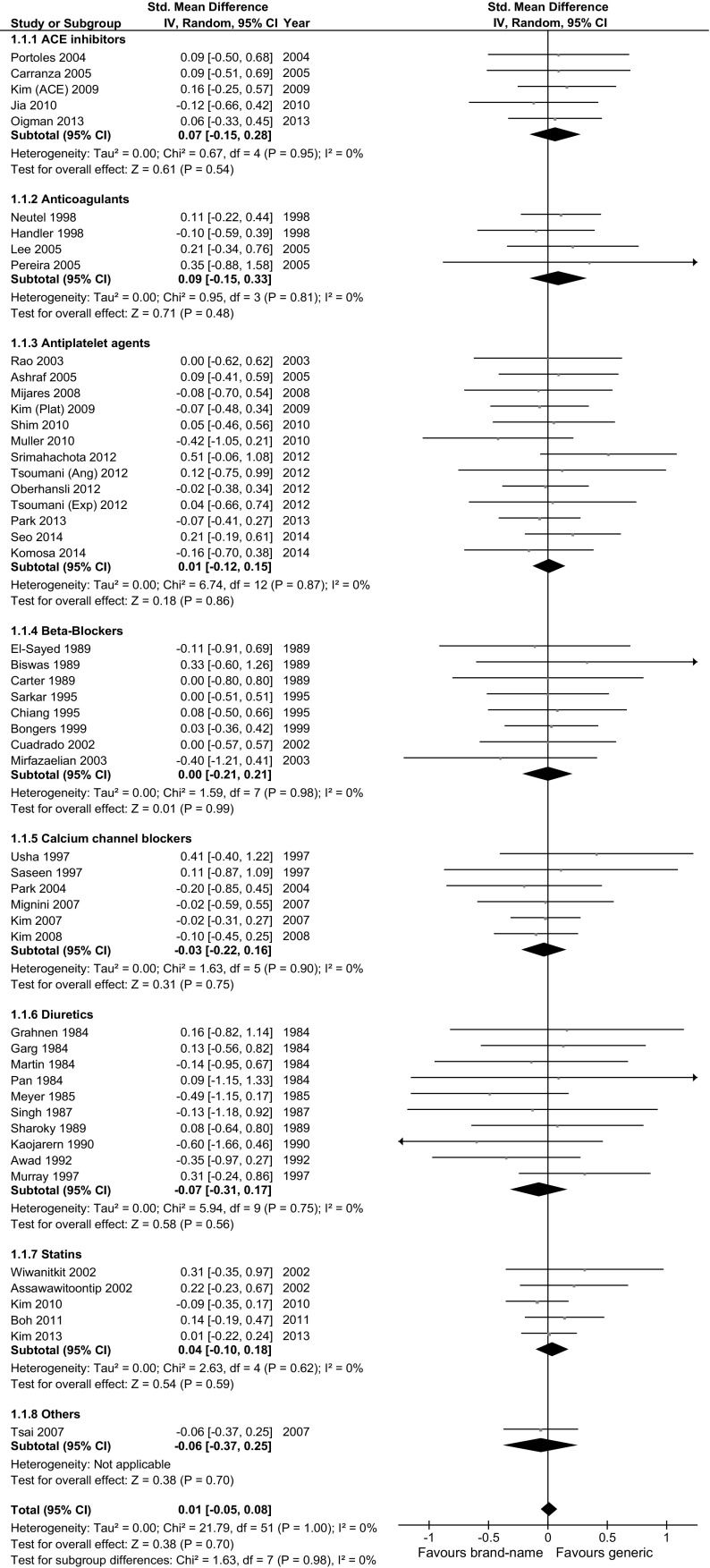
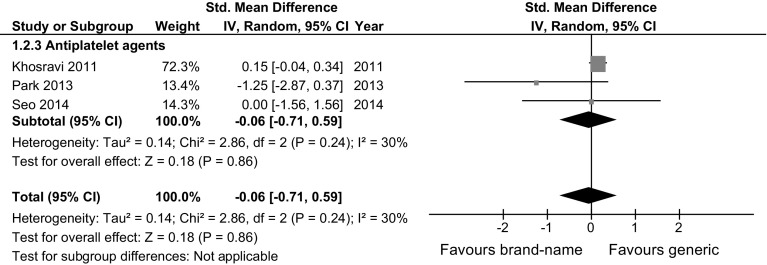
This meta-analysis aimed to compare the efficacy and adverse events, either serious or mild/moderate, of all generic versus brand-name cardiovascular medicines. We searched randomized trials in MEDLINE, Scopus, EMBASE, Cochrane Controlled Clinical Trial Register, and ClinicalTrials.gov (last update December 1, 2014). Attempts were made to contact the investigators of all potentially eligible trials. Two investigators independently extracted and analyzed soft (including systolic blood pressure, LDL cholesterol, and others) and hard efficacy outcomes (including major cardiovascular adverse events and death), minor/moderate and serious adverse events. We included 74 randomized trials; 53 reported ≥1 efficacy outcome (overall sample 3051), 32 measured mild/moderate adverse events (n = 2407), and 51 evaluated serious adverse events (n = 2892). We included trials assessing ACE inhibitors (n = 12), anticoagulants (n = 5), antiplatelet agents (n = 17), beta-blockers (n = 11), calcium channel blockers (n = 7); diuretics (n = 13); statins (n = 6); and others (n = 3). For both soft and hard efficacy outcomes, 100 % of the trials showed non-significant differences between generic and brand-name drugs. The aggregate effect size was 0.01 (95 % CI -0.05; 0.08) for soft outcomes; -0.06 (-0.71; 0.59) for hard outcomes. All but two trials showed non-significant differences in mild/moderate adverse events, and aggregate effect size was 0.07 (-0.06; 0.20). Comparable results were observed for each drug class and in each stratified meta-analysis. Overall, 8 serious possibly drug-related adverse events were reported: 5/2074 subjects on generics; 3/2076 subjects on brand-name drugs (OR 1.69; 95 % CI 0.40-7.20). This meta-analysis strengthens the evidence for clinical equivalence between brand-name and generic cardiovascular drugs. Physicians could be reassured about prescribing generic cardiovascular drugs, and health care organization about endorsing their wider use.
这项荟萃分析旨在比较所有通用型与品牌型心血管药物的疗效以及严重或轻/中度不良事件。我们在MEDLINE、Scopus、EMBASE、Cochrane对照临床试验注册库和ClinicalTrials.gov(最后更新时间为2014年12月1日)中检索随机试验。我们尝试联系所有可能符合条件的试验的研究者。两名研究者独立提取并分析软性疗效指标(包括收缩压、低密度脂蛋白胆固醇等)和硬性疗效指标(包括主要心血管不良事件和死亡)、轻/中度和严重不良事件。我们纳入了74项随机试验;53项报告了≥1项疗效指标(总体样本量为3051),32项测量了轻/中度不良事件(n = 2407),51项评估了严重不良事件(n = 2892)。我们纳入的试验评估了血管紧张素转换酶抑制剂(n = 12)、抗凝剂(n = 5)、抗血小板药物(n = 17)、β受体阻滞剂(n = 11)、钙通道阻滞剂(n = 7)、利尿剂(n = 13)、他汀类药物(n = 6)以及其他药物(n = 3)。对于软性和硬性疗效指标,100%的试验显示通用型和品牌型药物之间无显著差异。软性指标的总体效应量为0.01(95%CI -0.05;0.08);硬性指标为-0.06(-0.71;0.59)。除两项试验外,所有试验显示轻/中度不良事件无显著差异,总体效应量为0.07(-0.06;0.20)。在每个药物类别以及每项分层荟萃分析中均观察到类似结果。总体而言,报告了8起严重的可能与药物相关的不良事件:通用型药物组2074名受试者中有5例;品牌型药物组2076名受试者中有3例(比值比1.69;95%CI 0.40 - 7.20)。这项荟萃分析强化了品牌型和通用型心血管药物临床等效性的证据。医生在开具通用型心血管药物时可更加放心,医疗保健机构也可放心支持其更广泛使用。