Department of Biology, University of Waterloo, 200 University Avenue West, Waterloo, Ontario, N2L 3G1, Canada.
Microbiome. 2015 Dec 1;3:66. doi: 10.1186/s40168-015-0135-0.
Microorganisms are distributed on surfaces within homes, workplaces, and schools, with the potential to impact human health and disease. University campuses represent a unique opportunity to explore the distribution of microorganisms within built environments because of high human population densities, throughput, and variable building usage. For example, the main campus of the University of Waterloo spans four square kilometres, hosts over 40,000 individuals daily, and is comprised of a variety of buildings, including lecture halls, gyms, restaurants, residences, and a daycare.
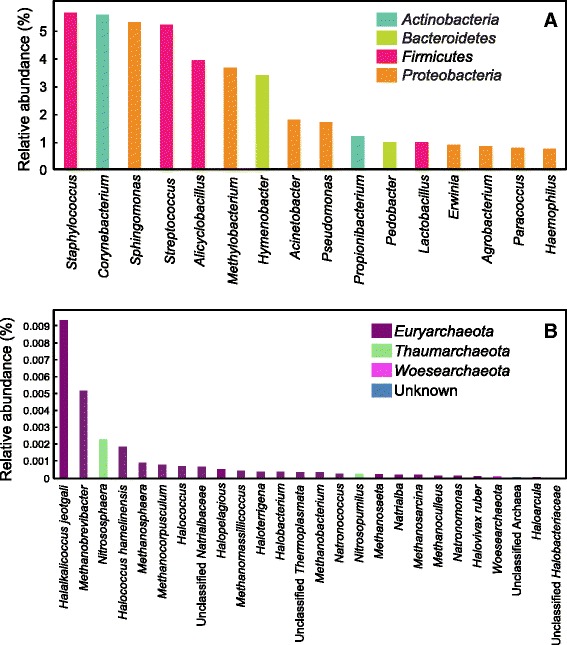
Representative left and right entrance door handles from each of the 65 buildings at the University of Waterloo were swabbed at three time points during an academic term in order to determine if microbial community assemblages coincided with building usage and whether these communities are stable temporally. Across all door handles, the dominant phyla were Proteobacteria, Firmicutes, Actinobacteria, and Bacteroidetes, which comprised 89.0 % of all reads. A total of 713 genera were observed, 16 of which constituted a minimum of 1 % of the 2,458,094 classified and rarefied reads. Archaea were found in low abundance (~0.03 %) but were present on 42.8 % of the door handles on 96 % of buildings across all time points, indicating that they are ubiquitous at very low levels on door handle surfaces. Although inter-handle variability was high, several individual building entrances harbored distinct microbial communities that were consistent over time. The presence of visible environmental debris on a subset of handles was associated with distinct microbial communities (beta diversity), increased richness (alpha diversity), and higher biomass (adenosine 5'-triphosphate; ATP).
This study demonstrates highly variable microbial communities associated with frequently contacted door handles on a university campus. Nonetheless, the data also revealed several building-specific and temporally stable bacterial and archaeal community patterns, with a potential impact of accumulated debris, a possible result of low human throughput, on detected microbial communities.
微生物分布在家庭、工作场所和学校的表面,有可能影响人类健康和疾病。大学校园是探索建筑环境中微生物分布的独特机会,因为这里人口密度高、人员流动量大、建筑用途多样。例如,滑铁卢大学的主校区占地 4 平方公里,每天接待超过 40000 人,由各种建筑组成,包括讲堂、健身房、餐厅、住宅和日托中心。
在一个学术学期的三个时间点,从滑铁卢大学的 65 座建筑中的每座建筑的左右入口门把手上擦拭样本,以确定微生物群落组合是否与建筑用途一致,以及这些群落是否具有时间稳定性。在所有的门把手上,优势菌群为变形菌门、厚壁菌门、放线菌门和拟杆菌门,占所有读数的 89.0%。共观察到 713 个属,其中 16 个属至少占分类和稀疏读取的 2,458,094 个读数的 1%。古菌丰度较低(~0.03%),但在所有时间点的 96%的建筑上的 42.8%的门把手上都有存在,表明它们在门把表面的极低水平上无处不在。尽管手柄之间的变异性很高,但一些个别建筑入口处仍存在着随着时间推移而保持一致的独特微生物群落。在门把手上发现了一些肉眼可见的环境碎片,这些碎片与独特的微生物群落(β多样性)、丰富度增加(α多样性)和更高的生物量(三磷酸腺苷;ATP)有关。
本研究表明,大学校园经常接触的门把手与高度可变的微生物群落相关。尽管如此,数据还显示了一些特定于建筑物和随时间稳定的细菌和古菌群落模式,可能是由于低人流量导致的积累的碎屑对检测到的微生物群落产生了影响。