Minelli A, Magri C, Barbon A, Bonvicini C, Segala M, Congiu C, Bignotti S, Milanesi E, Trabucchi L, Cattane N, Bortolomasi M, Gennarelli M
Department of Molecular and Translational Medicine, Biology and Genetic Division, University of Brescia, Brescia, Italy.
Genetic Unit, IRCCS Istituto Centro San Giovanni di Dio Fatebenefratelli, Brescia, Italy.
Transl Psychiatry. 2015 Dec 1;5(12):e687. doi: 10.1038/tp.2015.180.
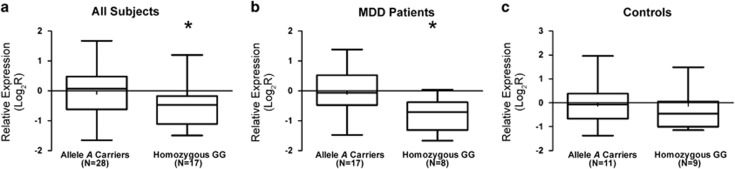
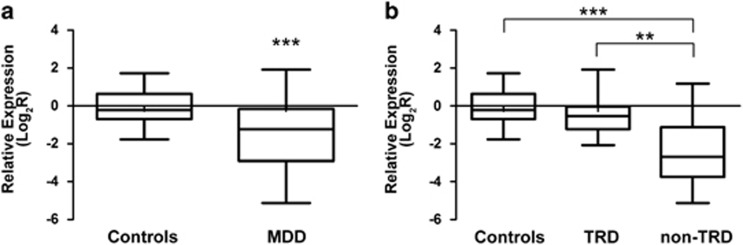
Several studies have demonstrated that allelic variants related to inflammation and the immune system may increase the risk for major depressive disorder (MDD) and reduce patient responsiveness to antidepressant treatment. Proteasomes are fundamental complexes that contribute to the regulation of T-cell function. Only one study has shown a putative role of proteasomal PSMA7, PSMD9 and PSMD13 genes in the susceptibility to an antidepressant response, and sparse data are available regarding the potential alterations in proteasome expression in psychiatric disorders such as MDD. The aim of this study was to clarify the role of these genes in the mechanisms underlying the response/resistance to MDD treatment. We performed a case-control association study on 621 MDD patients, of whom 390 were classified as treatment-resistant depression (TRD), and we collected peripheral blood cells and fibroblasts for mRNA expression analyses. The analyses showed that subjects carrying the homozygous GG genotype of PSMD13 rs3817629 had a twofold greater risk of developing TRD and exhibited a lower PSMD13 mRNA level in fibroblasts than subjects carrying the A allele. In addition, we found a positive association between PSMD9 rs1043307 and the presence of anxiety disorders in comorbidity with MDD, although this result was not significant following correction for multiple comparisons. In conclusion, by confirming the involvement of PSMD13 in the MDD treatment response, our data corroborate the hypothesis that the dysregulation of the complex responsible for the degradation of intracellular proteins and potentially controlling autoimmunity- and immune tolerance-related processes may be involved in several phenotypes, including the TRD.
多项研究表明,与炎症和免疫系统相关的等位基因变异可能会增加患重度抑郁症(MDD)的风险,并降低患者对抗抑郁治疗的反应性。蛋白酶体是有助于调节T细胞功能的基本复合物。仅有一项研究显示蛋白酶体PSMA7、PSMD9和PSMD13基因在抗抑郁反应易感性中具有假定作用,而关于诸如MDD等精神疾病中蛋白酶体表达的潜在改变,可用数据稀少。本研究的目的是阐明这些基因在MDD治疗反应/抵抗潜在机制中的作用。我们对621例MDD患者进行了病例对照关联研究,其中390例被归类为治疗抵抗性抑郁症(TRD),并收集外周血细胞和成纤维细胞用于mRNA表达分析。分析表明,携带PSMD13 rs3817629纯合GG基因型的受试者发生TRD的风险高出两倍,且其成纤维细胞中的PSMD13 mRNA水平低于携带A等位基因的受试者。此外,我们发现PSMD9 rs1043307与MDD合并焦虑症的存在之间存在正相关,尽管在进行多重比较校正后该结果并不显著。总之,通过证实PSMD13参与MDD治疗反应,我们的数据支持了这样一种假说,即负责细胞内蛋白质降解并可能控制自身免疫和免疫耐受相关过程的复合物失调可能与包括TRD在内的多种表型有关。