Gelman Susan J, Mahieu Nathaniel G, Cho Kevin, Llufrio Elizabeth M, Wencewicz Timothy A, Patti Gary J
Department of Chemistry, Washington University, St. Louis, MO 63130 USA ; Department of Medicine, Washington University School of Medicine, St. Louis, MO 63110 USA.
Department of Chemistry, Washington University, St. Louis, MO 63130 USA.
Cancer Metab. 2015 Dec 1;3:13. doi: 10.1186/s40170-015-0139-z. eCollection 2015.
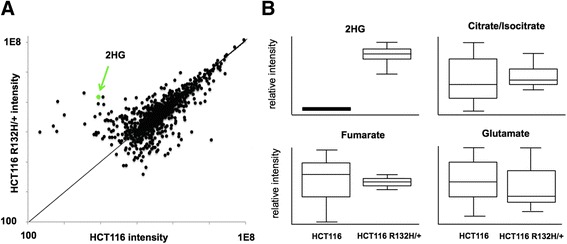
Two-hydroxyglutarate (2HG) is present at low concentrations in healthy mammalian cells as both an L and D enantiomer. Both the L and D enantiomers have been implicated in regulating cellular physiology by mechanisms that are only partially characterized. In multiple human cancers, the D enantiomer accumulates due to gain-of-function mutations in the enzyme isocitrate dehydrogenase (IDH) and has been hypothesized to drive malignancy through mechanisms that remain incompletely understood. While much attention has been dedicated to identifying the route of 2HG synthesis, the metabolic fate of 2HG has not been studied in detail. Yet the metabolism of 2HG may have important mechanistic consequences influencing cell function and cancer pathogenesis, such as modulating redox potential or producing unknown products with unique modes of action.
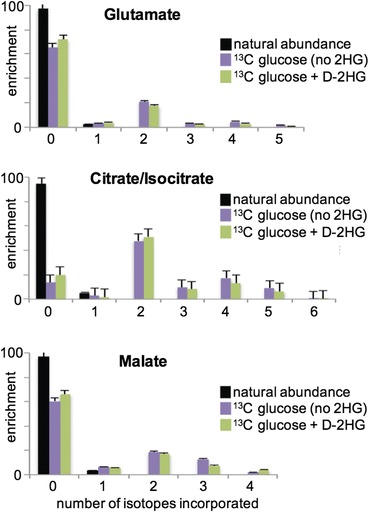
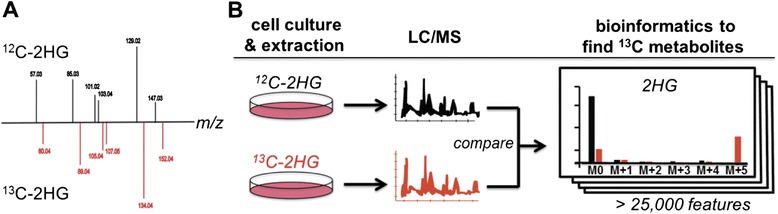
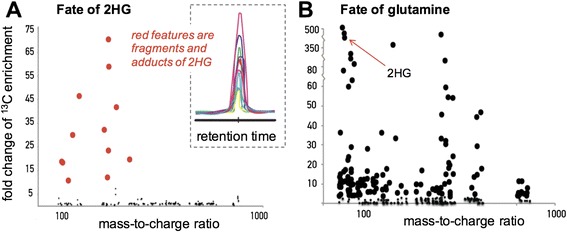
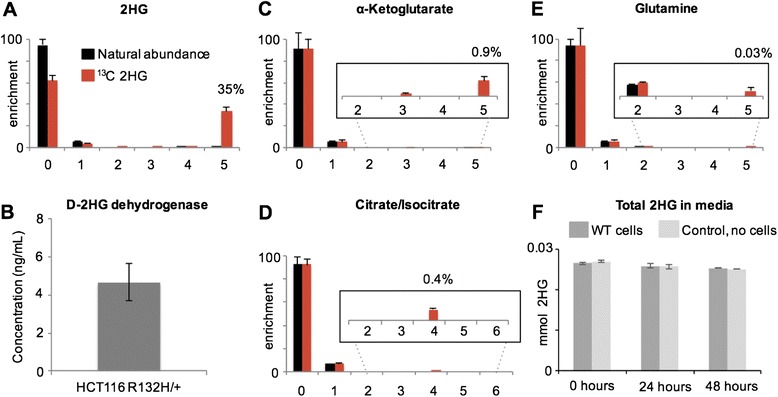
By applying our isotope-based metabolomic platform, we unbiasedly and comprehensively screened for products of L- and D-2HG in HCT116 colorectal carcinoma cells harboring a mutation in IDH1. After incubating HCT116 cells in uniformly (13)C-labeled 2HG for 24 h, we used liquid chromatography/mass spectrometry to track the labeled carbons in small molecules. Strikingly, we did not identify any products of 2HG metabolism from the thousands of metabolomic features that we screened. Consistent with these results, we did not detect any significant changes in the labeling patterns of tricarboxylic acid cycle metabolites from wild type or IDH1 mutant cells cultured in (13)C-labeled glucose upon the addition of L, D, or racemic mixtures of 2HG. A more sensitive, targeted analysis revealed trace levels of isotopic enrichment (<1 %) in some central carbon metabolites from (13)C-labeled 2HG. However, we found that cells do not deplete 2HG from the media at levels above our detection limit over a 48 h time period.
Taken together, we conclude that 2HG carbon is not readily transformed in the HCT116 cell line. These data indicate that the phenotypic alterations induced by 2HG are not a result of its metabolic products.
在健康的哺乳动物细胞中,两种对映体形式的2-羟基戊二酸(2HG)均以低浓度存在。L型和D型对映体都通过仅部分特征化的机制参与调节细胞生理。在多种人类癌症中,由于异柠檬酸脱氢酶(IDH)的功能获得性突变,D型对映体积聚,并且据推测其通过仍未完全了解的机制驱动恶性肿瘤发生。虽然人们已将大量注意力投入到确定2HG的合成途径上,但2HG的代谢命运尚未得到详细研究。然而,2HG的代谢可能具有影响细胞功能和癌症发病机制的重要机制后果,例如调节氧化还原电位或产生具有独特作用方式的未知产物。
通过应用我们基于同位素的代谢组学平台,我们对携带IDH1突变的HCT116结肠癌细胞中L-和D-2HG的产物进行了无偏且全面的筛选。在将HCT116细胞在均匀标记有(13)C的2HG中孵育24小时后,我们使用液相色谱/质谱法追踪小分子中的标记碳。令人惊讶的是,在我们筛选的数千个代谢组学特征中,我们未鉴定出任何2HG代谢产物。与这些结果一致,在添加L型、D型或外消旋混合物的2HG后,我们未检测到在以(13)C标记的葡萄糖培养的野生型或IDH1突变细胞中三羧酸循环代谢物的标记模式有任何显著变化。一项更灵敏的靶向分析揭示,在来自(13)C标记的2HG的一些中心碳代谢物中存在痕量水平的同位素富集(<1%)。然而,我们发现细胞在48小时时间段内不会将培养基中的2HG消耗至高于我们检测限的水平。
综上所述,我们得出结论,2HG的碳在HCT116细胞系中不易转化。这些数据表明,2HG诱导的表型改变不是其代谢产物的结果。