Devetzis Vasilios, Daryadel Arezoo, Roumeliotis Stefanos, Theodoridis Marios, Wagner Carsten A, Hettwer Stefan, Huynh-Do Uyen, Ploumis Passadakis, Arampatzis Spyridon
Department of Nephrology, Hypertension and Clinical Pharmacology, Inselspital, Bern University Hospital, Bern, Switzerland.
Institute of Physiology, University of Zurich, Zurich, Switzerland.
PLoS One. 2015 Dec 2;10(12):e0143524. doi: 10.1371/journal.pone.0143524. eCollection 2015.
Diabetes is the leading cause of CKD in the developed world. C-terminal fragment of agrin (CAF) is a novel kidney function and injury biomarker. We investigated whether serum CAF predicts progression of kidney disease in type 2 diabetics.
Serum CAF levels were measured in 71 elderly patients with diabetic nephropathy using a newly developed commercial ELISA kit (Neurotune®). Estimated glomerular filtration rate (eGFR) and proteinuria in spot urine were assessed at baseline and after 12 months follow up. The presence of end stage renal disease (ESRD) was evaluated after 24 months follow-up. Correlation and logistic regression analyses were carried out to explore the associations of serum CAF levels with GFR, proteinuria, GFR loss and incident ESRD. Renal handling of CAF was tested in neurotrypsin-deficient mice injected with recombinant CAF.
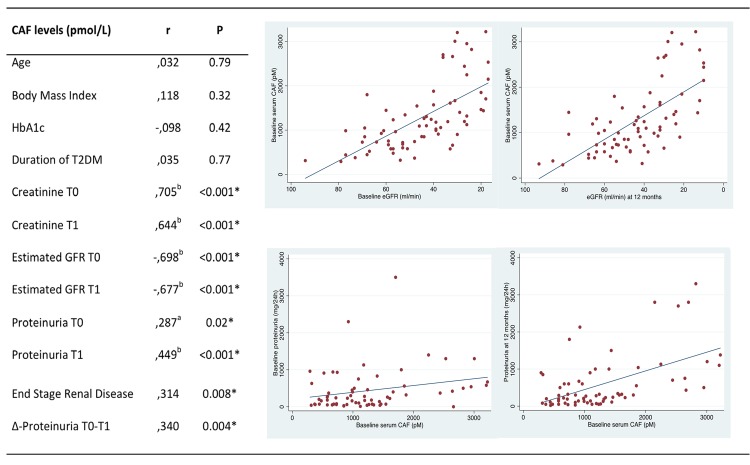
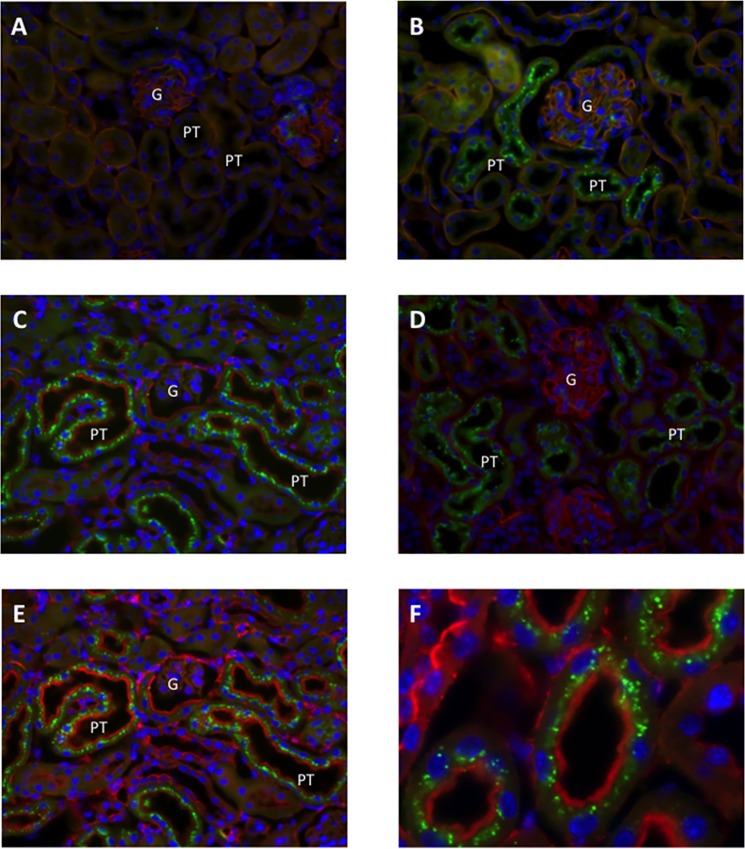
We found a strong association of serum CAF levels with eGFR and a direct association with proteinuria both at baseline (r = 0.698, p<0.001 and r = 0. 287, p = 0.02) as well as after 12 months follow-up (r = 0.677, p<0.001 and r = 0.449, p<0.001), respectively. Furthermore, in multivariate analysis, serum CAF levels predicted eGFR decline at 12 months follow-up after adjusting for known risk factors (eGFR, baseline proteinuria) [OR (95%CI) = 4.2 (1.2-14.5), p = 0.024]. In mice, injected CAF was detected in endocytic vesicles of the proximal tubule.
Serum CAF levels reflect renal function and are highly associated with eGFR and proteinuria at several time points. Serum CAF was able to predict subsequent loss of renal function irrespective of baseline proteinuria in diabetic nephropathy. CAF is likely removed from circulation by glomerular filtration and subsequent endocytosis in the proximal tubule. These findings may open new possibilities for clinical trial design, since serum CAF levels may be used as a selection tool to monitor kidney function in high-risk patients with diabetic nephropathy.
在发达国家,糖尿病是慢性肾脏病(CKD)的主要病因。聚集蛋白的C末端片段(CAF)是一种新型的肾功能和损伤生物标志物。我们研究了血清CAF是否能预测2型糖尿病患者的肾脏疾病进展。
使用新开发的商业化酶联免疫吸附测定试剂盒(Neurotune®),对71例老年糖尿病肾病患者的血清CAF水平进行检测。在基线期和随访12个月后,评估估算肾小球滤过率(eGFR)和随机尿中的蛋白尿情况。在随访24个月后,评估终末期肾病(ESRD)的发生情况。进行相关性和逻辑回归分析,以探究血清CAF水平与肾小球滤过率、蛋白尿、肾小球滤过率下降及新发ESRD之间的关联。在注射重组CAF的神经胰蛋白酶缺陷小鼠中,检测CAF的肾脏处理情况。
我们发现,血清CAF水平与eGFR在基线期(r = 0.698,p<0.001)及随访12个月后(r = 0.677,p<0.001)均呈强相关,与蛋白尿在基线期(r = 0.287,p = 0.02)及随访12个月后(r = 0.449,p<0.001)均呈直接相关。此外,在多变量分析中,在校正已知危险因素(eGFR、基线蛋白尿)后,血清CAF水平可预测随访12个月时的eGFR下降情况[比值比(95%置信区间)= 4.2(1.2 - 14.5),p = 0.024]。在小鼠中,注射的CAF在近端小管的内吞小泡中被检测到。
血清CAF水平反映肾功能,在多个时间点与eGFR和蛋白尿高度相关。血清CAF能够预测糖尿病肾病患者后续的肾功能丧失,而与基线蛋白尿无关。CAF可能通过肾小球滤过及随后在近端小管的内吞作用从循环中清除。这些发现可能为临床试验设计开辟新的可能性,因为血清CAF水平可作为一种筛选工具,用于监测糖尿病肾病高危患者的肾功能。