Zhang Chun, Ye Lihai, Chen Yiyi, Xiao Jun, Wu Yanhong, Tao Min, Xiao Yamei, Liu Shaojun
Key Laboratory of Protein Chemistry and Fish Developmental Biology of the Ministry of Education of China, College of Life Sciences, Hunan Normal University, Changsha, 410081, China.
BMC Genet. 2015 Dec 3;16:140. doi: 10.1186/s12863-015-0295-8.
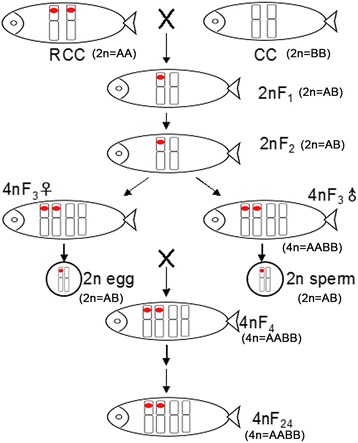
The establishment of the bisexual fertile fish hybrid lineage including the allodiploid and allotetraploid hybrids, from interspecific hybridization of red crucian carp (Carassius auratus red var. 2n = 100, 2n = AA) (♀) × common carp (Cyprinus carpio L. 2n = 100, 2n = BB) (♂), provided a good platform to investigate genetic relationship between the parents and their hybrid progenies.
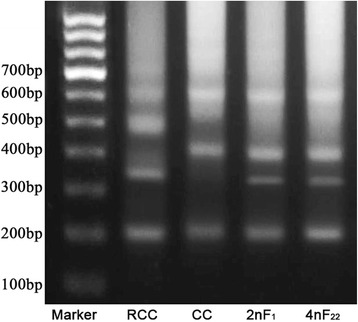
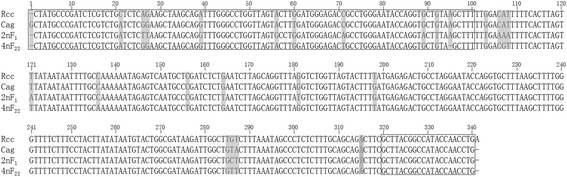
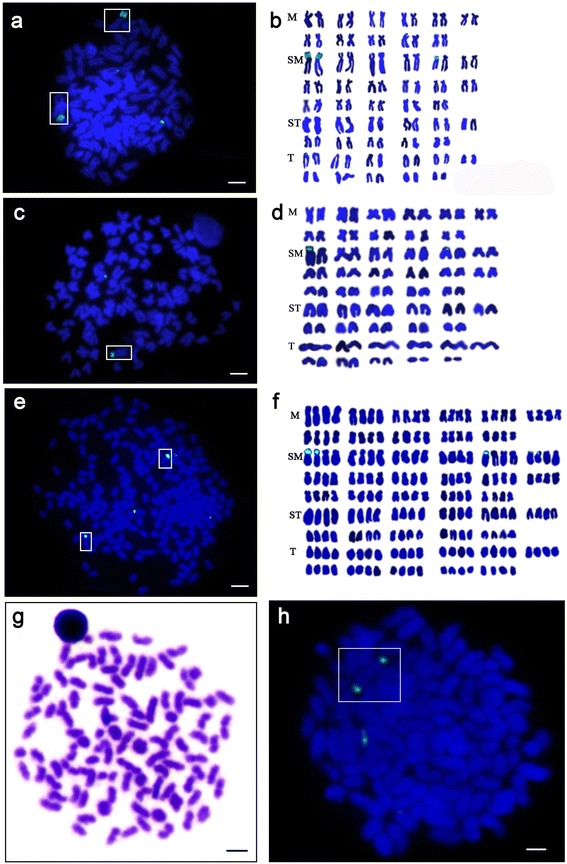
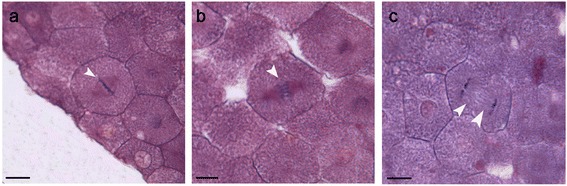
The chromosomal inheritance of diploid and allotetraploid hybrid progenies in successive generations, was studied by applying 5S rDNA fluorescence in situ hybridization. Signals of 5S rDNA distinguished the chromosomal constitution of common carp (B-genome) from red crucian carp (A-genome), in which two strong signals were observed on the first submetacentric chromosome, while no major signal was found in common carp. After fish hybridization, one strong signal of 5S rDNA was detected in the same locus on the chromosome of diploid hybrids. As expected, two strong signals were observed in 4nF3 tetraploid hybrids offspring and it is worth mentioning that two strong signals were detected in a separating bivalent of a primary spermatocyte in 4nF3. Furthermore, the mitosis of heterozygous chromosomes was shown normal and stable with blastular tissue histological studies.
We revealed that 5S rDNA signal can be applied to discern A-genome from B-genome, and that 5S rDNA bearing chromosomes can be stably passed down in successive generations. Our work provided a significant method in fish breeding and this is important for studies in fish evolutionary biology.
通过红鲫(Carassius auratus red var. 2n = 100, 2n = AA)(♀)与鲤鱼(Cyprinus carpio L. 2n = 100, 2n = BB)(♂)种间杂交建立的包含异源二倍体和异源四倍体杂种的双性可育鱼类杂交谱系,为研究亲本与其杂交后代之间的遗传关系提供了良好平台。
应用5S rDNA荧光原位杂交技术研究了二倍体和异源四倍体杂交后代连续世代的染色体遗传情况。5S rDNA信号区分了鲤鱼(B基因组)和红鲫(A基因组)的染色体组成,其中在红鲫的第一条亚中着丝粒染色体上观察到两个强信号,而在鲤鱼中未发现主要信号。鱼类杂交后,在二倍体杂种的染色体同一位点检测到一个5S rDNA强信号。正如预期的那样,在4nF3四倍体杂种后代中观察到两个强信号,值得一提的是,在4nF3的一个初级精母细胞的分离二价体中检测到两个强信号。此外,通过囊胚组织学研究表明杂合染色体的有丝分裂正常且稳定。
我们揭示了5S rDNA信号可用于区分A基因组和B基因组,并且携带5S rDNA的染色体能够在连续世代中稳定遗传。我们的工作为鱼类育种提供了一种重要方法,这对鱼类进化生物学研究具有重要意义。