Xu Jin, Casas-Ferreira Ana M, Ma Yun, Sen Arundhuti, Kim Min, Proitsi Petroula, Shkodra Maltina, Tena Maria, Srinivasan Parthi, Heaton Nigel, Jassem Wayel, Legido-Quigley Cristina
Faculty of Life Sciences &Medicine, King's College London, London, United Kingdom.
Department of Analytical Chemistry, Nutrition and Food Science, University of Salamanca, Spain.
Sci Rep. 2015 Dec 4;5:17737. doi: 10.1038/srep17737.
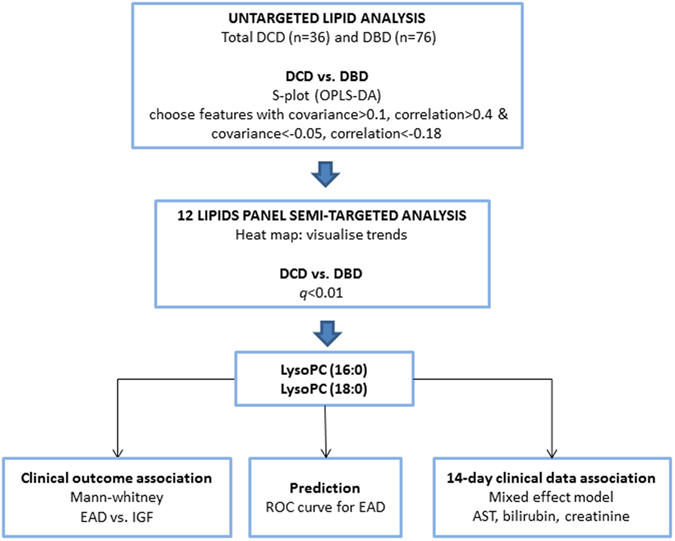
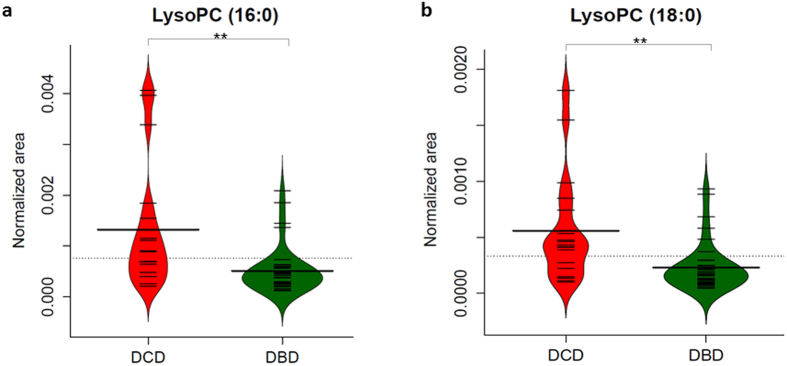
Finding specific biomarkers of liver damage in clinical evaluations could increase the pool of available organs for transplantation. Lipids are key regulators in cell necrosis and hence this study hypothesised that lipid levels could be altered in organs suffering severe ischemia. Matched pre- and post-transplant biopsies from donation after circulatory death (DCD, n = 36, mean warm ischemia time = 2 min) and donation after brain death (DBD, n = 76, warm ischemia time = none) were collected. Lipidomic discovery and multivariate analysis (MVA) were applied. Afterwards, univariate analysis and clinical associations were conducted for selected lipids differentiating between these two groups. MVA grouped DCD vs. DBD (p = 6.20 × 10(-12)) and 12 phospholipids were selected for intact lipid measurements. Two lysophosphatidylcholines, LysoPC (16:0) and LysoPC (18:0), showed higher levels in DCD at pre-transplantation (q < 0.01). Lysophosphatidylcholines were associated with aspartate aminotransferase (AST) 14-day post-transplantation (q < 0.05) and were more abundant in recipients undergoing early allograft dysfunction (EAD) (p < 0.05). A receiver-operating characteristics (ROC) curve combining both lipid levels predicted EAD with 82% accuracy. These findings suggest that LysoPC (16:0) and LysoPC (18:0) might have a role in signalling liver tissue damage due to warm ischemia before transplantation.
在临床评估中找到肝损伤的特定生物标志物可以增加可用于移植的器官库。脂质是细胞坏死的关键调节因子,因此本研究假设在遭受严重缺血的器官中脂质水平可能会发生改变。收集了循环死亡后捐赠(DCD,n = 36,平均热缺血时间 = 2分钟)和脑死亡后捐赠(DBD,n = 76,热缺血时间 = 无)的移植前后配对活检样本。应用了脂质组学发现和多变量分析(MVA)。之后,对区分这两组的选定脂质进行单变量分析和临床关联分析。MVA将DCD与DBD分组(p = 6.20×10⁻¹²),并选择了12种磷脂进行完整脂质测量。两种溶血磷脂酰胆碱,溶血磷脂酰胆碱(16:0)和溶血磷脂酰胆碱(18:0),在移植前DCD组中水平较高(q < 0.01)。溶血磷脂酰胆碱与移植后14天的天冬氨酸转氨酶(AST)相关(q < 0.05),并且在发生早期移植物功能障碍(EAD)的受者中含量更高(p < 0.05)。结合两种脂质水平的受试者工作特征(ROC)曲线预测EAD的准确率为82%。这些发现表明,溶血磷脂酰胆碱(16:0)和溶血磷脂酰胆碱(18:0)可能在指示移植前热缺血引起的肝组织损伤中起作用。