Suriya-Arunroj Lalitta, Gail Alexander
Sensorimotor Group, German Primate Center Göttingen, Germany.
Sensorimotor Group, German Primate Center Göttingen, Germany ; Bernstein Center for Computational Neuroscience Göttingen, Germany ; Faculty of Biology and Psychology, Georg-Elias-Müller Institute, Georg August University Göttingen, Germany.
Front Behav Neurosci. 2015 Nov 25;9:315. doi: 10.3389/fnbeh.2015.00315. eCollection 2015.
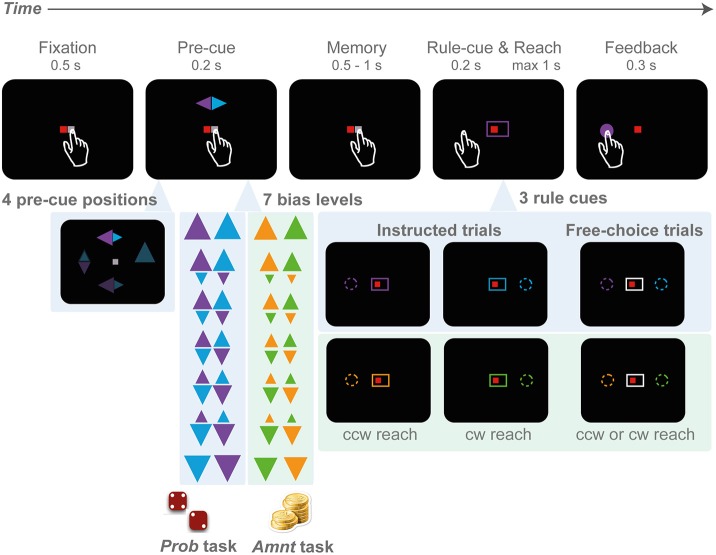
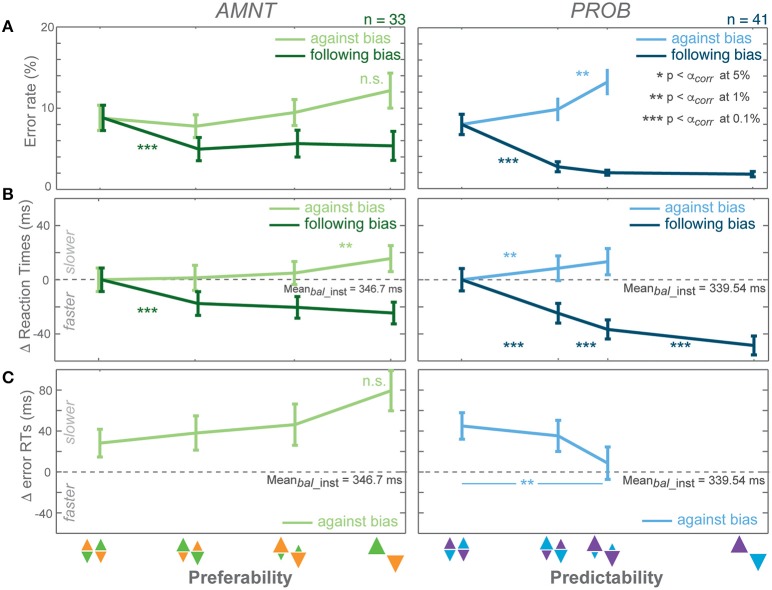
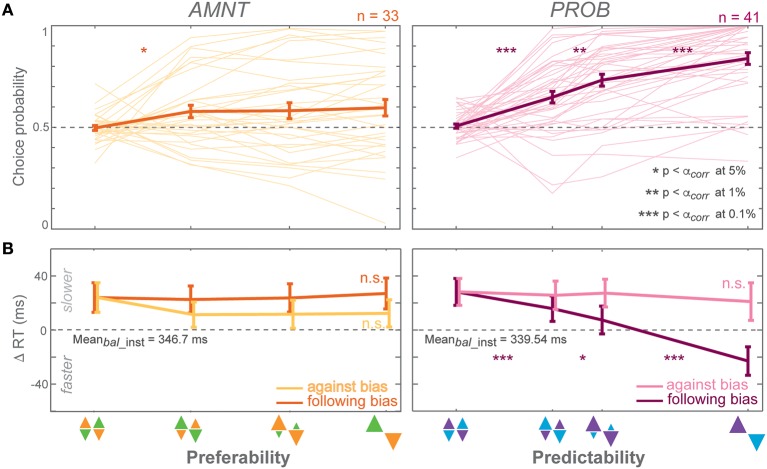
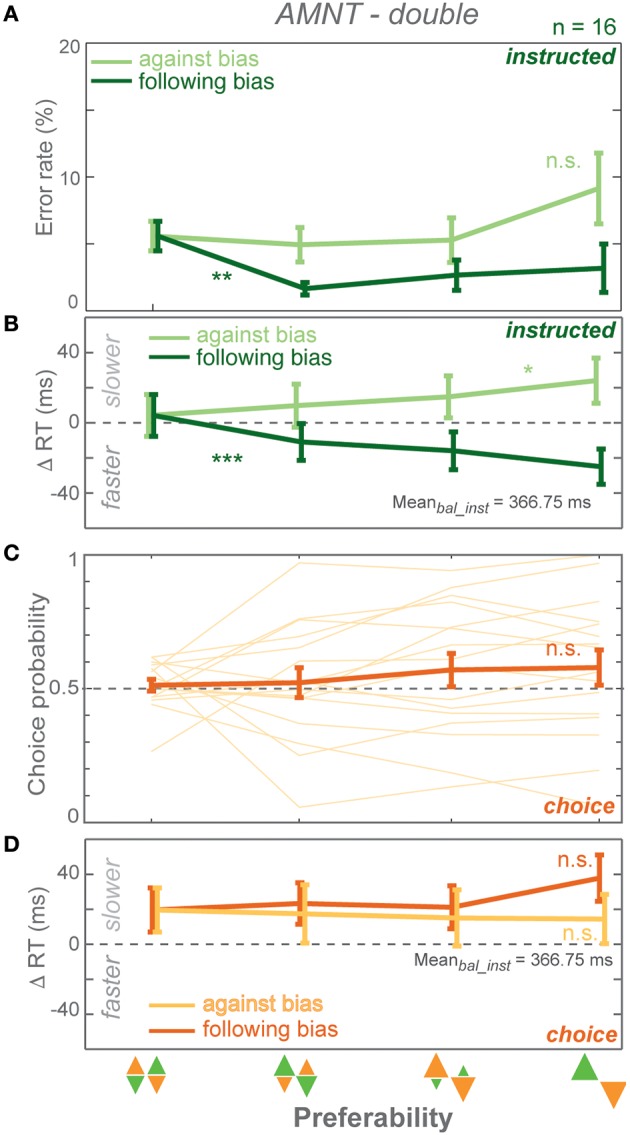
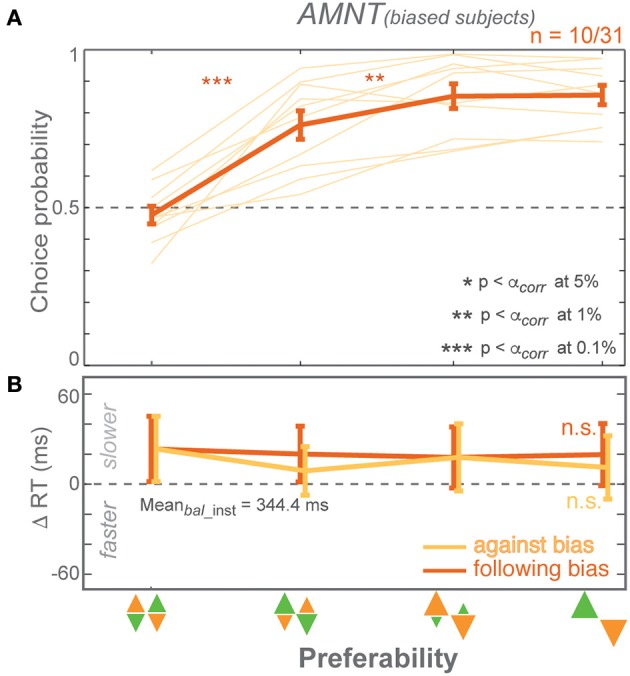
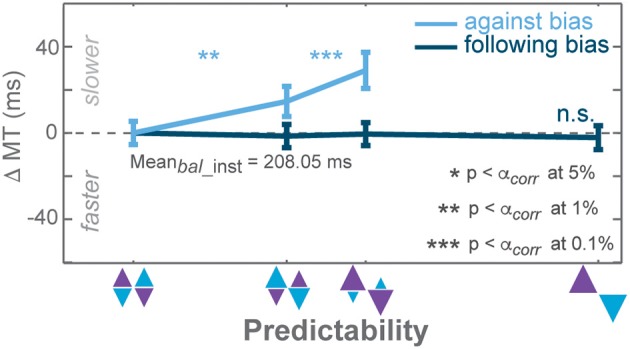
According to an emerging view, decision-making, and motor planning are tightly entangled at the level of neural processing. Choice is influenced not only by the values associated with different options, but also biased by other factors. Here we test the hypothesis that preliminary action planning can induce choice biases gradually and independently of objective value when planning overlaps with one of the potential action alternatives. Subjects performed center-out reaches obeying either a clockwise or counterclockwise cue-response rule in two tasks. In the probabilistic task, a pre-cue indicated the probability of each of the two potential rules to become valid. When the subsequent rule-cue unambiguously indicated which of the pre-cued rules was actually valid (instructed trials), subjects responded faster to rules pre-cued with higher probability. When subjects were allowed to choose freely between two equally rewarded rules (choice trials) they chose the originally more likely rule more often and faster, despite the lack of an objective advantage in selecting this target. In the amount task, the pre-cue indicated the amount of potential reward associated with each rule. Subjects responded faster to rules pre-cued with higher reward amount in instructed trials of the amount task, equivalent to the more likely rule in the probabilistic task. Yet, in contrast, subjects showed hardly any choice bias and no increase in response speed in favor of the original high-reward target in the choice trials of the amount task. We conclude that free-choice behavior is robustly biased when predictability encourages the planning of one of the potential responses, while prior reward expectations without action planning do not induce such strong bias. Our results provide behavioral evidence for distinct contributions of expected value and action planning in decision-making and a tight interdependence of motor planning and action selection, supporting the idea that the underlying neural mechanisms overlap.
根据一种新出现的观点,决策和运动规划在神经处理层面紧密相连。选择不仅受到与不同选项相关的值的影响,还受到其他因素的偏差影响。在这里,我们测试这样一个假设:当规划与潜在行动替代方案之一重叠时,初步行动规划可以逐渐且独立于客观价值地诱导选择偏差。在两项任务中,受试者按照顺时针或逆时针提示 - 反应规则进行中心向外伸展动作。在概率任务中,一个预提示表明两条潜在规则中每条规则有效的概率。当随后的规则提示明确指出预提示的两条规则中哪一条实际上有效时(指令试验),受试者对概率较高的预提示规则反应更快。当受试者被允许在两条同等奖励的规则之间自由选择时(选择试验),他们更频繁、更快地选择最初更有可能的规则,尽管选择这个目标并没有客观优势。在数量任务中,预提示表明与每条规则相关的潜在奖励数量。在数量任务的指令试验中,受试者对奖励数量较高的预提示规则反应更快,这与概率任务中更有可能的规则情况相当。然而,相比之下,在数量任务的选择试验中,受试者几乎没有表现出任何选择偏差,也没有因支持最初的高奖励目标而使反应速度加快。我们得出结论,当可预测性鼓励对潜在反应之一进行规划时,自由选择行为会受到强烈偏差影响,而没有行动规划的先前奖励预期不会诱导出如此强烈的偏差。我们的结果为预期价值和行动规划在决策中的不同贡献以及运动规划和行动选择的紧密相互依存提供了行为证据,支持了潜在神经机制重叠的观点。