Department of Psychology and Djavad Mowafaghian Centre for Brain Health, University of British Columbia, Vancouver, BC, CANADA, V6T 1Z4.
Department of Psychological and Brain Sciences, Neuroscience and Behavior Program, University of Massachusetts, Amherst, MA, USA, 01003.
eNeuro. 2018 Dec 10;5(6). doi: 10.1523/ENEURO.0422-18.2018. eCollection 2018 Nov-Dec.
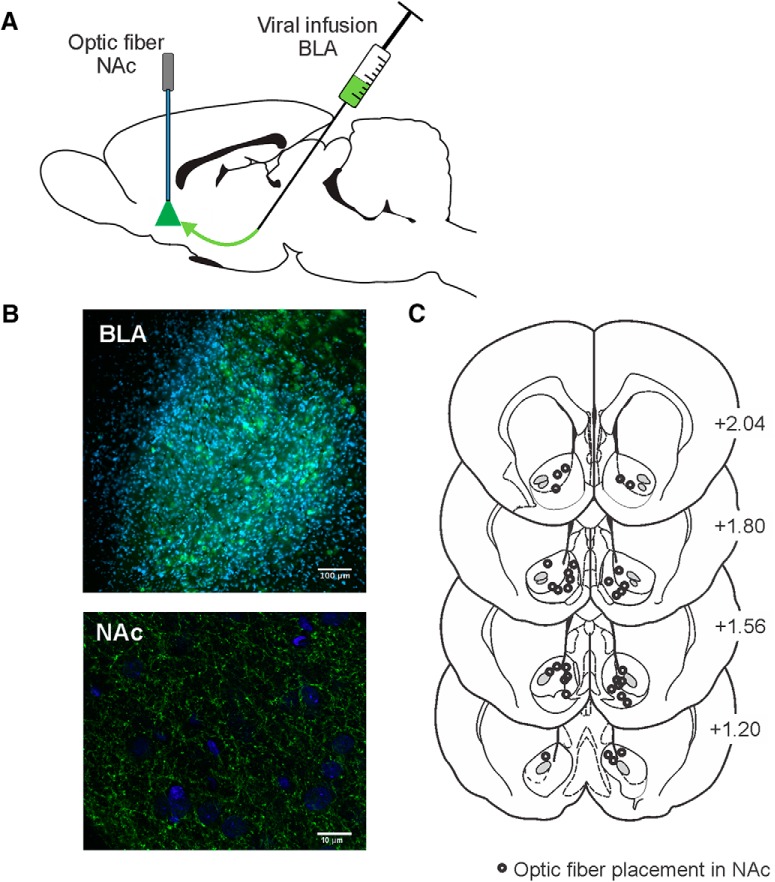
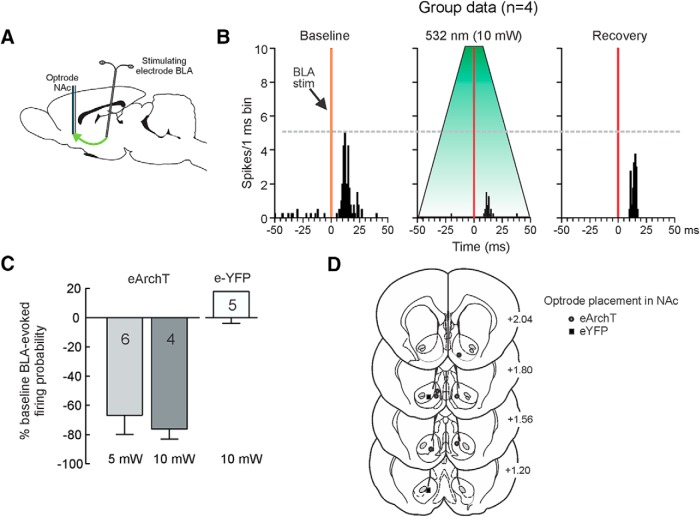
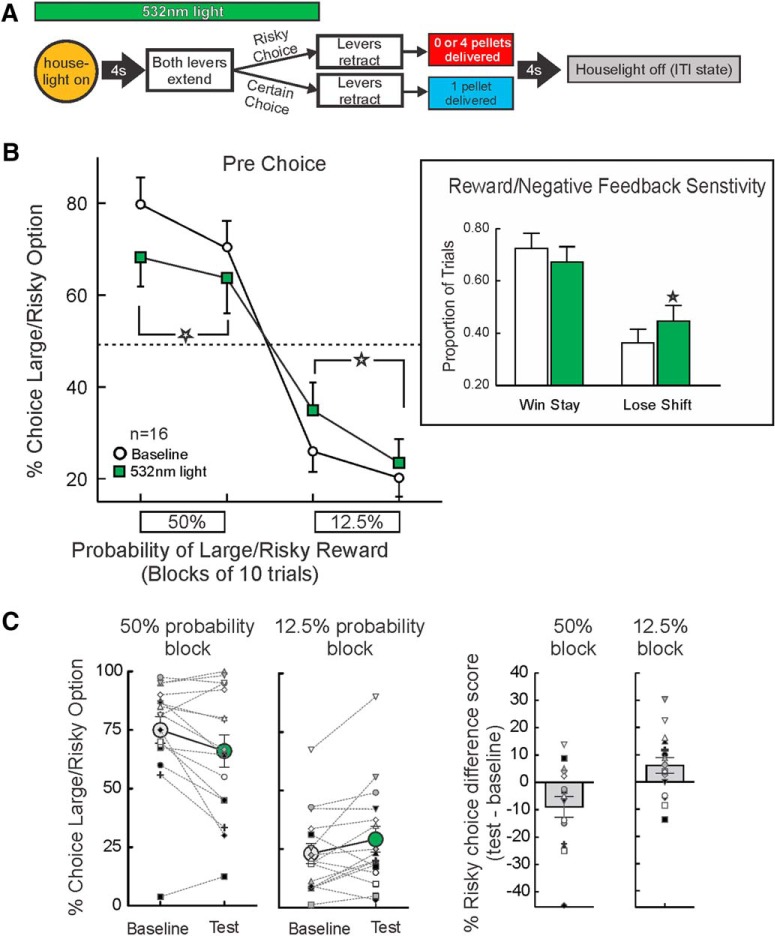
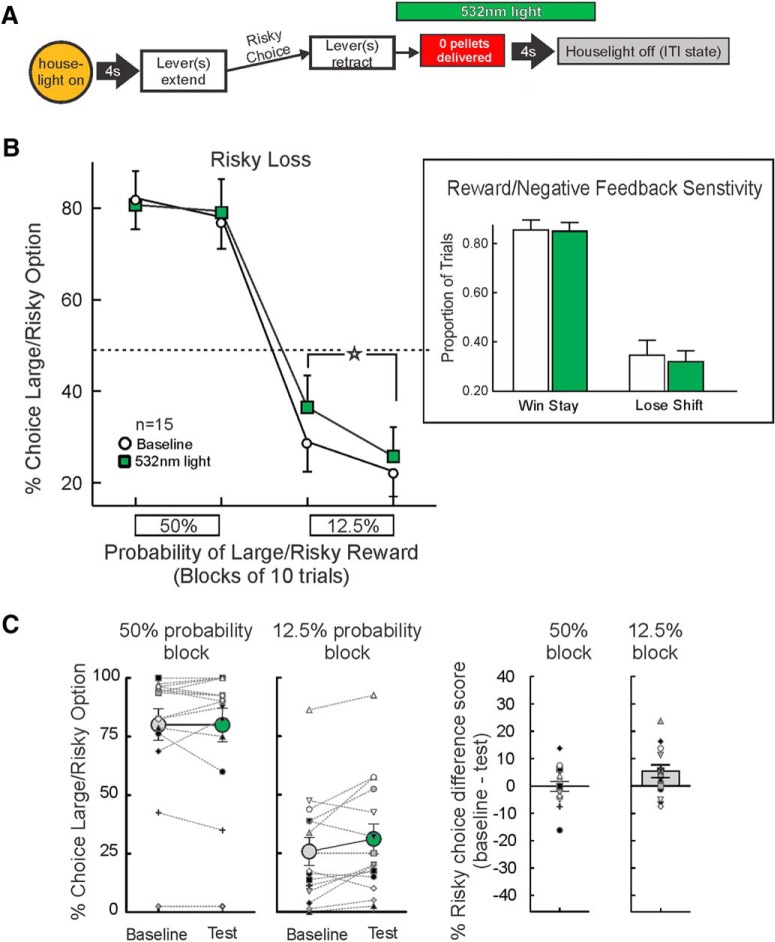
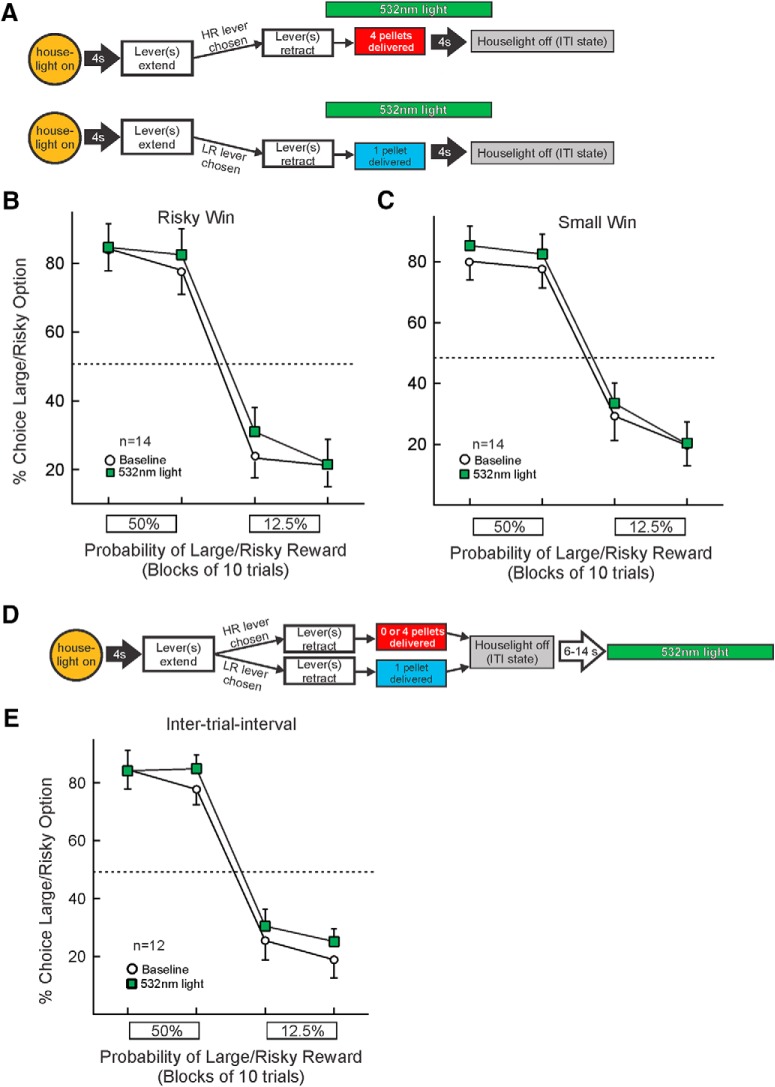
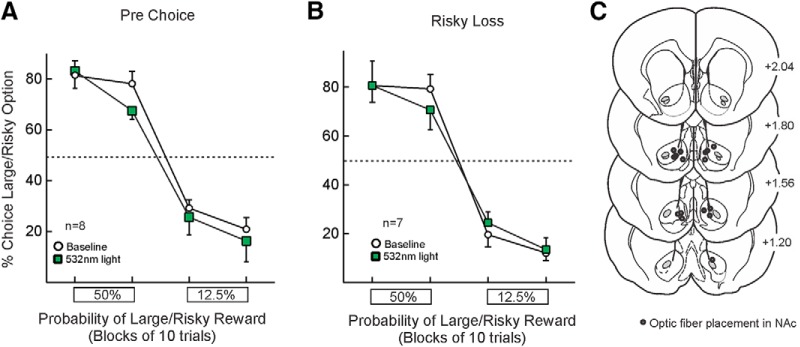
Decision making often requires weighing costs and benefits of different options that vary in terms of reward magnitude and uncertainty. Previous studies using pharmacological inactivations have shown that the basolateral amygdala (BLA) to nucleus accumbens (NAc) pathway promotes choice towards larger/riskier rewards. Neural activity in BLA and NAc shows distinct, phasic changes in firing prior to choice and following action outcomes, yet, how these temporally-discrete patterns of activity within BLA→NAc circuitry influence choice is unclear. We assessed how optogenetic silencing of BLA terminals in the NAc altered action selection during probabilistic decision making. Rats received intra-BLA infusions of viruses encoding the inhibitory opsin eArchT and were well trained on a probabilistic discounting task, where they chose between smaller/certain rewards and larger rewards delivered in a probabilistic manner, with the odds of obtaining the larger reward changing over a session (50-12.5%). During testing, activity of BLA→NAc inputs were suppressed with 4- to 7-s pulses of light delivered via optic fibers into the NAc during discrete task events: prior to choice or after choice outcomes. Inhibition prior to choice reduced selection of the preferred option, suggesting that during deliberation, BLA→NAc activity biases choice towards preferred rewards. Inhibition during reward omissions increased risky choice during the low-probability block, indicating that activity after non-rewarded actions serves to modify subsequent choice. In contrast, silencing during rewarded outcomes did not reliably affect choice. These data demonstrate how patterns of activity in BLA→NAc circuitry convey different types of information that guide action selection in situations involving reward uncertainty.
决策通常需要权衡不同选项的成本和收益,这些选项在奖励大小和不确定性方面有所不同。先前使用药理学失活的研究表明,基底外侧杏仁核(BLA)至伏隔核(NAc)的通路促进了更大/风险更大奖励的选择。BLA 和 NAc 中的神经活动在选择之前和行动结果之后表现出明显的、相位变化的发射,但这些 BLA→NAc 电路内的活动的时间离散模式如何影响选择尚不清楚。我们评估了光遗传学沉默 NAc 中的 BLA 末梢如何改变概率决策中的动作选择。大鼠接受了编码抑制性 opsin eArchT 的病毒的脑内注射,并在概率折扣任务中接受了良好的训练,在该任务中,它们在较小/确定的奖励和以概率方式提供的较大奖励之间进行选择,获得较大奖励的几率在一个会话中变化(50-12.5%)。在测试期间,通过光纤将光脉冲传递到 NAc 中,在离散任务事件期间抑制 BLA→NAc 输入的活动:在选择之前或在选择结果之后。在选择之前的抑制减少了对首选选项的选择,这表明在审议过程中,BLA→NAc 活动偏向于首选奖励。在奖励缺失期间的抑制增加了低概率块中的冒险选择,这表明非奖励动作后的活动用于修改随后的选择。相比之下,在奖励结果期间的沉默并没有可靠地影响选择。这些数据表明 BLA→NAc 电路中的活动模式如何传递不同类型的信息,从而在涉及奖励不确定性的情况下指导动作选择。