Hübner Claudia, Hübner Nils-Olaf, Wegner Christian, Flessa Steffen
Institute of Health Care Management, University of Greifswald, Friedrich-Loeffler-Str. 70, 17489 Greifswald, Germany.
Institute of Hygiene and Environmental Health, University Medicine of Greifswald, Greifswald, Germany ; IMD laboratory network, MVZ Greifswald GmbH, Greifswald, Germany.
Antimicrob Resist Infect Control. 2015 Dec 3;4:50. doi: 10.1186/s13756-015-0093-0. eCollection 2015.
Hospital infections with multiresistant bacteria, e.g., Methicillin-resistant Staphylococcus aureus (MRSA), cause heavy financial burden worldwide. Rapid and precise identification of MRSA carriage in combination with targeted hygienic management are proven to be effective but incur relevant extra costs. Therefore, health care providers have to decide which MRSA screening strategy and which diagnostic technology should be applied according to economic criteria.
The aim of this study was to determine which MRSA admission screening and infection control management strategy causes the lowest expected cost for a hospital. Focus was set on the Point-of-Care Testing (PoC).
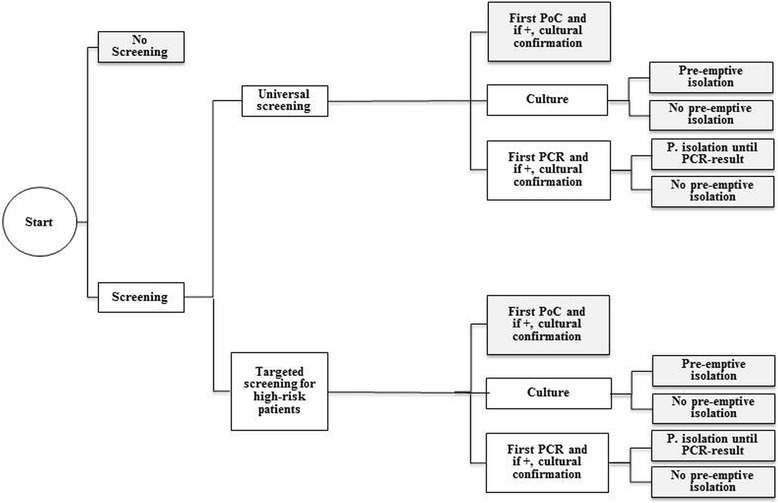
A decision tree analytic cost model was developed, primarily based on data from peer-reviewed literature. In addition, univariate sensitivity analyses of the different input parameters were conducted to study the robustness of the results.
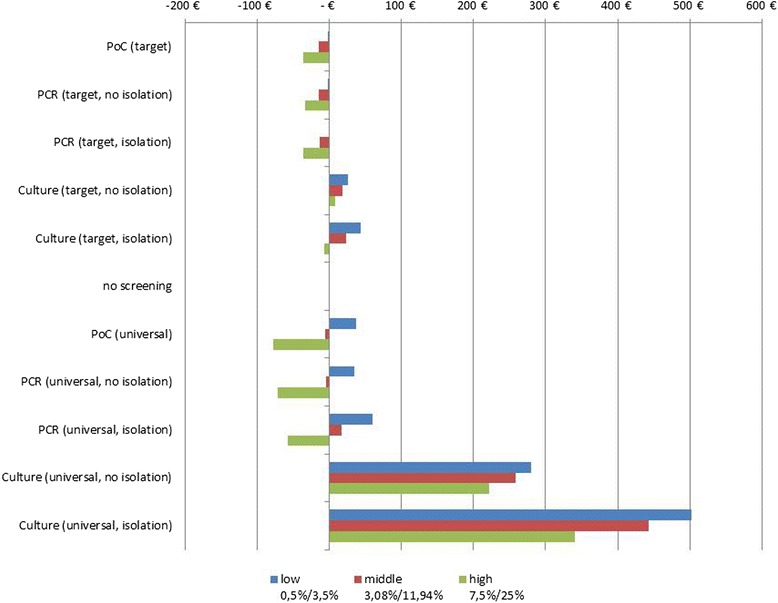
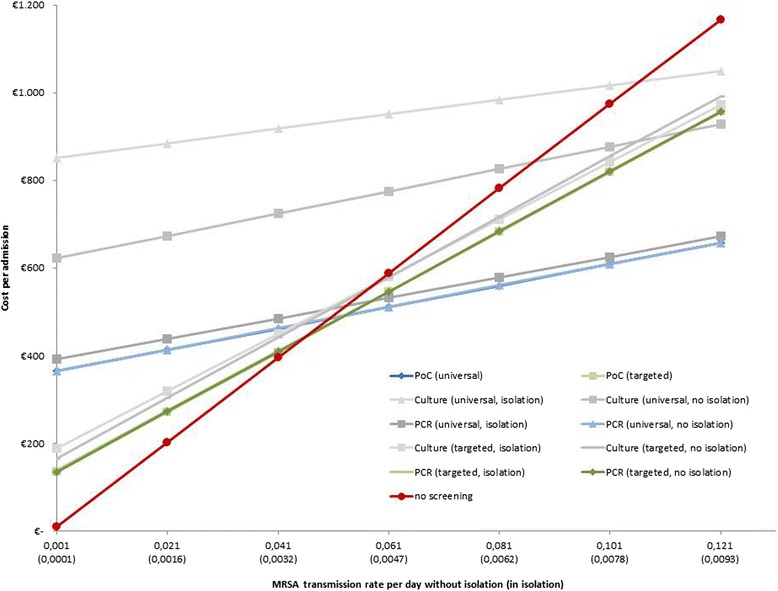
In the basic analysis, risk-based PoC screening showed the highest mean cost savings with 14.98 € per admission in comparison to no screening. Rapid universal screening methods became favorable at high MRSA prevalence, while in situations with low MRSA transmission rates omission of screening may be favorable.
Early detection of MRSA by rapid PoC or PCR technologies and consistent implementation of appropriate hygienic measures lead to high economic efficiency of MRSA management. Whether general or targeted screening is more efficient depends mainly on epidemiological and infrastructural parameters.
耐多药细菌引起的医院感染,如耐甲氧西林金黄色葡萄球菌(MRSA),在全球造成了沉重的经济负担。事实证明,快速准确地识别MRSA携带者并结合针对性的卫生管理是有效的,但会产生相关的额外成本。因此,医疗保健提供者必须根据经济标准决定应采用哪种MRSA筛查策略和哪种诊断技术。
本研究的目的是确定哪种MRSA入院筛查和感染控制管理策略会使医院的预期成本最低。重点放在即时检验(PoC)上。
开发了一种决策树分析成本模型,主要基于同行评审文献中的数据。此外,对不同输入参数进行了单变量敏感性分析,以研究结果的稳健性。
在基础分析中,与不进行筛查相比,基于风险的PoC筛查显示出最高的平均成本节省,每次入院节省14.98欧元。在MRSA患病率较高时,快速通用筛查方法变得有利,而在MRSA传播率较低的情况下,不进行筛查可能是有利的。
通过快速PoC或PCR技术早期检测MRSA并持续实施适当的卫生措施可提高MRSA管理的经济效益。全面筛查还是针对性筛查更有效,主要取决于流行病学和基础设施参数。