Yang Hae Jin, Shim Sang Goon, Ma Bong Oh, Kwak Ji Yeong
aDepartment of Internal Medicine, Changwon Hanmaeum Hospital bDepartment of Internal Medicine, Division of Gastroenterology cHealth Promotion Center, Sungkyunkwan University Samsung Changwon Hospital, Changwon-si dDepartment of Internal Medicine, Jinju Bando Hospital, Jinju-si, Republic of Korea.
Eur J Gastroenterol Hepatol. 2016 Mar;28(3):338-44. doi: 10.1097/MEG.0000000000000535.
Bone mineral density has been reported to negatively associate with nonalcoholic fatty liver disease. Osteocalcin, a bone formation marker and metabolic regulator, has been previously evaluated as the mediator between bone mineral density and nonalcoholic fatty liver disease. Herein, we aimed to investigate the correlations of nonalcoholic fatty liver disease with bone mineral density and serum osteocalcin levels in Korean men.
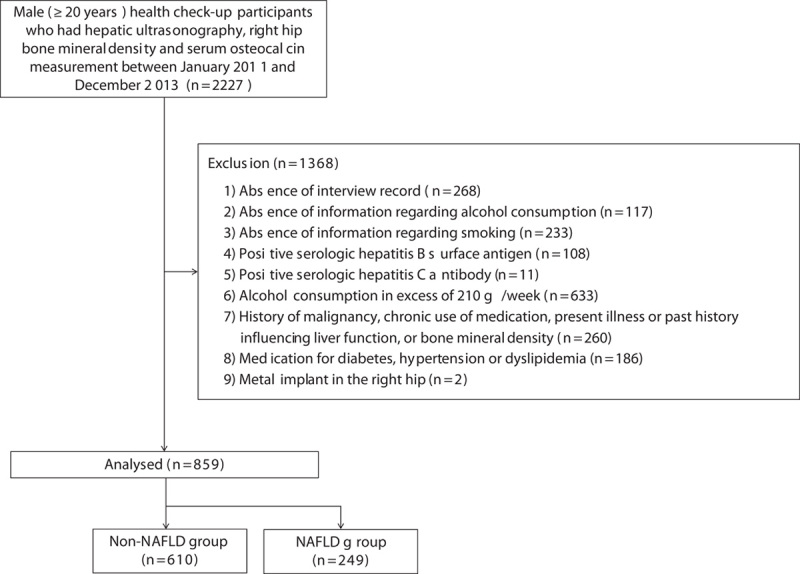
A total of 859 men (249 and 610 men with and without nonalcoholic fatty liver disease, respectively) were recruited for this retrospective cross-sectional study. All participants underwent hepatic ultrasonography and dual energy X-ray absorptiometry. Anthropometric and biochemical data, including the serum osteocalcin levels and homeostasis model assessment of insulin resistance (HOMA-IR), were collected.
Nonalcoholic fatty liver disease negatively associated with right-hip bone mineral density (odds ratio, 0.797; 95% confidence interval, 0.645-0.984; P=0.035) and serum osteocalcin (odds ratio, 0.948; 95% confidence interval, 0.910-0.988; P=0.011) after adjusting for BMI and HOMA-IR. The mean right-hip bone mineral density was lower in men with versus without nonalcoholic fatty liver disease after adjusting for serum osteocalcin, BMI and HOMA-IR (0.11±0.06 vs. 0.29±0.04; P=0.019).
Nonalcoholic fatty liver disease negatively associated with right-hip bone mineral density and serum osteocalcin in Korean men. General population-based prospective studies evaluating the causal relationship between bone metabolism and nonalcoholic fatty liver disease are needed, and the mechanism linking nonalcoholic fatty liver disease to bone mineral density beyond insulin resistance and osteocalcin should be evaluated in the future.
据报道,骨密度与非酒精性脂肪性肝病呈负相关。骨钙素是一种骨形成标志物和代谢调节因子,此前已被评估为骨密度与非酒精性脂肪性肝病之间的介导因子。在此,我们旨在研究韩国男性中非酒精性脂肪性肝病与骨密度及血清骨钙素水平之间的相关性。
本回顾性横断面研究共纳入859名男性(分别有249名和610名患有和未患有非酒精性脂肪性肝病的男性)。所有参与者均接受了肝脏超声检查和双能X线吸收测定法。收集了人体测量和生化数据,包括血清骨钙素水平和胰岛素抵抗的稳态模型评估(HOMA-IR)。
在调整体重指数(BMI)和HOMA-IR后,非酒精性脂肪性肝病与右髋骨密度呈负相关(比值比,0.797;95%置信区间,0.645 - 0.984;P = 0.035),与血清骨钙素也呈负相关(比值比,0.948;95%置信区间,0.910 - 0.988;P = 0.011)。在调整血清骨钙素、BMI和HOMA-IR后,患有非酒精性脂肪性肝病的男性的平均右髋骨密度低于未患该病的男性(0.11±0.06对0.29±0.04;P = 0.019)。
在韩国男性中,非酒精性脂肪性肝病与右髋骨密度和血清骨钙素呈负相关。需要开展基于普通人群的前瞻性研究来评估骨代谢与非酒精性脂肪性肝病之间的因果关系,并且未来应评估非酒精性脂肪性肝病与骨密度之间除胰岛素抵抗和骨钙素之外的联系机制。