Chen Hongli, Chen Siyu, Liu Dan, Liang Yebei, Li Huating, Bao Yuqian, Zhu Zhijun, Dong Keqing, Li Wen, Feng Liang, Cheng Di, Jiang Fusong, Wei Li, Hou Xuhong, Jia Weiping
Department of Endocrinology and Metabolism, Shanghai Sixth People's Hospital Affiliated to Shanghai Jiao Tong University School of Medicine, Shanghai Diabetes Institute, Shanghai Key Laboratory of Diabetes Mellitus, Shanghhai Clinical Center for Diabetes, Shanghai Key Clinical Center for Metabolic Disease, Shanghai 200233, China.
Department of Endocrinology and Metabolism, The Fourth Affiliated Hospital of Soochow University (Suzhou Dushu Lake Hospital), Suzhou 215000, China.
Cell Rep Med. 2025 Jan 21;6(1):101884. doi: 10.1016/j.xcrm.2024.101884. Epub 2025 Jan 6.
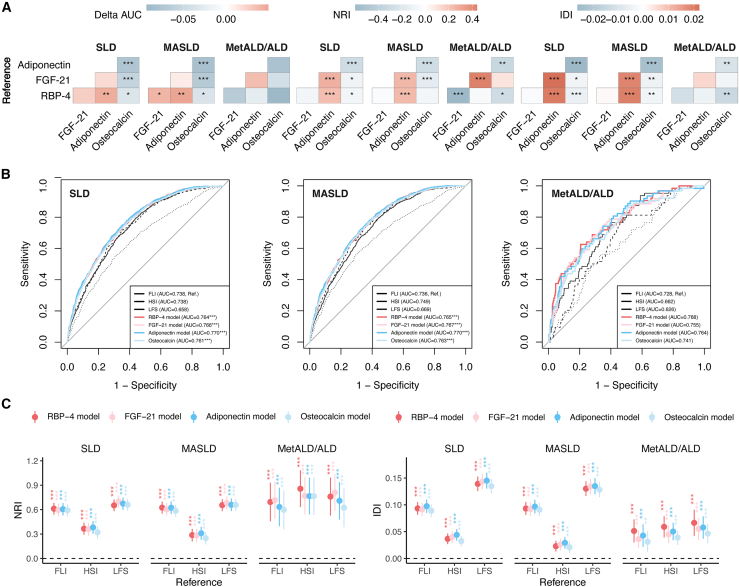
The effectiveness of established biomarkers for non-alcoholic fatty liver disease (NAFLD) within the updated framework of steatotic liver disease (SLD) remains uncertain. This cohort study examines the association of four metabolic biomarkers-retinol-binding protein 4 (RBP-4), fibroblast growth factor 21 (FGF-21), adiponectin, and osteocalcin-with SLD and its subtypes: metabolic dysfunction-associated steatotic liver disease (MASLD) and metabolic dysfunction with alcohol-related liver disease (MetALD)/alcohol-related liver disease (ALD). Among 3,504 Chinese participants aged 55-70, 938 (26.8%) have developed SLD over 5 years, including 871 with MASLD and 67 with MetALD/ALD. The findings indicate that models incorporating RBP-4, FGF-21, adiponectin, and osteocalcin improve predictive accuracy for SLD beyond conventional models. Notably, adiponectin emerges as the most versatile marker, while elevated baseline levels of FGF-21 or RBP-4 indicate specific needs for metabolic or alcohol-related interventions, respectively, supporting tailored precision medicine strategies.
在脂肪性肝病(SLD)的更新框架内,已确立的非酒精性脂肪性肝病(NAFLD)生物标志物的有效性仍不确定。这项队列研究考察了四种代谢生物标志物——视黄醇结合蛋白4(RBP - 4)、成纤维细胞生长因子21(FGF - 21)、脂联素和骨钙素——与SLD及其亚型:代谢功能障碍相关脂肪性肝病(MASLD)以及代谢功能障碍合并酒精性肝病(MetALD)/酒精性肝病(ALD)之间的关联。在3504名年龄在55至70岁的中国参与者中,938人(26.8%)在5年内患上了SLD,其中871人患有MASLD,67人患有MetALD/ALD。研究结果表明,纳入RBP - 4、FGF - 21、脂联素和骨钙素的模型比传统模型提高了对SLD的预测准确性。值得注意的是,脂联素成为最具通用性的标志物,而FGF - 21或RBP - 4的基线水平升高分别表明对代谢或酒精相关干预的特定需求,这支持了量身定制的精准医学策略。