Danis Ronald P, Lavine Jeremy A, Domalpally Amitha
Department of Ophthalmology and Visual Sciences, University of Wisconsin-Madison, Madison, WI, USA.
Clin Ophthalmol. 2015 Nov 20;9:2159-74. doi: 10.2147/OPTH.S92359. eCollection 2015.
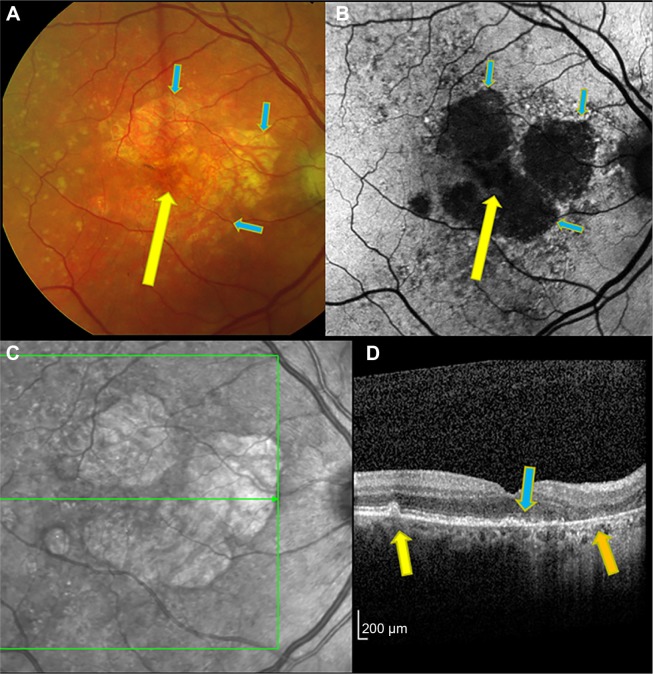
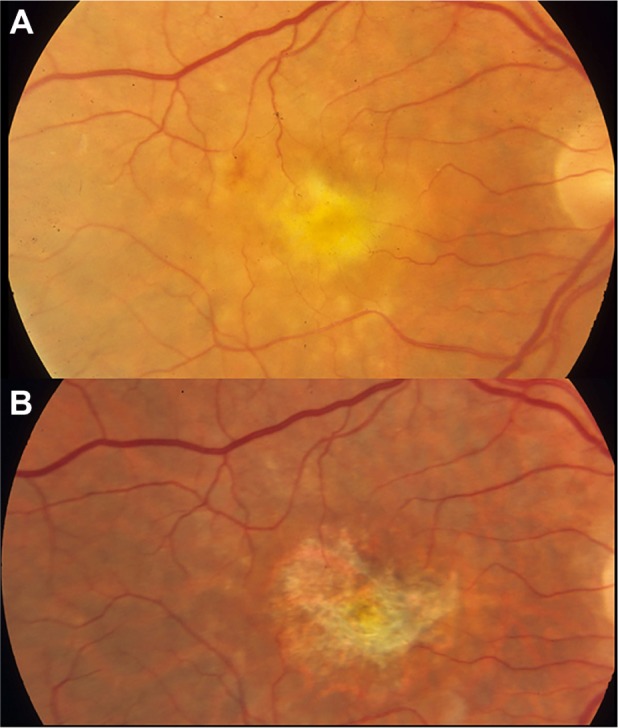
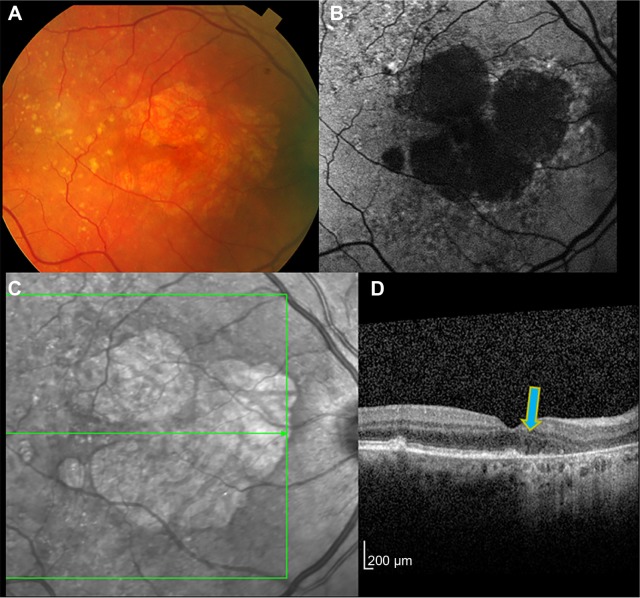
Geographic atrophy (GA) of the retinal pigment epithelium (RPE) is a devastating complication of age-related macular degeneration (AMD). GA may be classified as drusen-related (drusen-associated GA) or neovascularization-related (neovascular-associated GA). Drusen-related GA remains a large public health concern due to the burden of blindness it produces, but pathophysiology of the condition is obscure and there are no proven treatment options. Genotyping, cell biology, and clinical imaging point to upregulation of parainflammatory pathways, oxidative stress, and choroidal sclerosis as contributors, among other factors. Onset and monitoring of progression is accomplished through clinical imaging instrumentation such as optical coherence tomography, photography, and autofluorescence, which are the tools most helpful in determining end points for clinical trials at present. A number of treatment approaches with diverse targets are in development at this time, some of which are in human clinical trials. Neovascular-associated GA is a consequence of RPE loss after development of neovascular AMD. The neovascular process leads to a plethora of cellular stresses such as ischemia, inflammation, and dramatic changes in cell environment that further taxes RPE cells already dysfunctional from drusen-associated changes. GA may therefore develop secondary to the neovascular process de novo or preexisting drusen-associated GA may continue to worsen with the development of neovascular AMD. Neovascular-associated GA is a prominent cause of continued vision loss in patients with otherwise successfully treated neovascular AMD. Clearly, treatment with vascular endothelial growth factor (VEGF) inhibitors early in the course of the neovascular disease is of great clinical benefit. However, there is a rationale and some suggestive evidence that anti-VEGF agents themselves could be toxic to RPE and enhance neovascular-associated GA. The increasing prevalence of legal blindness from this condition due to the aging of the general population lends urgency to the search for a therapy to ameliorate GA.
视网膜色素上皮(RPE)的地图样萎缩(GA)是年龄相关性黄斑变性(AMD)的一种破坏性并发症。GA可分为与玻璃膜疣相关的(玻璃膜疣相关性GA)或与新生血管相关的(新生血管相关性GA)。由于其导致的失明负担,玻璃膜疣相关性GA仍然是一个重大的公共卫生问题,但该病症的病理生理学尚不清楚,且尚无经证实的治疗选择。基因分型、细胞生物学和临床成像表明,除其他因素外,旁炎症途径、氧化应激和脉络膜硬化的上调也是其促成因素。通过光学相干断层扫描、摄影和自发荧光等临床成像仪器来实现发病和进展监测,这些是目前最有助于确定临床试验终点的工具。目前正在研发多种具有不同靶点的治疗方法,其中一些正在进行人体临床试验。新生血管相关性GA是新生血管性AMD发生后RPE丧失的结果。新生血管过程会导致大量细胞应激,如缺血、炎症以及细胞环境的剧烈变化,这进一步加重了已经因玻璃膜疣相关变化而功能失调的RPE细胞的负担。因此,GA可能继发于新生血管过程,或者现有的玻璃膜疣相关性GA可能随着新生血管性AMD的发展而继续恶化。新生血管相关性GA是原本已成功治疗的新生血管性AMD患者持续视力丧失的一个主要原因。显然,在新生血管疾病早期用血管内皮生长因子(VEGF)抑制剂进行治疗具有重大临床益处。然而,有理论依据和一些提示性证据表明,抗VEGF药物本身可能对RPE有毒性,并会加重新生血管相关性GA。由于总体人群老龄化,这种疾病导致法定失明的患病率不断上升,这使得寻找改善GA的治疗方法变得紧迫。