Bian Xiaocui, Zhou Renlong, Yang Yuting, Li Peiying, Hang Yannan, Hu Youmin, Yang Liqun, Wen Daxiang
1. Department of Anesthesiology, Renji Hospital, School of Medicine, Shanghai Jiaotong University, Shanghai 200001, China;
2. Laboratory Room for Physiology, Pathophysiology & Pharmacology, School of Medicine, Shanghai Jiaotong University, Shanghai 200025, China.
Int J Med Sci. 2015 Oct 15;12(11):848-52. doi: 10.7150/ijms.12616. eCollection 2015.
Opioid induced bowel dysfunction is the most common side effect of preoperatively administrated morphine, fentanyl and its derivative. However, the influence of dezocine on intestinal mobility is rarely reported. This study was designed to investigate the effects of dezocine, morphine and sufentanil on both intestinal smooth muscle contraction and propulsion in rats.
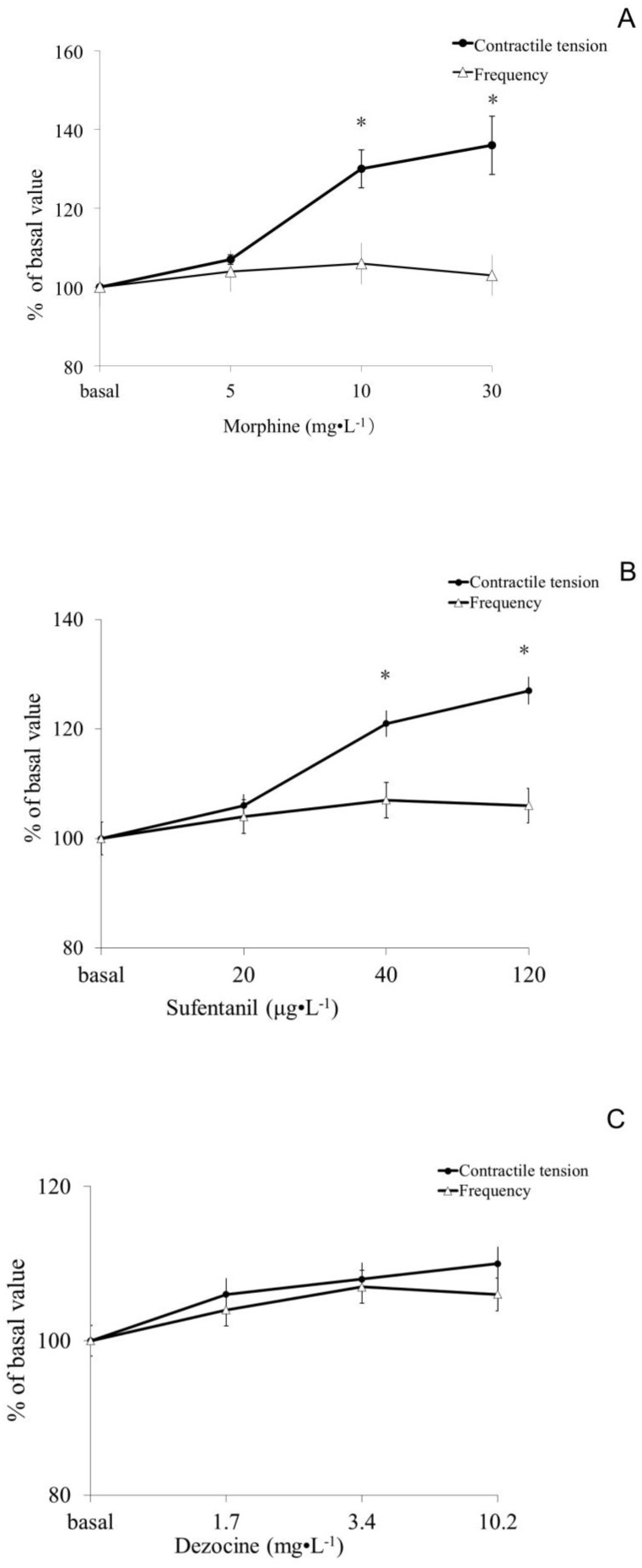
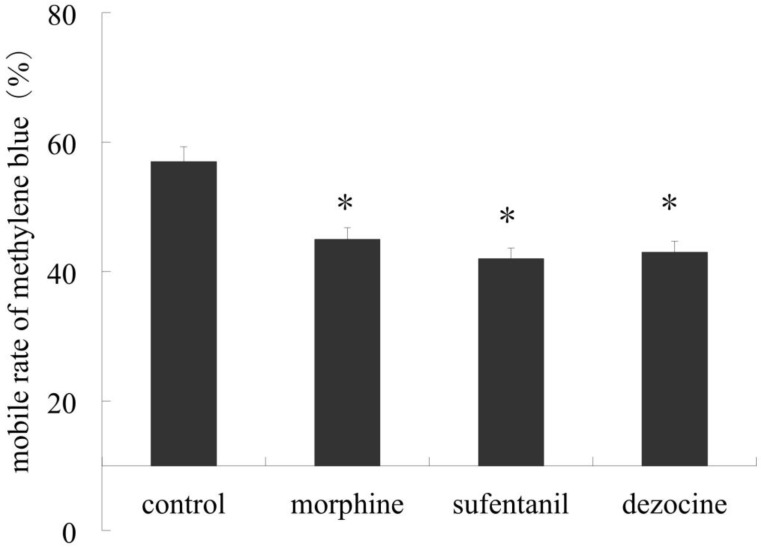
Contractile tension and frequency of isolated rat small intestine smooth muscle were measured using tension transducer after incubation with different concentrations of dezocine, morphine and sufentanil. The propulsive rate of methylene blue in rat intestinal tract was measured 30 minutes after intraperitoneal injection of morphine, sufentanil and dezocine. Percent of change in contractile tension and contraction frequency compared to baseline level were calculated to evaluate muscle contraction. Propulsive rate of methylene blue was calculated as the percentage of methylene blue moving distance in intestinal tract compared to the length of the small intestine.
Morphine and sufentanil significantly increased the contractile tension of isolated small intestine smooth muscle at high doses. The contraction frequency did not change significantly among the 3 tested doses. Increasing the dose of dezocine from 1.7 mg.L(-1) to 10.2 mg.L(-1) did not change either the contractile tension or the contraction frequency. The propulsive rate of methylene blue in intestinal tract was significantly decreased after the treatment with morphine, sufentanil and dezocine (45.6%, 43.7%, and 42.1% respectively) compared to control group(57.1%), while the difference among the 3 drug groups were not significant.
Morphine and sufentanil may dose dependently increase the contractile tension and contraction ability of isolated rat small intestine smooth muscle, while dezocine has no significant effect on intestine smooth muscle contraction. However, all these opioids might impair small intestinal propulsion.
阿片类药物引起的肠道功能障碍是术前给予吗啡、芬太尼及其衍生物最常见的副作用。然而,地佐辛对肠道蠕动的影响鲜有报道。本研究旨在探讨地佐辛、吗啡和舒芬太尼对大鼠肠道平滑肌收缩和推进的影响。
将不同浓度的地佐辛、吗啡和舒芬太尼与离体大鼠小肠平滑肌孵育后,使用张力换能器测量其收缩张力和频率。腹腔注射吗啡、舒芬太尼和地佐辛30分钟后,测量大鼠肠道中甲基蓝的推进率。计算收缩张力和收缩频率相对于基线水平的变化百分比,以评估肌肉收缩情况。甲基蓝推进率以甲基蓝在肠道中的移动距离占小肠长度的百分比计算。
高剂量时,吗啡和舒芬太尼显著增加离体小肠平滑肌的收缩张力。在3个测试剂量中,收缩频率无显著变化。将地佐辛剂量从1.7mg·L⁻¹增加到10.2mg·L⁻¹,收缩张力和收缩频率均未改变。与对照组(57.1%)相比,吗啡、舒芬太尼和地佐辛处理后肠道中甲基蓝的推进率显著降低(分别为45.6%、43.7%和42.1%),而3个药物组之间的差异不显著。
吗啡和舒芬太尼可能剂量依赖性地增加离体大鼠小肠平滑肌的收缩张力和收缩能力,而地佐辛对肠道平滑肌收缩无显著影响。然而,所有这些阿片类药物可能都会损害小肠推进功能。