Bekliz Meriem, Verneau Jonathan, Benamar Samia, Raoult Didier, La Scola Bernard, Colson Philippe
URMITE, UM 63, Centre National de la Recherche Scientifique 7278, IRD 198, INSERM U1095, Aix-Marseille University Marseille, France.
URMITE, UM 63, Centre National de la Recherche Scientifique 7278, IRD 198, INSERM U1095, Aix-Marseille University Marseille, France ; IHU Méditerranée Infection, Pôle des Maladies Infectieuses et Tropicales Clinique et Biologique, Fédération de Bactériologie-Hygiène-Virologie, Centre Hospitalo-Universitaire Timone Marseille, France ; Special Infectious Agents Unit, King Fahd Medical Research Center, King Abdulaziz University Jeddah, Saudi Arabia.
Front Microbiol. 2015 Nov 27;6:1308. doi: 10.3389/fmicb.2015.01308. eCollection 2015.
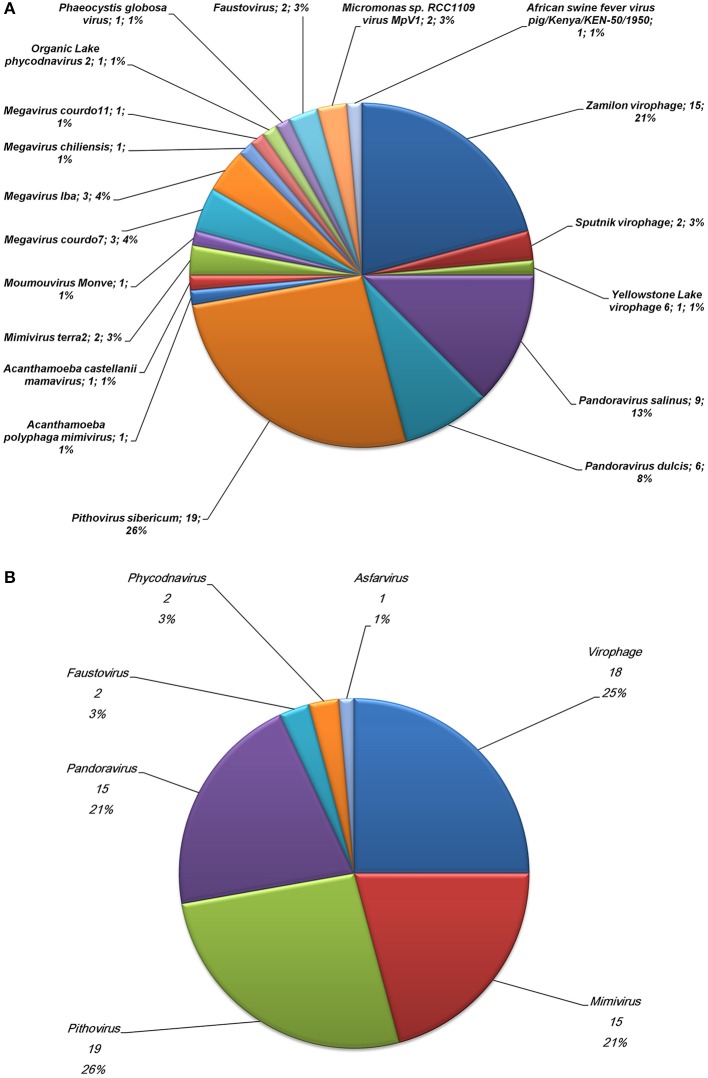
Virophages replicate within viral factories inside the Acanthamoeba cytoplasm, and decrease the infectivity and replication of their associated giant viruses. Culture isolation and metagenome analyses have suggested that they are common in our environment. By screening metagenomic databases in search of amoebal viruses, we detected virophage-related sequences among sequences generated from the same non-aerated bioreactor metagenome as recently screened by another team for virophage capsid-encoding genes. We describe here the assembled partial genome of a virophage closely related to Zamilon, which infects Acanthamoeba with mimiviruses of lineages B and C but not A. Searches for sequences related to amoebal giant viruses, other Megavirales representatives and virophages were conducted using BLAST against this bioreactor metagenome (PRJNA73603). Comparative genomic and phylogenetic analyses were performed using sequences from previously identified virophages. A total of 72 metagenome contigs generated from the bioreactor were identified as best matching with sequences from Megavirales representatives, mostly Pithovirus sibericum, pandoraviruses and amoebal mimiviruses from three lineages A-C, as well as from virophages. In addition, a partial genome from a Zamilon-like virophage, we named Zamilon 2, was assembled. This genome has a size of 6716 base pairs, corresponding to 39% of the Zamilon genome, and comprises partial or full-length homologs for 15 Zamilon predicted open reading frames (ORFs). Mean nucleotide and amino acid identities for these 15 Zamilon 2 ORFs with their Zamilon counterparts were 89% (range, 81-96%) and 91% (range, 78-99%), respectively. Notably, these ORFs included two encoding a capsid protein and a packaging ATPase. Comparative genomics and phylogenetic analyses indicated that the partial genome was that of a new Zamilon-like virophage. Further studies are needed to gain better knowledge of the tropism and prevalence of virophages in our biosphere and in humans.
病毒噬菌体在棘阿米巴细胞质内的病毒工厂中复制,并降低其相关巨型病毒的感染力和复制能力。培养物分离和宏基因组分析表明它们在我们的环境中很常见。通过筛选宏基因组数据库以寻找阿米巴病毒,我们在与另一个团队最近筛选病毒噬菌体衣壳编码基因的同一非曝气生物反应器宏基因组产生的序列中检测到了与病毒噬菌体相关的序列。我们在此描述了一种与扎米隆密切相关的病毒噬菌体的组装部分基因组,它感染B和C谱系但不感染A谱系的带有米米病毒的棘阿米巴。使用BLAST在这个生物反应器宏基因组(PRJNA73603)中搜索与阿米巴巨型病毒、其他巨病毒目代表和病毒噬菌体相关的序列。使用先前鉴定的病毒噬菌体的序列进行了比较基因组学和系统发育分析。从该生物反应器产生的总共72个宏基因组重叠群被鉴定为与巨病毒目代表的序列最匹配,主要是来自A - C三个谱系的西伯利亚髓病毒、潘多拉病毒和阿米巴米米病毒,以及病毒噬菌体。此外,组装了一个来自类似扎米隆的病毒噬菌体的部分基因组,我们将其命名为扎米隆2。这个基因组大小为6716个碱基对,相当于扎米隆基因组的百分之三十九,并且包含15个扎米隆预测开放阅读框(ORF)的部分或全长同源物。这15个扎米隆2的ORF与其扎米隆对应物的平均核苷酸和氨基酸同一性分别为89%(范围为81 - 96%)和91%(范围为78 - 99%)。值得注意的是,这些ORF包括两个编码衣壳蛋白和一个包装ATP酶的基因。比较基因组学和系统发育分析表明该部分基因组属于一种新的类似扎米隆的病毒噬菌体。需要进一步研究以更好地了解病毒噬菌体在我们的生物圈和人类中的嗜性和流行情况。