Zhang Xiaoyu, Zheng Hang, Zhu Hong-Yan, Hu Shufen, Wang Shusheng, Jiang Xinghong, Xu Guang-Yin
Jiangsu Key Laboratory of Translational Research and Therapy for Neuro-Psycho-Diseases, Institute of Neuroscience, Soochow University, Suzhou, China.
Center for Translational Medicine, the Affiliated Zhangjiagang Hospital of Soochow University, Zhangjiagang, China.
J Neurogastroenterol Motil. 2016 Apr 30;22(2):333-43. doi: 10.5056/jnm15127.
BACKGROUND/AIMS: This study was to investigate whether transforming growth factor-β1 (TGF-β1) plays a role in hyperalgesia in chronic pancreatitis (CP) and the underlying mechanisms.
CP was induced in male adult rats by intraductal injection of trinitrobenzene sulfonic acid (TNBS). Abdominal hyperalgesia was assessed by referred somatic behaviors to mechanical stimulation of rat abdomen. Dil dye injected into the pancreas was used to label pancreas-specific dorsal root ganglion (DRG) neurons. Whole cell patch clamp recordings and calcium imaging were performed to examine the effect of TGF-β1 on acutely isolated pancreas-specific DRG neurons. Western blot analysis was carried out to measure the expression of TGF-β1 and its receptors.
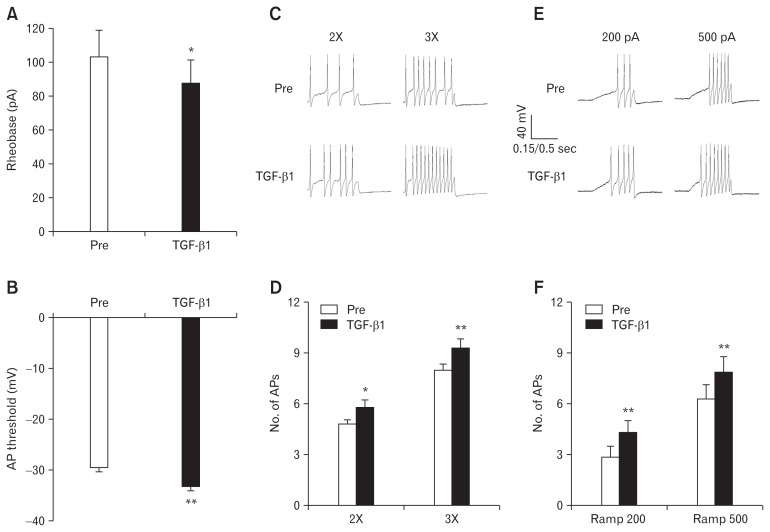
TNBS injection significantly upregulated expression of TGF-β1 in the pancreas and DRGs, and TGF-β1 receptors in DRGs (T9-T13)in CP rats. Intrathecal injection of TGF-β receptor I antagonist SB431542 attenuated abdominal hyperalgesia in CP rats. TGF-β1 application depolarized the membrane potential and caused firing activity of DRG neurons. TGF-β1 application also reduced rheobase, hyperpolarized action potential threshold, and increased numbers of action potentials evoked by current injection of pancreas-specific DRG neurons. TGF-β1 application also increased the concentration of intracellular calcium of DRG neurons, which was inhibited by SB431542. Furthermore, intrathecal injection of TGF-β1 produced abdominal hyperalgesia in healthy rats.
These results suggest that TGF-β1 enhances neuronal excitability and increases the concentration of intracellular calcium. TGF-β1 and its receptors are involved in abdominal hyperalgesia in CP. This and future study might identify a potentially novel target for the treatment of abdominal pain in CP.
背景/目的:本研究旨在探讨转化生长因子-β1(TGF-β1)在慢性胰腺炎(CP)痛觉过敏中是否起作用及其潜在机制。
通过向成年雄性大鼠胰管内注射三硝基苯磺酸(TNBS)诱导CP。通过对大鼠腹部机械刺激引发的躯体行为来评估腹部痛觉过敏。将稀释染料注入胰腺以标记胰腺特异性背根神经节(DRG)神经元。采用全细胞膜片钳记录和钙成像技术,检测TGF-β1对急性分离的胰腺特异性DRG神经元的影响。进行蛋白质免疫印迹分析以测定TGF-β1及其受体的表达。
TNBS注射显著上调了CP大鼠胰腺和DRG中TGF-β1的表达,以及DRG(T9 - T13)中TGF-β1受体的表达。鞘内注射TGF-β受体I拮抗剂SB431542可减轻CP大鼠的腹部痛觉过敏。应用TGF-β1可使DRG神经元膜电位去极化并引发放电活动。应用TGF-β1还降低了基强度,使动作电位阈值超极化,并增加了胰腺特异性DRG神经元电流注入诱发的动作电位数量。应用TGF-β1还增加了DRG神经元的细胞内钙浓度,这一作用被SB431542抑制。此外,鞘内注射TGF-β1可使健康大鼠产生腹部痛觉过敏。
这些结果表明,TGF-β1增强神经元兴奋性并增加细胞内钙浓度。TGF-β1及其受体参与了CP的腹部痛觉过敏。本研究及未来研究可能会确定一个治疗CP腹痛的潜在新靶点。