Pommerening H, van Dullemen S, Kieslich M, Schubert R, Zielen S, Voss S
Children's Hospital, Allergology, Pneumology and Cystic Fibrosis, Goethe-University Theodor-Stern Kai, Frankfurt/Main, Germany.
Orphanet J Rare Dis. 2015 Dec 9;10:155. doi: 10.1186/s13023-015-0373-z.
Ataxia-telangiectasia (A-T) is a devastating human autosomal recessive disorder that causes progressive cerebellar ataxia, immunodeficiency, premature aging, chromosomal instability and increased cancer risk. Affected patients show growth failure, poor weight gain, low body mass index (BMI), myopenia and increased fatigue during adolescence. The prevalence of alterations in body composition, muscle strength and hormonal status has not been well described in classical A-T patients. Additionally, no current guidelines are available for the assessment and management of these changes.
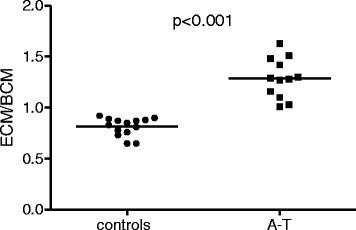
We analyzed body composition, manual muscle strength and hormonal status in 25 A-T patients and 26 age-matched, healthy controls. Bioelectrical impedance analysis (BIA) was performed to evaluate the body composition, fat-free mass (FFM), body cell mass (BCM), extracellular matrix (ECM), phase angle (PhA), fat mass (FM) and ECM to BCM ratio. Manual muscle strength was measured using a hydraulic hand dynamometer.
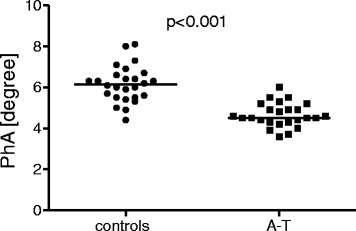
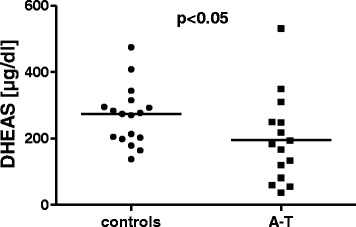
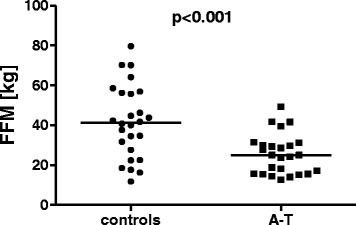
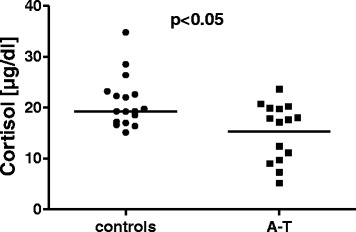
The BMI, FFM and PhA were significantly lower in A-T patients than in controls (BMI 16.56 ± 3.52 kg/m(2) vs. 19.86 ± 3.54 kg/m(2); Z-Score: -1.24 ± 1.29 vs. 0.05 ± 0.92, p <0.001; FFM 25.4 ± 10.03 kg vs. 41.77 ± 18.25 kg, p < 0.001; PhA: 4.6 ± 0.58° vs. 6.15 ± 0.88°, p < 0.001). Manual muscle strength was significantly impaired in A-T patients compared with controls (10.65 ± 10.97 kg vs. 26.8 ± 30.39 kg, p < 0.0001). In addition, cortisol and dehydroepiandrosterone sulfate (DHEAS) levels were significantly lower in A-T patients than in controls.
Altered body composition, characterized by depleted BMI, PhA and BCM; by the need to sit in a wheelchair; by altered hormone levels; and by poor muscle strength, is a major factor underlying disease progression and increased fatigue in A-T patients.
ClinicalTrials.gov NCT02345200.
共济失调毛细血管扩张症(A-T)是一种严重的人类常染色体隐性疾病,可导致进行性小脑共济失调、免疫缺陷、早衰、染色体不稳定和癌症风险增加。受影响的患者在青春期会出现生长发育迟缓、体重增加缓慢、低体重指数(BMI)、肌肉减少和疲劳加剧。经典A-T患者身体成分、肌肉力量和激素状态改变的患病率尚未得到充分描述。此外,目前尚无针对这些变化的评估和管理指南。
我们分析了25例A-T患者和26例年龄匹配的健康对照者的身体成分、手动肌力和激素状态。采用生物电阻抗分析(BIA)评估身体成分、去脂体重(FFM)、身体细胞质量(BCM)、细胞外基质(ECM)、相位角(PhA)、脂肪量(FM)以及ECM与BCM的比值。使用液压式握力计测量手动肌力。
A-T患者的BMI、FFM和PhA显著低于对照组(BMI 16.56±3.52kg/m² vs. 19.86±3.54kg/m²;Z评分:-1.24±1.29 vs. 0.05±0.92,p<0.001;FFM 25.4±10.03kg vs. 41.77±18.25kg,p<0.001;PhA:4.6±0.58° vs. 6.15±0.88°,p<0.001)。与对照组相比,A-T患者的手动肌力明显受损(10.65±10.97kg vs. 26.8±30.39kg,p<0.0001)。此外,A-T患者的皮质醇和硫酸脱氢表雄酮(DHEAS)水平显著低于对照组。
身体成分改变,表现为BMI、PhA和BCM降低,需要坐轮椅,激素水平改变以及肌肉力量差,是A-T患者疾病进展和疲劳加剧的主要因素。
ClinicalTrials.gov NCT02345200。