Askew Chris, Reynolds Gemma, Fielding-Smith Sarah, Field Andy P
Department of Psychology, Kingston University.
School of Psychology, University of Sussex.
J Abnorm Psychol. 2016 Feb;125(2):279-291. doi: 10.1037/abn0000131. Epub 2015 Dec 14.
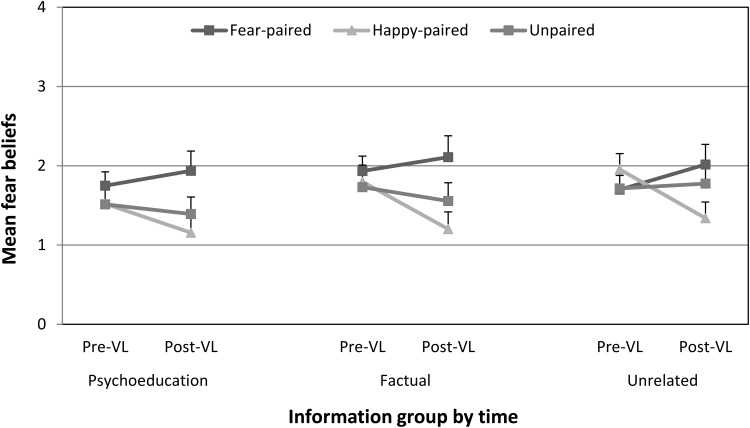
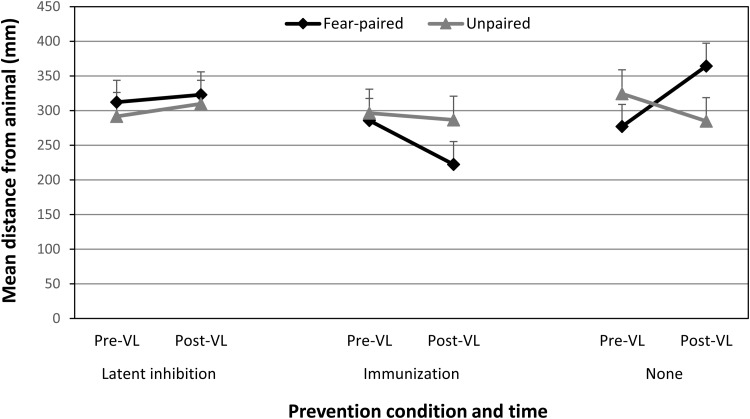
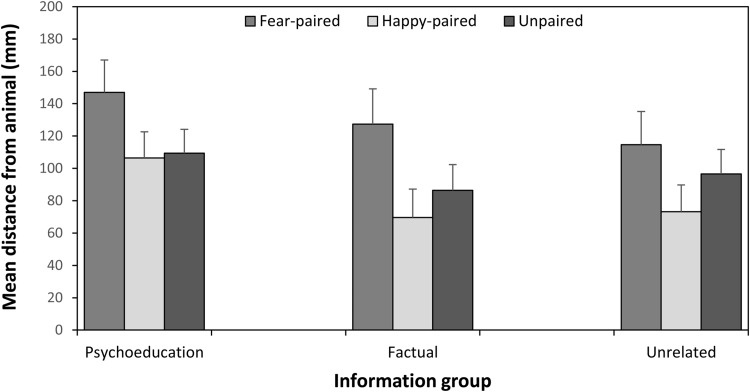
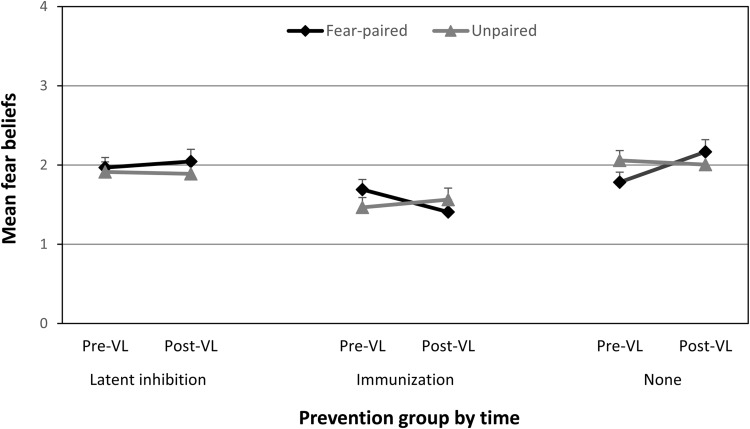
One of the challenges to conditioning models of fear acquisition is to explain how different individuals can experience similar learning events and only some of them subsequently develop fear. Understanding factors moderating the impact of learning events on fear acquisition is key to understanding the etiology and prevention of fear in childhood. This study investigates these moderators in the context of vicarious (observational) learning. Two experiments tested predictions that the acquisition or inhibition of fear via vicarious learning is driven by associative learning mechanisms similar to direct conditioning. In Experiment 1, 3 groups of children aged 7 to 9 years received 1 of 3 inhibitive information interventions-psychoeducation, factual information, or no information (control)-prior to taking part in a vicarious fear learning procedure. In Experiment 2, 3 groups of children aged 7 to 10 years received 1 of 3 observational learning interventions-positive modeling (immunization), observational familiarity (latent inhibition), or no prevention (control)-before vicarious fear learning. Results indicated that observationally delivered manipulations inhibited vicarious fear learning, while preventions presented via written information did not. These findings confirm that vicarious learning shares some of the characteristics of direct conditioning and can explain why not all individuals will develop fear following a vicarious learning event. They also suggest that the modality of inhibitive learning is important and should match the fear learning pathway for increased chances of inhibition. Finally, the results demonstrate that positive modeling is likely to be a particularly effective method for preventing fear-related observational learning in children.
恐惧习得条件模型面临的挑战之一是解释为何不同个体经历相似的学习事件,却只有部分人随后会产生恐惧。了解调节学习事件对恐惧习得影响的因素,是理解儿童期恐惧的病因及预防的关键。本研究在替代性(观察性)学习背景下探究这些调节因素。两项实验检验了以下预测:通过替代性学习习得或抑制恐惧是由类似于直接条件作用的联想学习机制驱动的。在实验1中,三组7至9岁的儿童在参与替代性恐惧学习程序之前,分别接受了三种抑制性信息干预中的一种——心理教育、事实性信息或无信息(对照组)。在实验2中,三组7至10岁的儿童在替代性恐惧学习之前,分别接受了三种观察性学习干预中的一种——积极示范(免疫)、观察熟悉度(潜伏抑制)或无预防措施(对照组)。结果表明,通过观察传递的操作会抑制替代性恐惧学习,而通过书面信息呈现的预防措施则不会。这些发现证实,替代性学习具有直接条件作用的一些特征,并且可以解释为什么并非所有个体在经历替代性学习事件后都会产生恐惧。它们还表明,抑制性学习的方式很重要,并且应该与恐惧学习途径相匹配,以增加抑制的机会。最后,结果表明积极示范可能是预防儿童恐惧相关观察性学习的一种特别有效的方法。