Bublatzky Florian, Riemer Martin, Guerra Pedro
Department of Psychosomatic Medicine and Psychotherapy, Central Institute of Mental Health Mannheim, Medical Faculty Mannheim/Heidelberg University, Mannheim, Germany.
Department of Psychology, School of Social Sciences, University of Mannheim, Mannheim, Germany.
Front Psychol. 2019 Sep 13;10:2091. doi: 10.3389/fpsyg.2019.02091. eCollection 2019.
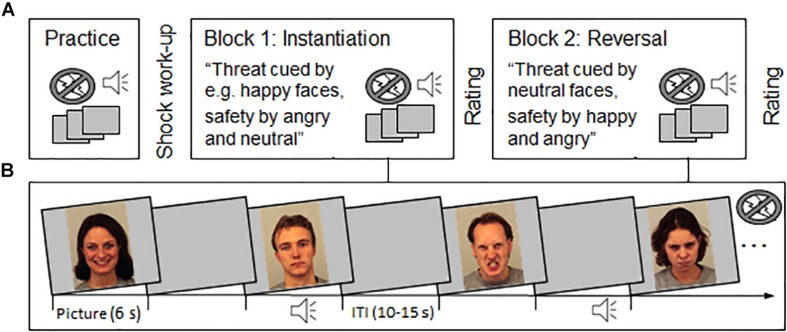
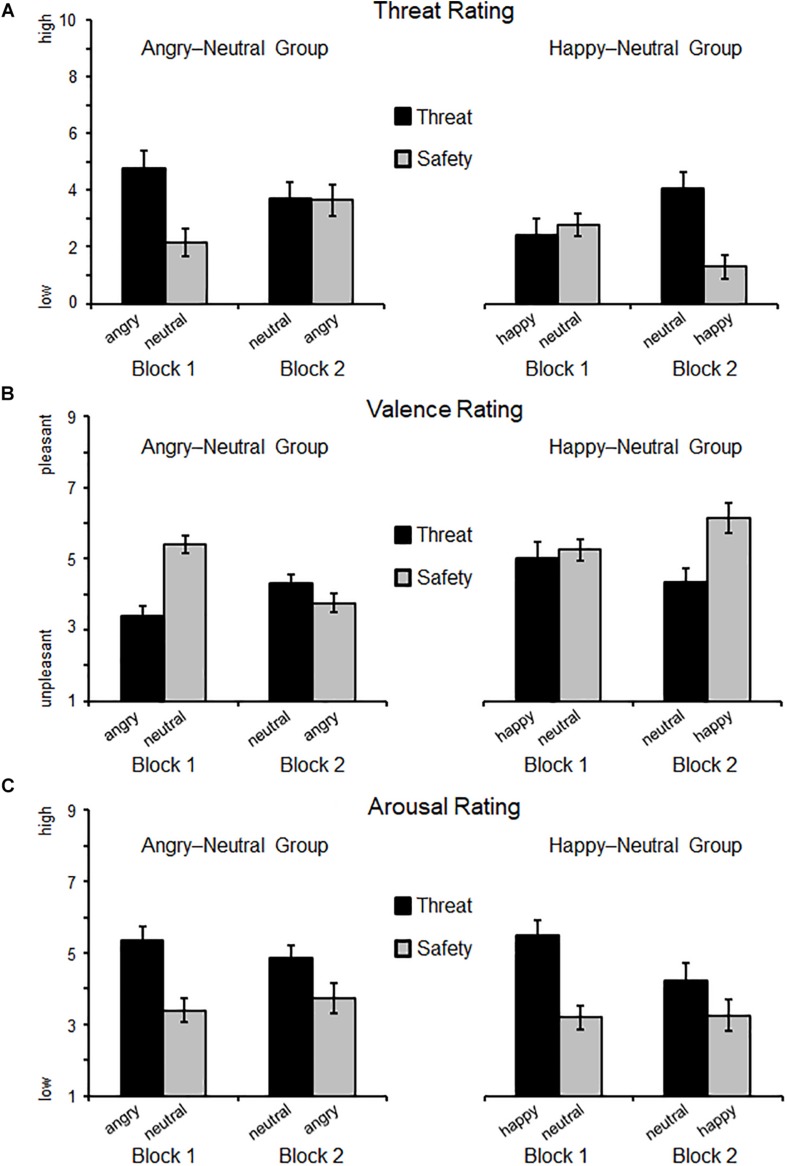
Facial expressions inform about other peoples' emotion and motivation and thus are central for social communication. However, the meaning of facial expressions may change depending on what we have learned about the related consequences. For instance, a smile might easily become threatening when displayed by a person who is known to be dangerous. The present study examined the malleability of emotional facial valence by means of social learning. To this end, facial expressions served as cues for verbally instructed threat-of-shock or safety (e.g., "happy faces cue shocks"). Moreover, reversal instructions tested the flexibility of threat/safety associations (e.g., "now happy faces cue safety"). Throughout the experiment, happy, neutral, and angry facial expressions were presented and auditory startle probes elicited defensive reflex activity. Results show that self-reported ratings and physiological reactions to threat/safety cues dissociate. Regarding threat and valence ratings, happy facial expressions tended to be more resistant becoming a threat cue, and angry faces remain threatening even when instructed as safety cue. For physiological response systems, however, we observed threat-potentiated startle reflex and enhanced skin conductance responses for threat compared to safety cues regardless of whether threat was cued by happy or angry faces. Thus, the incongruity of visual and verbal threat/safety information modulates conscious perception, but not the activation of physiological response systems. These results show that verbal instructions can readily overwrite the intrinsic meaning of facial emotions, with clear benefits for social communication as learning and anticipation of threat and safety readjusted to accurately track environmental changes.
面部表情传达他人的情感和动机,因此是社交沟通的核心。然而,面部表情的含义可能会因我们对相关后果的了解而改变。例如,当一个已知危险的人露出微笑时,这微笑可能很容易变得具有威胁性。本研究通过社会学习考察了情绪性面部效价的可塑性。为此,面部表情作为口头指示电击威胁或安全的线索(例如,“笑脸预示电击”)。此外,反转指示测试了威胁/安全关联的灵活性(例如,“现在笑脸预示安全”)。在整个实验过程中,呈现快乐、中性和愤怒的面部表情,听觉惊吓探针引发防御性反射活动。结果表明,自我报告的评分与对威胁/安全线索的生理反应相分离。关于威胁和效价评分,快乐的面部表情往往更难成为威胁线索,而愤怒的面孔即使被指示为安全线索时仍保持威胁性。然而,对于生理反应系统,我们观察到与安全线索相比,无论威胁是由快乐面孔还是愤怒面孔提示,威胁都会增强惊吓反射并增强皮肤电导反应。因此,视觉和言语威胁/安全信息的不一致调节了意识感知,但没有调节生理反应系统的激活。这些结果表明,言语指示可以轻易覆盖面部情绪的内在含义,这对社交沟通有明显的好处,因为对威胁和安全的学习和预期会重新调整以准确跟踪环境变化。