Tanaka Motoko, Robinson Bridget A, Chutiraka Kasana, Geary Clair D, Reed Jonathan C, Lingappa Jaisri R
Department of Global Health, University of Washington, Seattle, Washington, USA.
Department of Global Health, University of Washington, Seattle, Washington, USA Departments of Medicine and Microbiology, University of Washington, Seattle, Washington, USA
J Virol. 2015 Dec 9;90(4):1944-63. doi: 10.1128/JVI.02698-15. Print 2016 Feb 15.
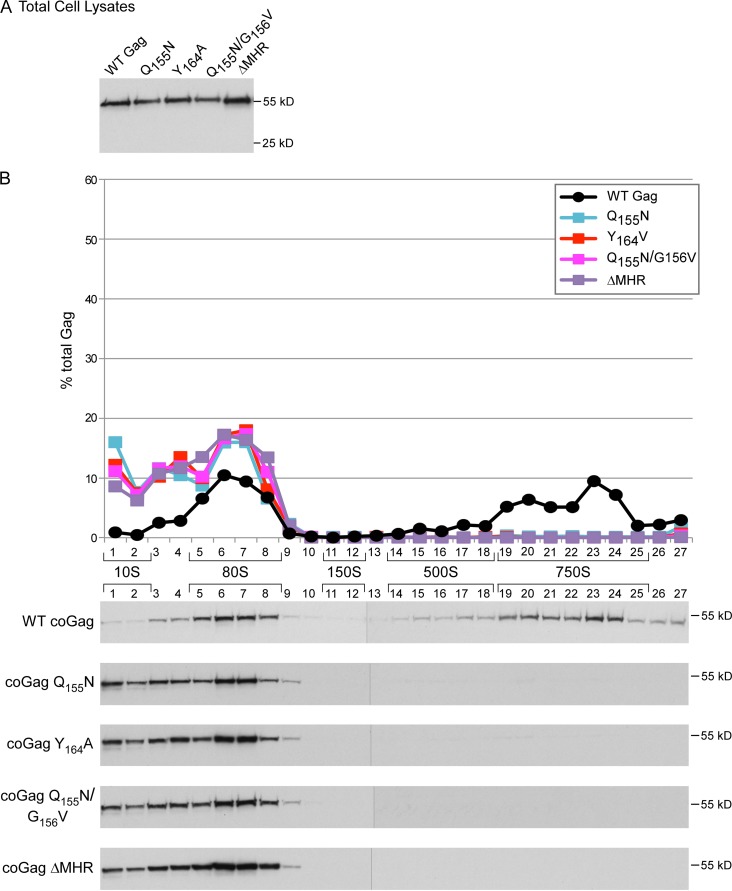
The major homology region (MHR) is a highly conserved motif that is found within the Gag protein of all orthoretroviruses and some retrotransposons. While it is widely accepted that the MHR is critical for assembly of HIV-1 and other retroviruses, how the MHR functions and why it is so highly conserved are not understood. Moreover, consensus is lacking on when HIV-1 MHR residues function during assembly. Here, we first addressed previous conflicting reports by confirming that MHR deletion, like conserved MHR residue substitution, leads to a dramatic reduction in particle production in human and nonhuman primate cells expressing HIV-1 proviruses. Next, we used biochemical analyses and immunoelectron microscopy to demonstrate that conserved residues in the MHR are required after assembling Gag has associated with genomic RNA, recruited critical host factors involved in assembly, and targeted to the plasma membrane. The exact point of inhibition at the plasma membrane differed depending on the specific mutation, with one MHR mutant arrested as a membrane-associated intermediate that is stable upon high-salt treatment and other MHR mutants arrested as labile, membrane-associated intermediates. Finally, we observed the same assembly-defective phenotypes when the MHR deletion or conserved MHR residue substitutions were engineered into Gag from a subtype B, lab-adapted provirus or Gag from a subtype C primary isolate that was codon optimized. Together, our data support a model in which MHR residues act just after membrane targeting, with some MHR residues promoting stability and another promoting multimerization of the membrane-targeted assembling Gag oligomer.
The retroviral Gag protein exhibits extensive amino acid sequence variation overall; however, one region of Gag, termed the major homology region, is conserved among all retroviruses and even some yeast retrotransposons, although the reason for this conservation remains poorly understood. Highly conserved residues in the major homology region are required for assembly of retroviruses; however, when these residues are required during assembly is not clear. Here, we used biochemical and electron microscopic analyses to demonstrate that these conserved residues function after assembling HIV-1 Gag has associated with genomic RNA, recruited critical host factors involved in assembly, and targeted to the plasma membrane but before Gag has completed the assembly process. By revealing precisely when conserved residues in the major homology region are required during assembly, these studies resolve existing controversies and set the stage for future experiments aimed at a more complete understanding of how the major homology region functions.
主要同源区域(MHR)是一种高度保守的基序,存在于所有正逆转录病毒和一些逆转录转座子的Gag蛋白中。虽然人们普遍认为MHR对HIV-1和其他逆转录病毒的组装至关重要,但其作用方式以及为何如此高度保守尚不清楚。此外,对于HIV-1 MHR残基在组装过程中何时发挥作用也缺乏共识。在此,我们首先通过确认MHR缺失(类似于保守MHR残基替换)会导致表达HIV-1前病毒的人类和非人类灵长类细胞中病毒颗粒产生显著减少,解决了先前相互矛盾的报道。接下来,我们使用生化分析和免疫电子显微镜来证明,在Gag与基因组RNA结合、招募参与组装的关键宿主因子并靶向质膜之后,MHR中的保守残基是必需的。在质膜处的具体抑制点因特定突变而异,一种MHR突变体停滞为与膜相关的中间体,在高盐处理下稳定,而其他MHR突变体停滞为不稳定的、与膜相关的中间体。最后,当将MHR缺失或保守MHR残基替换引入B亚型实验室适应前病毒的Gag或密码子优化的C亚型原代分离株的Gag中时,我们观察到了相同的组装缺陷表型。总之,我们的数据支持一个模型,即MHR残基在膜靶向之后立即起作用,一些MHR残基促进稳定性,另一些促进靶向膜的组装Gag寡聚体的多聚化。
逆转录病毒Gag蛋白总体上表现出广泛的氨基酸序列变异;然而,Gag的一个区域,即主要同源区域,在所有逆转录病毒甚至一些酵母逆转录转座子中都是保守的,尽管这种保守的原因仍知之甚少。主要同源区域中的高度保守残基是逆转录病毒组装所必需的;然而,这些残基在组装过程中何时需要尚不清楚。在此,我们使用生化和电子显微镜分析来证明,这些保守残基在组装的HIV-1 Gag与基因组RNA结合、招募参与组装的关键宿主因子并靶向质膜之后但在Gag完成组装过程之前发挥作用。通过精确揭示主要同源区域中的保守残基在组装过程中何时需要,这些研究解决了现有争议,并为未来旨在更全面了解主要同源区域功能的实验奠定了基础。