Narahari Saravu R, Aggithaya Madhur G, Thamban Chendalam, Muralidharan Kunnathody, Kanjarpane Aniruddha B
Institute of Applied Dermatology, Kasaragod, Kerala, India.
Social Science division, Central Plantation Crops Research Institute, Kudlu, Kasaragod, Kerala, India.
Ayu. 2014 Jul-Sep;35(3):243-51. doi: 10.4103/0974-8520.153734.
Research methodology in traditional Indian system of medicine.
To determine the knowledge level of investigators conducting clinical trials in traditional medicines (TMs) including Ayurveda.
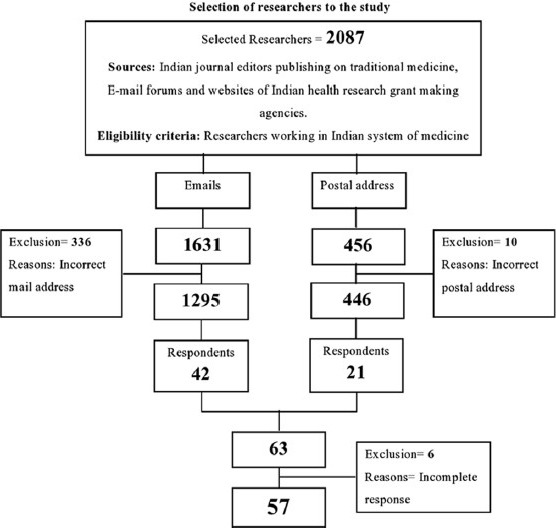
This was a questionnaire survey conducted for selected researchers trained in any specialty and working in TM. 2087 researchers were selected based on selection criteria. A validated and pretested questionnaire containing the questions regarding regulatory issues, literature search, evidence-based medicine, clinical trial design, patient selection, and study reporting were sent either through E-mail or post. The answered questionnaires were analyzed. The parameters were analyzed based on median and interquartile range (IQR).
Forty two responses were received through E-mail and 21 researchers responded through post. Out of 63, six researchers sent incomplete responses. Among the remaining 57 respondents; 34 (59.6%) investigators had postdoctoral degree, 43 investigators (75.4%) did not receive any structured training on research methodology, 23 (40.4%) had two decades of research experience. Thirty three (74%) of investigators who received government funding didn't have any training on research methodology. Ayurveda experts group had better knowledge compared to pharmaceutical sciences and basic science group although they had a dilemma about conducting clinical evaluation of TM within the specific framework of rigorous clinical pharmacological principles without ignoring the Ayurvedic concepts such as Dosha, Prakruti etc., Investigators below 30 years possessed higher knowledge of research methodology when analyzed based on the age. The respondents working in research organizations, government organizations, and academic institutions had lower knowledge compared to those who were in private organizations/practice.
It is recommend that investigators, peer reviewers, and fund managers involved in traditional medicine research need training especially in research methodology.
印度传统医学体系中的研究方法。
确定从事包括阿育吠陀在内的传统医学(TMs)临床试验的研究人员的知识水平。
这是一项针对选定的在任何专业接受过培训并从事传统医学工作的研究人员进行的问卷调查。根据选择标准挑选了2087名研究人员。通过电子邮件或邮寄方式发送一份经过验证和预测试的问卷,其中包含有关监管问题、文献检索、循证医学、临床试验设计、患者选择和研究报告的问题。对回收的问卷进行分析。基于中位数和四分位间距(IQR)对参数进行分析。
通过电子邮件收到42份回复,21名研究人员通过邮寄回复。在63份回复中,有6名研究人员的回复不完整。在其余57名受访者中;34名(59.6%)研究人员拥有博士后学位,43名研究人员(75.4%)未接受过任何关于研究方法的结构化培训,23名(40.4%)有二十年的研究经验。获得政府资助的研究人员中有33名(74%)没有接受过研究方法方面的培训。阿育吠陀专家组比药学和基础科学组有更好的知识,尽管他们在不忽视诸如 Dosha、Prakruti 等阿育吠陀概念的情况下,在严格的临床药理学原则的特定框架内进行传统医学的临床评估方面存在困境。按年龄分析时,30岁以下的研究人员对研究方法的知识掌握程度更高。在研究机构、政府组织和学术机构工作的受访者与在私人组织/实践中的受访者相比,知识水平较低。
建议参与传统医学研究的研究人员、同行评审人员和基金管理人员需要接受培训,尤其是在研究方法方面。