Martinez-Ibeas A M, Power Clare, McClure Jennifer, Sayers Riona G
Animal and Biosciences Department, Animal & Grassland Research and Innovation Centre, Teagasc, Moorepark, Fermoy, Co. Cork, Ireland.
Institute of Technology Carlow, Kilkenny Road, Carlow, Co. Carlow, Ireland.
Ir Vet J. 2015 Dec 9;68:28. doi: 10.1186/s13620-015-0059-9. eCollection 2015.
BVD and IBR are contagious viral diseases highly prevalent in Irish cattle. Despite their significant reproductive and economic impact very little is known about the BVD and IBR status of stock bulls (a bull used for breeding purposes). There are still a high proportion of dairy farms in Ireland that rely on the use of a bull for breeding cattle and ensuring the fertility of the bulls is of paramount importance for the efficiency of the farms. The prevalence of BoHV-1 and BVD in stock bulls in Irish dairy herds has never been investigated. The objectives of this study therefore were: (i) to provide descriptive, observational data on the use of stock bulls on Irish dairy farms; (ii) to investigate the BVD and BoHV1 status of a sub-set of stock bulls; (iii) to investigate factors associated with BVD and BoHV1 status of stock bulls and (iv) to investigate factors associated with dairy herd status for BVD and BoHV1, including any associations with the use of stock bull. A total of 529 blood samples from bulls involved in the dairy breeding process were analysed for BVD virus using RT-PCR, and BoHV-1 antibodies by ELISA test. A total of 305 different dairy herds took part in the study and the overall BVD and BoHV-1 herd status was determined by ELISA using four bulk tank milk samples over the 2009 lactation. Logistic regression was used to investigate the associations between the stock bulls and BVD and BoHV-1 herd and individual status.
Of the 305 total participating farms, 235 farms (77 %) had at least one bull and 167 farms had purchased bulls. Two bulls (0.4 %) out of 529 tested were found positive for BVD virus and 87 (16.7 %) tested seropositive for BoHV-1. Some significant associations were identified between the purchase of bulls and both viral diseases. Purchased bulls were three times more likely to be seropositive for BoHV-1 than homebred bulls. In the same way, herds with purchased bulls were three times more likely to be classified as seropositive for BVD and four times more likely to have evidence of recent BoHV-1 circulation than farms where all the bulls were homebred.
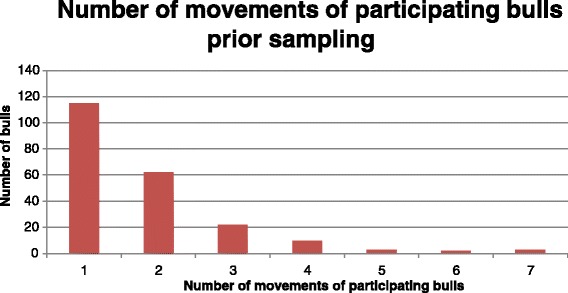
The prevalence of BoHV-1 and BVD in stock bulls in Irish dairy herds has never been investigated. This study highlights the widespread use of stock bulls in Irish dairy herds, as well as the high rate of exchange of bulls between farms. Significant associations were found between the origin of the bull and their serological BoHV-1 status. In keeping with these results, bulls with higher number movements between farms were more likely to be seropositive for BoHV-1.
牛病毒性腹泻(BVD)和传染性牛鼻气管炎(IBR)是在爱尔兰牛群中高度流行的传染性病毒病。尽管它们对繁殖和经济有重大影响,但对于种公牛(用于繁殖目的的公牛)的BVD和IBR状况却知之甚少。爱尔兰仍有很大比例的奶牛场依靠公牛进行繁殖,确保公牛的生育能力对农场的效率至关重要。爱尔兰奶牛群中种公牛的牛疱疹病毒1型(BoHV-1)和BVD的流行情况从未被调查过。因此,本研究的目的是:(i)提供关于爱尔兰奶牛场种公牛使用情况的描述性观察数据;(ii)调查一部分种公牛的BVD和BoHV-1状况;(iii)调查与种公牛的BVD和BoHV-1状况相关的因素;(iv)调查与奶牛群BVD和BoHV-1状况相关的因素,包括与使用种公牛的任何关联。使用逆转录聚合酶链反应(RT-PCR)对参与奶牛繁殖过程的529头公牛的血液样本进行BVD病毒分析,并通过酶联免疫吸附测定(ELISA)检测BoHV-1抗体。共有305个不同的奶牛场参与了该研究,并通过ELISA使用2009年泌乳期的四个混合奶罐样本确定了BVD和BoHV-1的总体牛群状况。使用逻辑回归来研究种公牛与BVD和BoHV-1牛群及个体状况之间的关联。
在总共305个参与农场中,235个农场(77%)至少有一头公牛,167个农场购买过公牛。在529头接受检测的公牛中,有两头(0.4%)被检测出BVD病毒呈阳性,87头(16.7%)检测出BoHV-1血清学阳性。在购买公牛与这两种病毒病之间发现了一些显著关联。购买的公牛BoHV-1血清学阳性的可能性是自家养殖公牛的三倍。同样,与所有公牛均为自家养殖的农场相比,有购买公牛的牛群被归类为BVD血清学阳性的可能性高三倍,有近期BoHV-1传播证据的可能性高四倍。
爱尔兰奶牛群中种公牛的BoHV-1和BVD的流行情况从未被调查过。本研究突出了种公牛在爱尔兰奶牛群中的广泛使用,以及农场之间公牛的高交换率。在公牛的来源与其血清学BoHV-1状况之间发现了显著关联。与这些结果一致,在农场之间移动次数较多的公牛更有可能BoHV-1血清学阳性。