Department of Pathology, Microbiology, and Immunology, School of Veterinary Medicine, University of California-Davis , Davis, CA , USA.
Department of Pathobiological Sciences, School of Veterinary Medicine, University of Wisconsin-Madison , Madison, WI , USA.
Front Vet Sci. 2015 Aug 13;2:22. doi: 10.3389/fvets.2015.00022. eCollection 2015.
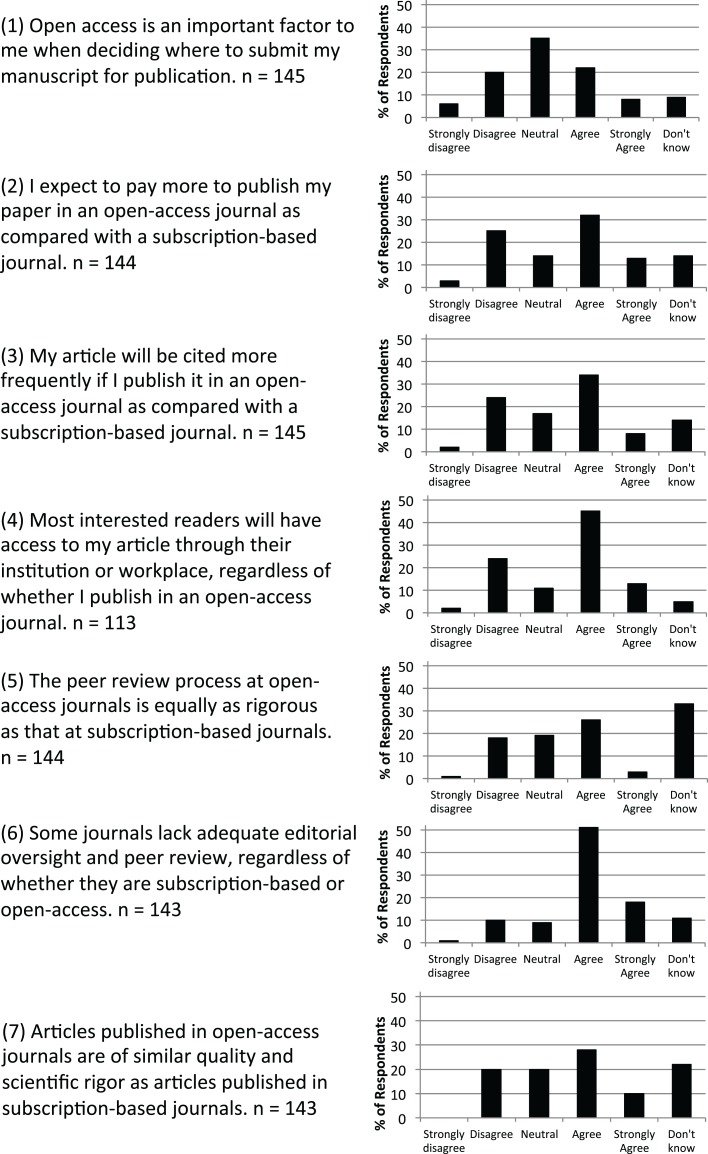
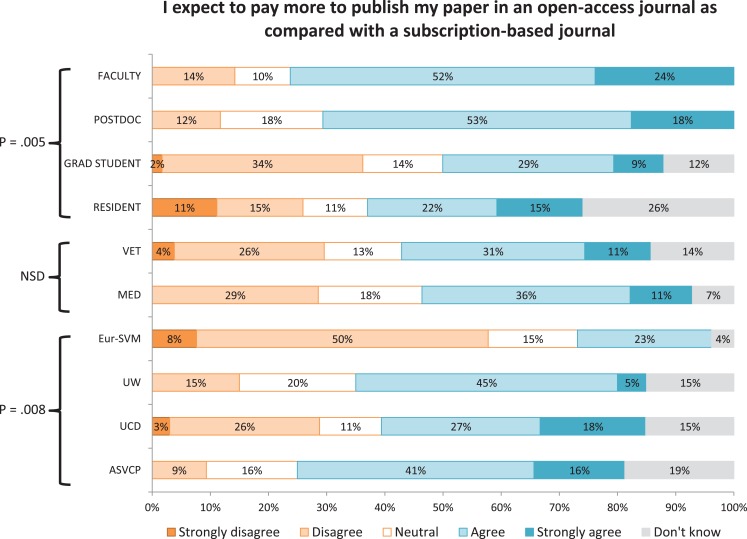
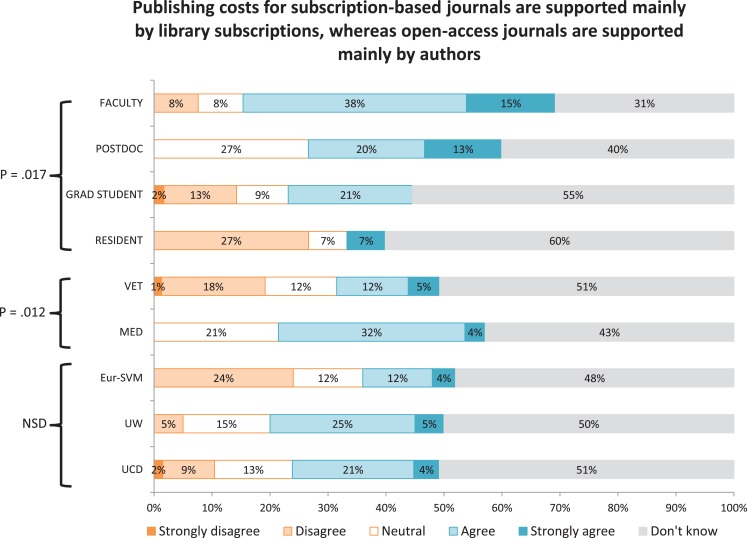
Authors face many choices when selecting a journal for publication. Prospective authors, especially trainees, may be unaware of "predatory" online journals or how to differentiate them from legitimate journals. In this study, we assessed awareness of open-access and predatory journals among prospective authors attending scientific writing workshops; our long-term goal was to inform educational goals for the workshops. We surveyed participants of writing workshops at veterinary and medical schools and an international conference over a 1-year period. The survey included 14 statements for respondents to indicate agreement level on a Likert-like scale and four questions on awareness of resources about predatory journals; respondents also defined "predatory journal." A total of 145 participants completed the survey: 106 (73.1%) from veterinary schools and 86 (59.3%) graduate students or residents. Fewer faculty (vs trainees) agreed that open access was an important factor in deciding where to publish; faculty and postdoctoral researchers were more likely to expect to pay more to publish in an open-access journal. Most respondents (120/145, 82.7%) agreed/strongly agreed that the decision to accept a manuscript should not be influenced by publication charges, but 50% (56/112) indicated that they "didn't know" how publishing costs were supported. Of the 142 respondents who answered, 33 (23.0%) indicated awareness of the term "predatory journal"; 34 (23.9%) were aware of the Directory of Open Access Journals; 24 (16.9%) were aware of the Science "sting" article about predatory journals; and 7 (4.8%) were aware of Beall's list. Most (93/144, 64.5%) definitions of predatory journals described poor but not predatory journal practices, and some respondents misunderstood the term completely. Mentors should help novice authors to be aware of predatory journals and to distinguish between legitimate and illegitimate open-access journals, thus selecting the best journal for their work.
作者在选择发表期刊时有很多选择。潜在作者,尤其是学员,可能不知道“掠夺性”在线期刊,也不知道如何将它们与合法期刊区分开来。在这项研究中,我们评估了参加科学写作研讨会的潜在作者对开放获取和掠夺性期刊的认识;我们的长期目标是为研讨会的教育目标提供信息。我们在一年内调查了兽医和医学院以及国际会议的写作研讨会的参与者。该调查包括 14 个陈述,供受访者在李克特式量表上表示同意程度,以及四个关于掠夺性期刊资源意识的问题;受访者还定义了“掠夺性期刊”。共有 145 名参与者完成了调查:106 名(73.1%)来自兽医学校,86 名(59.3%)为研究生或住院医师。与学员相比,较少的教职员工(与学员相比)认为开放获取是决定发表地点的重要因素;教职员工和博士后研究人员更有可能期望在开放获取期刊上支付更多费用。大多数受访者(145 名中的 120 名,82.7%)同意/强烈同意接受稿件的决定不应受到出版费用的影响,但 50%(112 名中的 56 名)表示他们“不知道”出版费用是如何得到支持的。在回答问题的 142 名受访者中,有 33 名(23.0%)意识到“掠夺性期刊”一词;34 名(23.9%)知道开放获取期刊目录;24 名(16.9%)知道《科学》杂志关于掠夺性期刊的“诱饵”文章;7 名(4.8%)知道比尤尔清单。大多数(144 名中的 93 名,64.5%)掠夺性期刊的定义描述了较差但不是掠夺性的期刊实践,一些受访者完全误解了这个术语。导师应该帮助新手作者意识到掠夺性期刊的存在,并区分合法和非法的开放获取期刊,从而为他们的工作选择最好的期刊。