Rikiishi Kazuhide, Matsuura Takakazu, Ikeda Yoko, Maekawa Masahiko
Institute of Plant Science and Resources, Okayama University, Kurashiki, Okayama, Japan.
PLoS One. 2015 Dec 15;10(12):e0145242. doi: 10.1371/journal.pone.0145242. eCollection 2015.
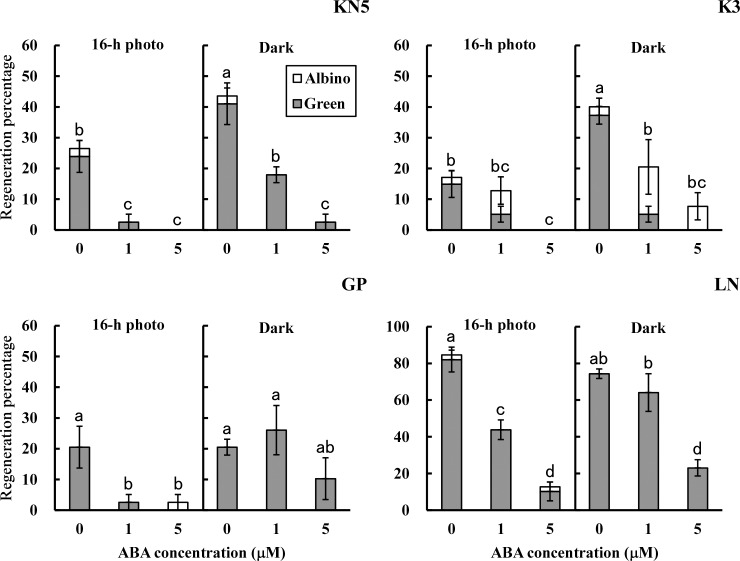
Shoot regeneration in calli derived from immature barley embryos is regulated by light conditions during the callus-induction period. Barley cultivars Kanto Nijo-5 (KN5) and K-3 (K3) showed lower efficiency of shoot regeneration in a 16-h photoperiod during callus-induction than those in continuous darkness, whereas shoot regeneration was enhanced in cultures under a 16-h photoperiod in Golden Promise (GP) and Lenins (LN). These cultivars were classified as photo-inhibition type (KN5 and K3) or photo-induction type (GP and LN) according to their response to light. Contents of endogenous plant hormones were determined in calli cultured under a 16-h photoperiod and continuous darkness. In photo-inhibition type, higher accumulation of abscisic acid (ABA) was detected in calli cultured under a 16-h photoperiod, whereas calli showed lower levels of endogenous ABA in continuous darkness. However, cultivars of photo-induction type showed lower levels of ABA in calli cultured under both light conditions, similarly to photo-inhibition type in continuous darkness. Exogenous ABA inhibited the callus growth and shoot regeneration independent of light conditions in all cultivars. In photo-inhibition type, lower levels of endogenous ABA induced by ABA biosynthesis inhibitor, fluridone, reduced the photo-inhibition of shoot regeneration. Expression of ABA biosynthesis gene, HvNCED1, in calli was regulated by the light conditions. Higher expression was observed in calli cultured under a 16-h photoperiod. These results indicate that ABA biosynthesis could be activated through the higher expression of HvNCED1 in a 16-h photoperiod and that the higher accumulations of ABA inhibit shoot regeneration in the photo-inhibition type cultivars.
来自未成熟大麦胚的愈伤组织中的芽再生受愈伤组织诱导期光照条件的调节。大麦品种关东二条-5(KN5)和K-3(K3)在愈伤组织诱导期的16小时光周期下芽再生效率低于连续黑暗条件下,而在金色承诺(GP)和列宁(LN)品种中,16小时光周期培养下芽再生增强。根据它们对光的反应,这些品种被分为光抑制型(KN5和K3)或光诱导型(GP和LN)。测定了在16小时光周期和连续黑暗条件下培养的愈伤组织中内源植物激素的含量。在光抑制型中,在16小时光周期下培养的愈伤组织中检测到脱落酸(ABA)积累更高,而在连续黑暗条件下愈伤组织中内源ABA水平较低。然而,光诱导型品种在两种光照条件下培养的愈伤组织中ABA水平均较低,与连续黑暗条件下的光抑制型相似。外源ABA在所有品种中均抑制愈伤组织生长和芽再生,且与光照条件无关。在光抑制型中,ABA生物合成抑制剂氟啶酮诱导的较低水平内源ABA降低了芽再生的光抑制。愈伤组织中ABA生物合成基因HvNCED1的表达受光照条件调节。在16小时光周期下培养的愈伤组织中观察到更高的表达。这些结果表明,在16小时光周期下,HvNCED1的高表达可激活ABA生物合成,且ABA的高积累抑制了光抑制型品种的芽再生。