Gaiko-Shcherbak Aljona, Fabris Gloria, Dreissen Georg, Merkel Rudolf, Hoffmann Bernd, Noetzel Erik
Institute of Complex Systems ICS7: Biomechanics, Forschungszentrum Jülich, Jülich, Germany.
PLoS One. 2015 Dec 16;10(12):e0145174. doi: 10.1371/journal.pone.0145174. eCollection 2015.
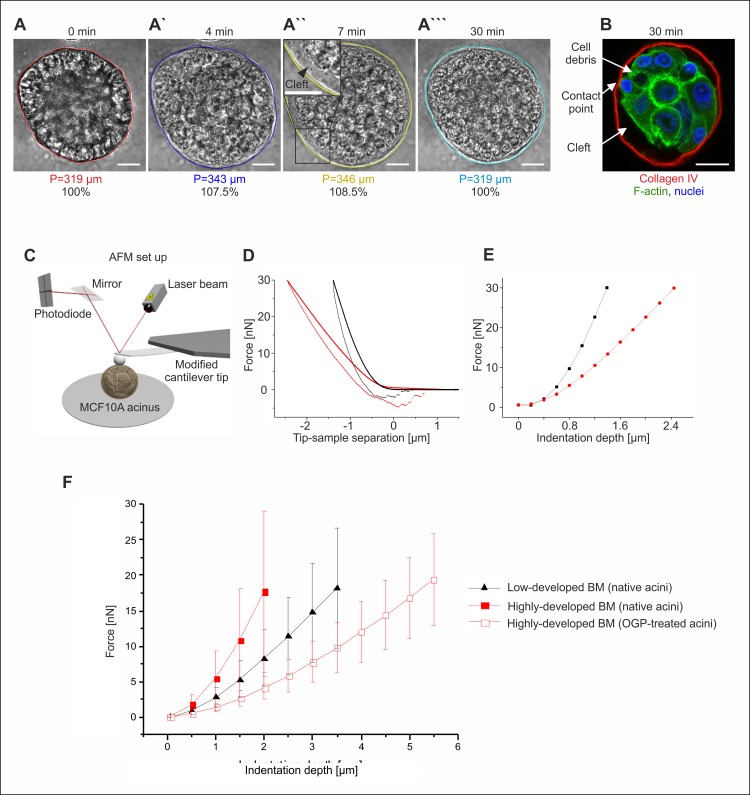
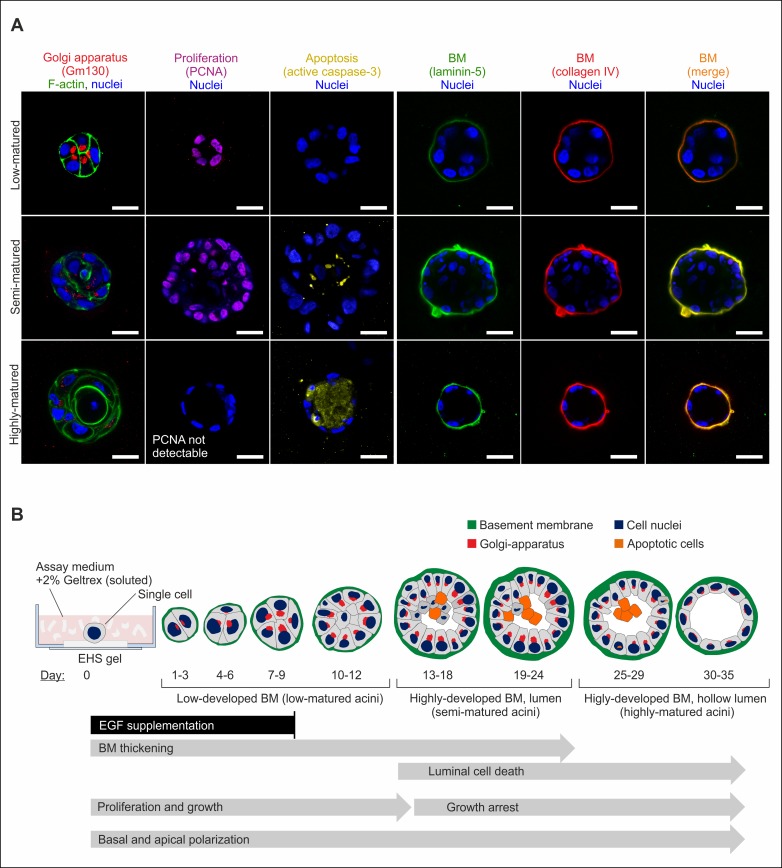
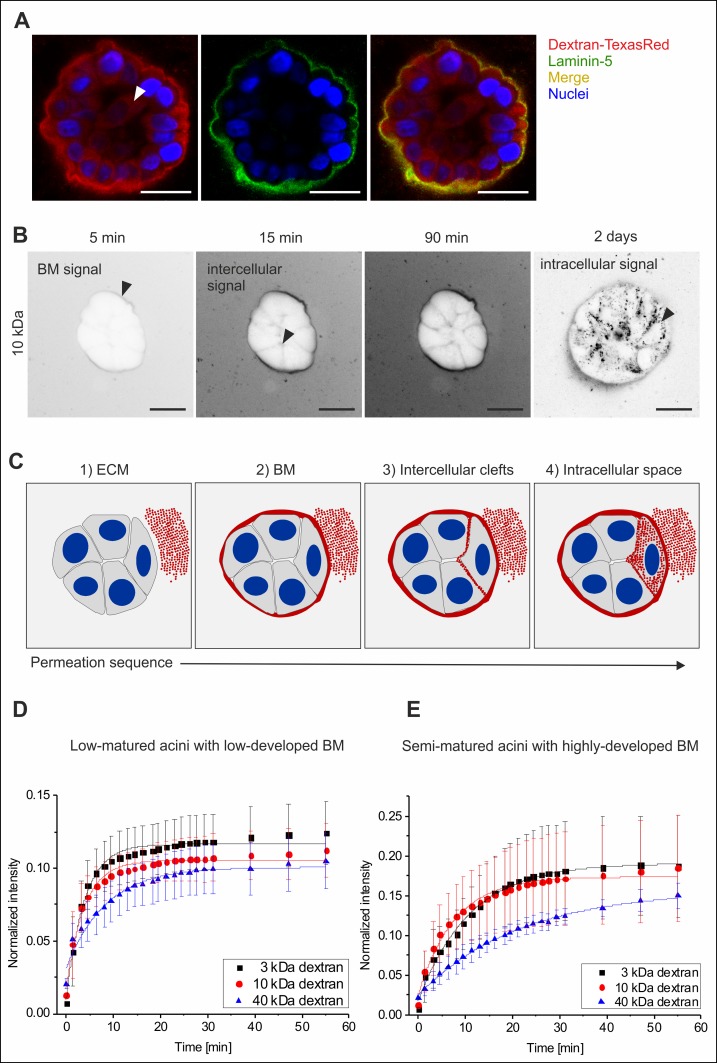
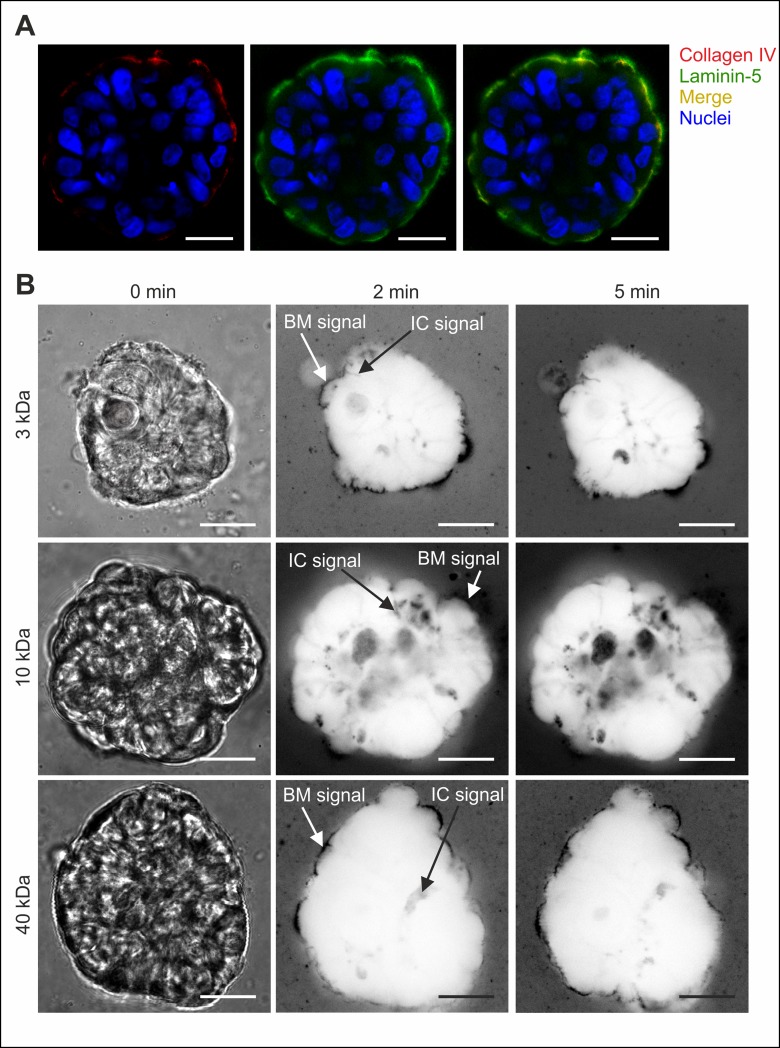
The biophysical properties of the basement membrane that surrounds human breast glands are poorly understood, but are thought to be decisive for normal organ function and malignancy. Here, we characterize the breast gland basement membrane with a focus on molecule permeation and mechanical stability, both crucial for organ function. We used well-established and nature-mimicking MCF10A acini as 3D cell model for human breast glands, with ether low- or highly-developed basement membrane scaffolds. Semi-quantitative dextran tracer (3 to 40 kDa) experiments allowed us to investigate the basement membrane scaffold as a molecule diffusion barrier in human breast acini in vitro. We demonstrated that molecule permeation correlated positively with macromolecule size and intriguingly also with basement membrane development state, revealing a pore size of at least 9 nm. Notably, an intact collagen IV mesh proved to be essential for this permeation function. Furthermore, we performed ultra-sensitive atomic force microscopy to quantify the response of native breast acini and of decellularized basement membrane shells against mechanical indentation. We found a clear correlation between increasing acinar force resistance and basement membrane formation stage. Most important native acini with highly-developed basement membranes as well as cell-free basement membrane shells could both withstand physiologically relevant loads (≤ 20 nN) without loss of structural integrity. In contrast, low-developed basement membranes were significantly softer and more fragile. In conclusion, our study emphasizes the key role of the basement membrane as conductor of acinar molecule influx and mechanical stability of human breast glands, which are fundamental for normal organ function.
人们对围绕人类乳腺的基底膜的生物物理特性了解甚少,但认为其对正常器官功能和恶性肿瘤具有决定性作用。在此,我们对乳腺基底膜进行了表征,重点关注分子渗透和机械稳定性,这两者对器官功能都至关重要。我们使用成熟的、模拟天然环境的MCF10A腺泡作为人类乳腺的三维细胞模型,其具有低发育或高度发育的基底膜支架。半定量葡聚糖示踪剂(3至40 kDa)实验使我们能够在体外研究基底膜支架作为人类乳腺腺泡中分子扩散屏障的情况。我们证明分子渗透与大分子大小呈正相关,有趣的是还与基底膜发育状态相关,揭示出孔径至少为9纳米。值得注意的是,完整的IV型胶原网被证明对这种渗透功能至关重要。此外,我们进行了超灵敏原子力显微镜检查,以量化天然乳腺腺泡和脱细胞基底膜壳对机械压痕的反应。我们发现腺泡抗压力的增加与基底膜形成阶段之间存在明显的相关性。最重要的是,具有高度发育基底膜的天然腺泡以及无细胞基底膜壳都能够承受生理相关负荷(≤20 nN)而不丧失结构完整性。相比之下,低发育的基底膜明显更柔软且更脆弱。总之,我们的研究强调了基底膜作为乳腺腺泡分子流入导体和人类乳腺机械稳定性的关键作用,这对正常器官功能至关重要。