Sestito Rosanna, Cianfrocca Roberta, Rosanò Laura, Tocci Piera, Semprucci Elisa, Di Castro Valeriana, Caprara Valentina, Ferrandina Gabriella, Sacconi Andrea, Blandino Giovanni, Bagnato Anna
Translational Research Functional Departmental Area, Regina Elena National Cancer Institute, Rome, Italy.
Gynecologic Oncology Unit, Catholic University of Rome, Rome, Italy.
Oncotarget. 2016 Jan 26;7(4):4009-23. doi: 10.18632/oncotarget.6546.
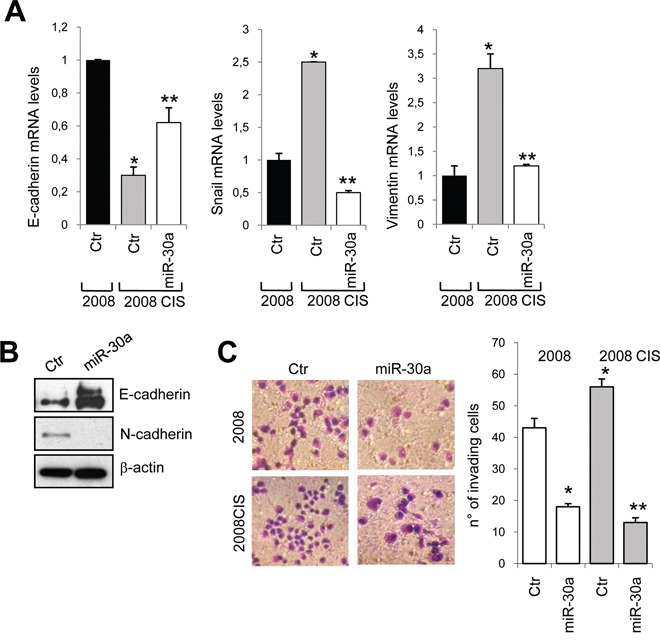
Drug resistance remains the major clinical barrier to successful treatment in epithelial ovarian carcinoma (EOC) patients, and the evidence of microRNA involvement in drug resistance has been recently emerging. Endothelin-1 (ET-1)/ETA receptor (ETAR) axis is aberrantly activated in chemoresistant EOC cells and elicits pleiotropic effects promoting epithelial-to-mesenchymal transition (EMT) and the acquisition of chemoresistance. However, the relationship between ETAR and miRNA is still unknown. Hence, in this study we evaluated whether dysregulation of miRNA might enhance ETAR expression in sensitive and resistant EOC cells. Based on bioinformatic tools, we selected putative miRNA able to recognize the 3'UTR of ETAR. An inverse correlation was observed between the expression levels of miR-30a and ETAR in both EOC cell lines and tumor samples. miR-30a was found to specifically bind to the 3'UTR of ETAR mRNA, indicating that ETAR is a direct target of miR-30a. Overexpression of miR-30a decreased Akt and mitogen activated protein kinase signaling pathway activation, cell proliferation, invasion, plasticity, EMT marker levels, and vascular endothelial growth factor release. Interestingly, ectopic expression of miR-30a re-sensitized platinum-resistant EOC cells to cisplatinum-induced apoptosis. Consistently, resistant EOC xenografts overexpressing miR-30a resulted in significantly less tumor growth than controls. Together our study provides a new perspective on the regulatory mechanism of ETAR gene. Interestingly, our findings highlight that blockade of ETAR regulatory axis is the mechanism underlying the tumor suppressor function of miR-30a in chemoresistant EOC cells.
耐药性仍然是上皮性卵巢癌(EOC)患者成功治疗的主要临床障碍,最近有证据表明微小RNA参与了耐药过程。内皮素-1(ET-1)/ETA受体(ETAR)轴在化疗耐药的EOC细胞中异常激活,并引发多效性作用,促进上皮-间质转化(EMT)和获得耐药性。然而,ETAR与微小RNA之间的关系仍不清楚。因此,在本研究中,我们评估了微小RNA的失调是否会增强敏感和耐药EOC细胞中ETAR的表达。基于生物信息学工具,我们选择了能够识别ETAR 3'UTR的假定微小RNA。在EOC细胞系和肿瘤样本中均观察到miR-30a与ETAR的表达水平呈负相关。发现miR-30a特异性结合ETAR mRNA的3'UTR,表明ETAR是miR-30a的直接靶点。miR-30a的过表达降低了Akt和丝裂原活化蛋白激酶信号通路的激活、细胞增殖、侵袭、可塑性、EMT标志物水平以及血管内皮生长因子的释放。有趣的是,miR-30a的异位表达使铂耐药的EOC细胞对顺铂诱导的凋亡重新敏感。一致地,过表达miR-30a的耐药EOC异种移植瘤的肿瘤生长明显低于对照组。我们的研究共同为ETAR基因的调控机制提供了新的视角。有趣的是,我们的发现突出了ETAR调控轴的阻断是miR-30a在化疗耐药EOC细胞中发挥肿瘤抑制功能的机制。