Khan Huma, Gupta Seema, Husain Nuzhat, Misra Sanjeev, Mps Negi, Jamal Naseem, Ghatak Ashim
Department of Radiotherapy, King George's Medical University, Lucknow, Uttar Pradesh, India.
Department of Pathology, RMLIMS, Lucknow, Uttar Pradesh, India.
BBA Clin. 2014 Nov 21;3:11-7. doi: 10.1016/j.bbacli.2014.11.004. eCollection 2015 Jun.
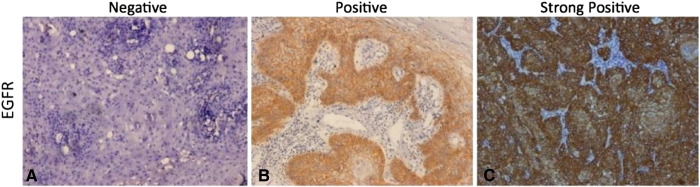
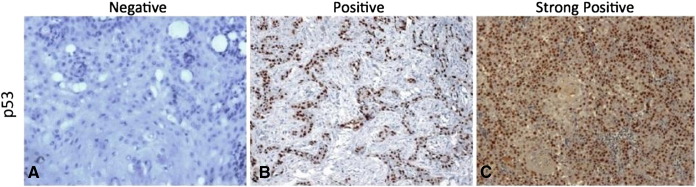
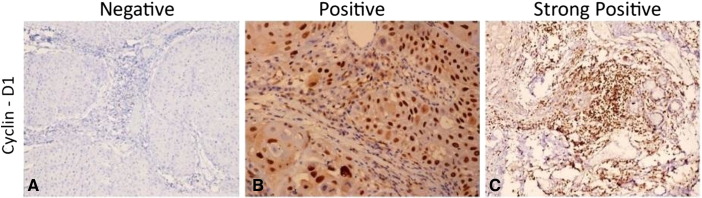
Cyclin-D1, p53 and EGFR are molecular markers that regulate the cell cycle and play an important role in tumor progression and development. The present study evaluates the prognostic significance of these markers with chemoradiation response in patients of locally advanced oral squamous cell carcinoma (OSCC).
A total of 97 OSCC patients (females = 19 and males = 78), aged 20-67 years and stage III/IV were recruited. Treatment response was assessed according to WHO criteria. Cyclin-D1, p53 and EGFR expressions in tumor tissue was estimated by immunohistochemical (IHC) method and quantified as percentage positive nuclei.
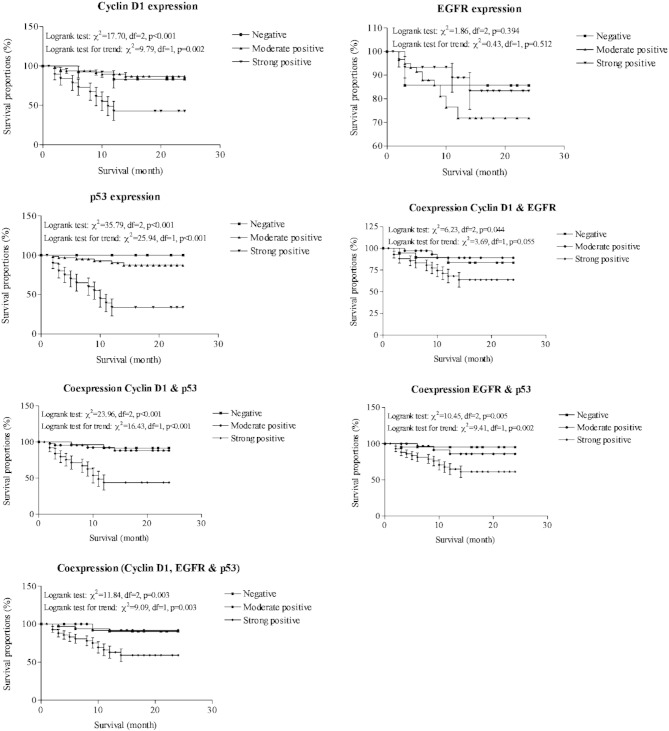
The positive expression rates of molecular markers were 86.6% for Cyclin-D1, 92.8% for EGFR and 85.6% for p53. The strong positive expressions of both Cyclin-D1 and p53 showed significant association with poor response. The Cox multivariate regression analysis showed coexpressions of Cyclin-D1 and p53 a significant and independent predictor of overall survival (OR = 1.90, 95% CI = 1.45-4.82, p = 0.046) after adjusting the demographic, clinicopathological and radiological response. The strong positive expressions of Cyclin-D1 and p53 and coexpressions of Cyclin-D1, EGFR and p53 showed significant (p < 0.05 or p < 0.01 or p < 0.001) and lower survival as compared to negative or moderate positive expressions and coexpressions, respectively.
Expressions and coexpressions of Cyclin-D1 and p53 may serve as a prognostic marker in OSCC patients.
细胞周期蛋白D1、p53和表皮生长因子受体(EGFR)是调节细胞周期的分子标志物,在肿瘤进展和发展中起重要作用。本研究评估这些标志物在局部晚期口腔鳞状细胞癌(OSCC)患者中对放化疗反应的预后意义。
共招募了97例年龄在20 - 67岁、处于III/IV期的OSCC患者(女性19例,男性78例)。根据世界卫生组织标准评估治疗反应。采用免疫组织化学(IHC)方法估计肿瘤组织中细胞周期蛋白D1、p53和EGFR的表达,并以阳性细胞核百分比进行量化。
分子标志物的阳性表达率分别为:细胞周期蛋白D1为86.6%,EGFR为92.8%,p53为85.6%。细胞周期蛋白D1和p53的强阳性表达均与反应不佳显著相关。Cox多因素回归分析显示,在调整人口统计学、临床病理和放射学反应后,细胞周期蛋白D1和p53的共表达是总生存的显著且独立预测因子(OR = 1.90,95% CI = 1.45 - 4.82,p = 0.046)。与阴性或中度阳性表达及共表达相比,细胞周期蛋白D1和p53的强阳性表达以及细胞周期蛋白D1、EGFR和p53的共表达显示出显著(p < 0.05或p < 0.01或p < 0.001)且更低的生存率。
细胞周期蛋白D1和p53的表达及共表达可能作为OSCC患者的预后标志物。