Santos Elisa S L, Cerqueira-Silva Carlos Bernard M, Mori Gustavo M, Ahnert Dário, Mello Durval L N, Pires José Luis, Corrêa Ronan X, de Souza Anete P
Laboratory of Applied Molecular Genetics, Department of Exact and Natural Sciences, State University of Southwest Bahia, Itapetinga, Bahia, Brazil.
Center for Molecular Biology and Genetic Engineering, University of Campinas, Campinas, São Paulo, Brazil.
PLoS One. 2015 Dec 16;10(12):e0145276. doi: 10.1371/journal.pone.0145276. eCollection 2015.
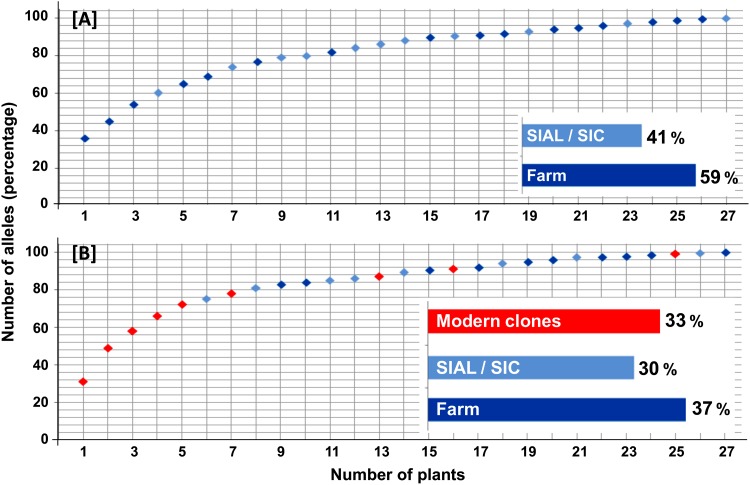
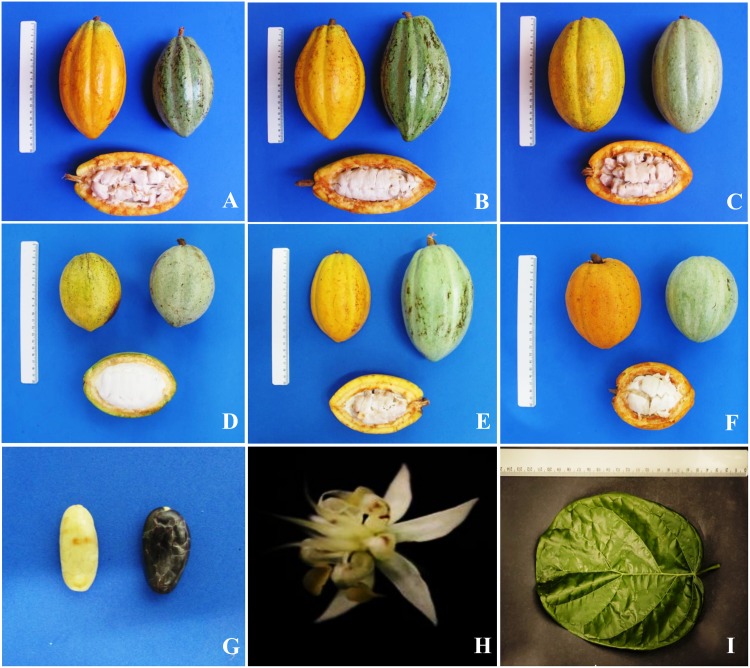
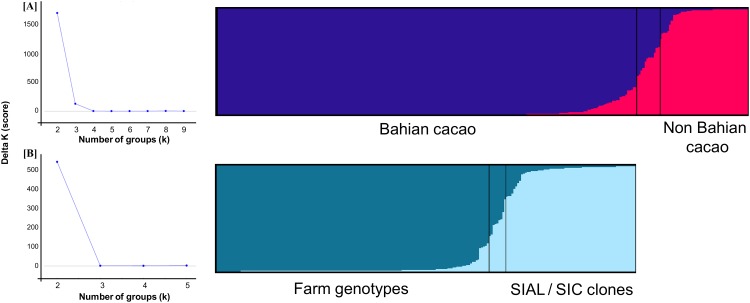
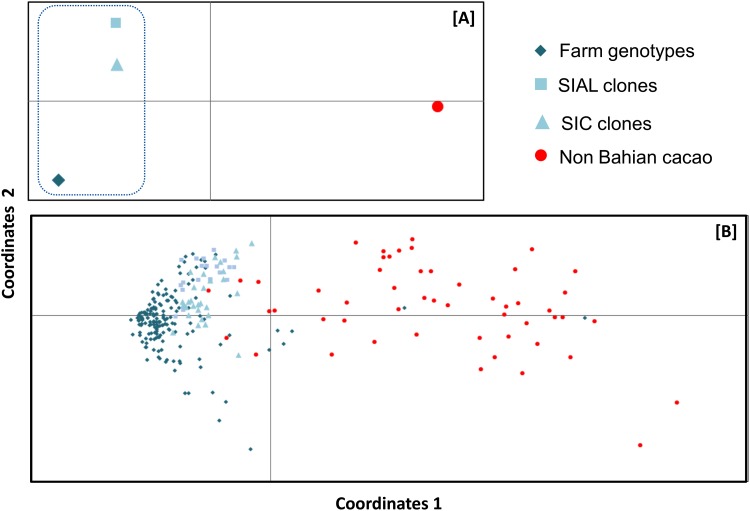
Bahia is the most important cacao-producing state in Brazil, which is currently the sixth-largest country worldwide to produce cacao seeds. In the eighteenth century, the Comum, Pará and Maranhão varieties of cacao were introduced into southern Bahia, and their descendants, which are called 'Bahian cacao' or local Bahian varieties, have been cultivated for over 200 years. Comum plants have been used to start plantations in African countries and extended as far as countries in South Asia and Oceania. In Brazil, two sets of clones selected from Bahian varieties and their mutants, the Agronomic Institute of East (SIAL) and Bahian Cacao Institute (SIC) series, represent the diversity of Bahian cacao in germplasm banks. Because the genetic diversity of Bahian varieties, which is essential for breeding programs, remains unknown, the objective of this work was to assess the genetic structure and diversity of local Bahian varieties collected from farms and germplasm banks. To this end, 30 simple sequence repeat (SSR) markers were used to genotype 279 cacao plants from germplasm and local farms. The results facilitated the identification of 219 cacao plants of Bahian origin, and 51 of these were SIAL or SIC clones. Bahian cacao showed low genetic diversity. It could be verified that SIC and SIAL clones do not represent the true diversity of Bahian cacao, with the greatest amount of diversity found in cacao trees on the farms. Thus, a core collection to aid in prioritizing the plants to be sampled for Bahian cacao diversity is suggested. These results provide information that can be used to conserve Bahian cacao plants and applied in breeding programs to obtain more productive Bahian cacao with superior quality and tolerance to major diseases in tropical cacao plantations worldwide.
巴伊亚州是巴西最重要的可可生产州,巴西目前是全球第六大可可种子生产国。18世纪,可可的Comum、帕拉和马拉尼昂品种被引入巴伊亚州南部,它们的后代被称为“巴伊亚可可”或巴伊亚本地品种,已经种植了200多年。Comum植株已被用于在非洲国家建立种植园,并扩展到了南亚和大洋洲的国家。在巴西,从巴伊亚品种及其突变体中选出的两组克隆,即东部农业研究所(SIAL)系列和巴伊亚可可研究所(SIC)系列,代表了种质库中巴伊亚可可的多样性。由于对于育种计划至关重要的巴伊亚品种的遗传多样性仍然未知,这项工作的目的是评估从农场和种质库收集的巴伊亚本地品种的遗传结构和多样性。为此,使用30个简单序列重复(SSR)标记对来自种质库和当地农场的279株可可植株进行基因分型。结果有助于鉴定出219株巴伊亚原产的可可植株,其中51株是SIAL或SIC克隆。巴伊亚可可显示出较低的遗传多样性。可以证实,SIC和SIAL克隆并不代表巴伊亚可可的真正多样性,农场中的可可树具有最大量的多样性。因此,建议建立一个核心种质库,以帮助确定巴伊亚可可多样性采样植株的优先级。这些结果提供了可用于保护巴伊亚可可植株的信息,并可应用于育种计划,以获得在全球热带可可种植园中具有更高产量、更优品质和对主要病害具有耐受性的巴伊亚可可。