Kobayashi Hisanori, Ohnishi Takashi, Nakagawa Ryoko, Yoshizawa Kazutake
Evidence Generation Department, Medical Affairs Division, Janssen Pharmaceutical K.K., Tokyo, Japan.
Int J Geriatr Psychiatry. 2016 Aug;31(8):892-904. doi: 10.1002/gps.4405. Epub 2015 Dec 17.
Comparative evidence for efficacy and safety of second-generation cholinesterase inhibitors (ChEIs) is still sparse.
The purpose of this research is to compare three ChEIs, donepezil, galantamine and rivastigmine, in patients with mild-to-moderate Alzheimer's disease (AD).
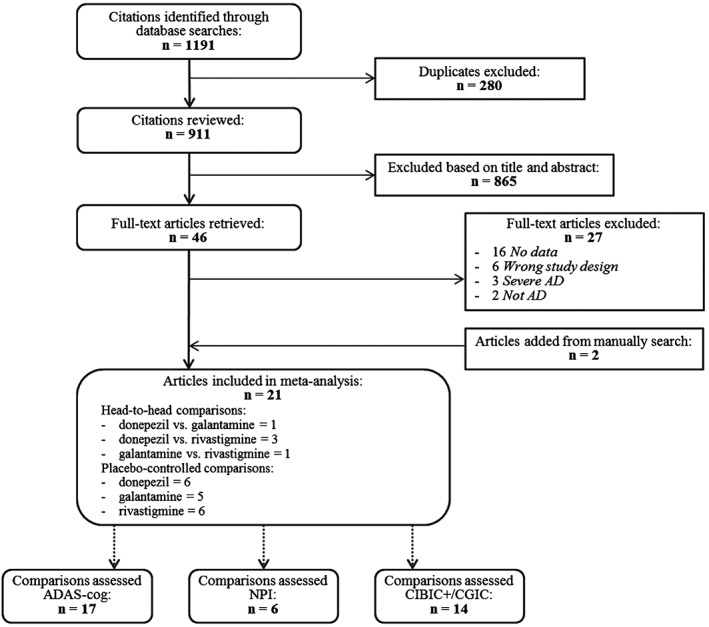
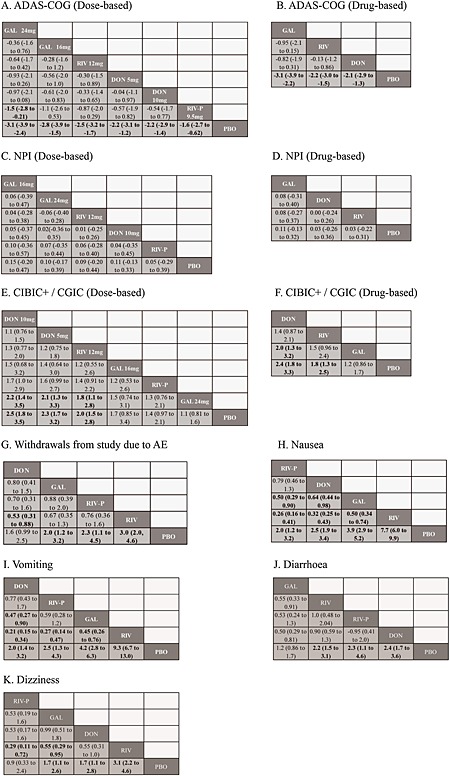
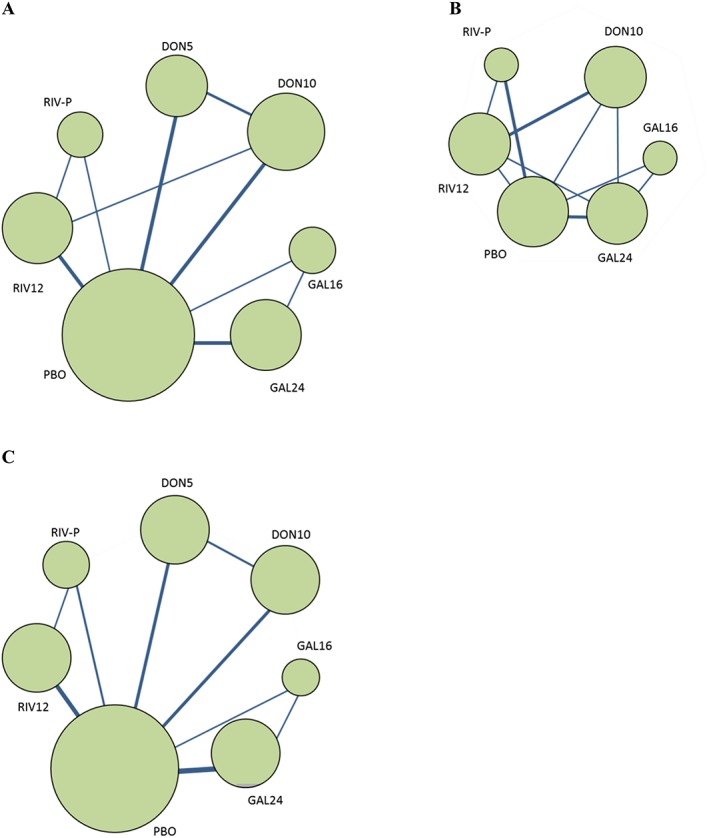
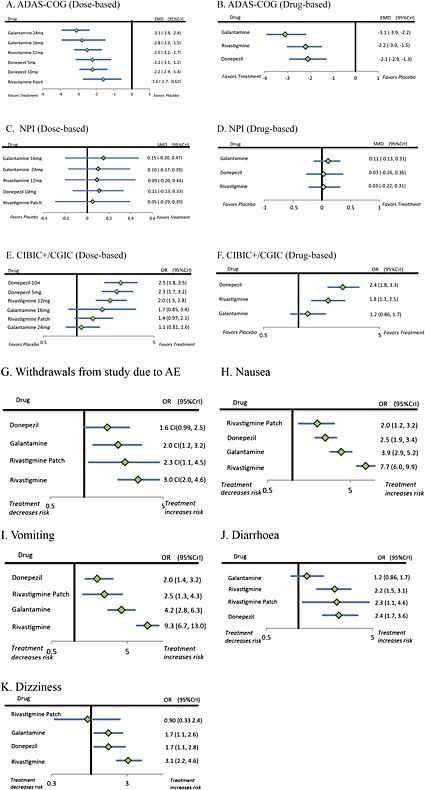
We conducted a systematic review for published articles and included randomised, double-blind, placebo-controlled trials and head-to-head randomised trials evaluating the efficacy and safety of ChEIs in patients with AD. We examined Alzheimer's Disease Assessment Scale, cognitive subscale (ADAS-Cog), Neuropsychiatric Inventory (NPI), Clinician's Interview-Based Impression of Change plus caregiver's input (CIBIC+) and Clinical Global Impression of Change (CGIC) as efficacy endpoints. Withdrawals due to adverse events and number of patients experiencing nausea, vomiting, diarrhoea and dizziness were examined as safety profiles. Network meta-analyses were sequentially performed for efficacy and safety outcomes based on drug/dose treatment conditions.
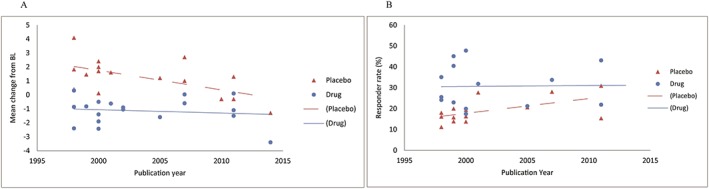
Among the 21 trials included, network meta-analysis showed that all treatments were significantly more efficacious than placebo in cognition measured by ADAS-Cog. All treatments except galantamine were significantly more efficacious than placebo in global change in CIBIC+ or CGIC. Across all conditions, no significant efficacy was observed in neuropsychiatric symptoms measured by NPI. Derived hierarchies in the efficacy of treatment conditions were variables across efficacy and safety.
Our analysis is the first attempt to incorporate available direct and indirect evidence. The results suggest that ChEIs should have significant efficacy for cognition and global change assessment, but the efficacy on neuropsychiatric symptoms is questionable in patients with mild-to-moderate AD.
第二代胆碱酯酶抑制剂(ChEIs)疗效和安全性的比较证据仍然匮乏。
本研究旨在比较三种ChEIs,即多奈哌齐、加兰他敏和卡巴拉汀,在轻至中度阿尔茨海默病(AD)患者中的疗效。
我们对已发表的文章进行了系统评价,纳入了评估ChEIs在AD患者中疗效和安全性的随机、双盲、安慰剂对照试验以及头对头随机试验。我们将阿尔茨海默病评估量表认知子量表(ADAS-Cog)、神经精神科问卷(NPI)、基于临床医生访谈的变化印象加照顾者意见(CIBIC+)和临床总体变化印象(CGIC)作为疗效终点。将因不良事件导致的撤药情况以及出现恶心、呕吐、腹泻和头晕的患者数量作为安全性指标。根据药物/剂量治疗条件,依次对疗效和安全性结果进行网状Meta分析。
在纳入的21项试验中,网状Meta分析表明,在通过ADAS-Cog测量的认知方面,所有治疗均显著优于安慰剂。除加兰他敏外,所有治疗在CIBIC+或CGIC的总体变化方面均显著优于安慰剂。在所有条件下,通过NPI测量的神经精神症状未观察到显著疗效。治疗条件疗效的派生层次结构在疗效和安全性方面存在差异。
我们的分析是首次尝试整合可用的直接和间接证据。结果表明,ChEIs对认知和总体变化评估应具有显著疗效,但对轻至中度AD患者的神经精神症状疗效存疑。