Soleymani Ali, Pennekamp Frank, Petchey Owen L, Weibel Robert
Department of Geography, University of Zurich, Zurich, Switzerland.
Institute of Evolutionary Biology and Environmental Studies, University of Zurich, Zurich, Switzerland.
PLoS One. 2015 Dec 17;10(12):e0145345. doi: 10.1371/journal.pone.0145345. eCollection 2015.
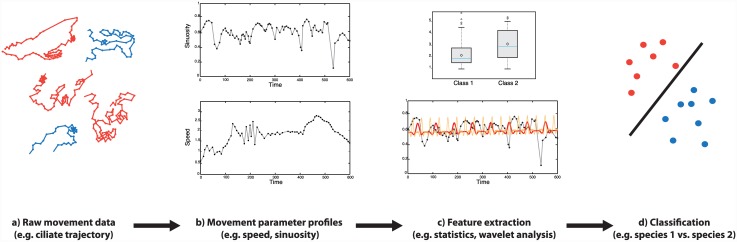
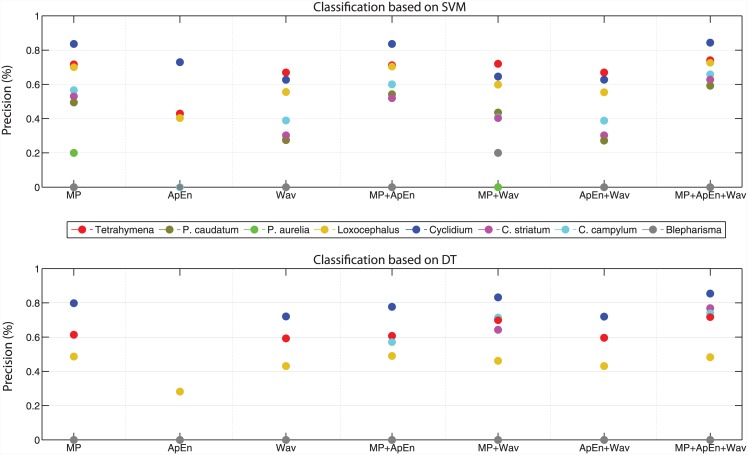
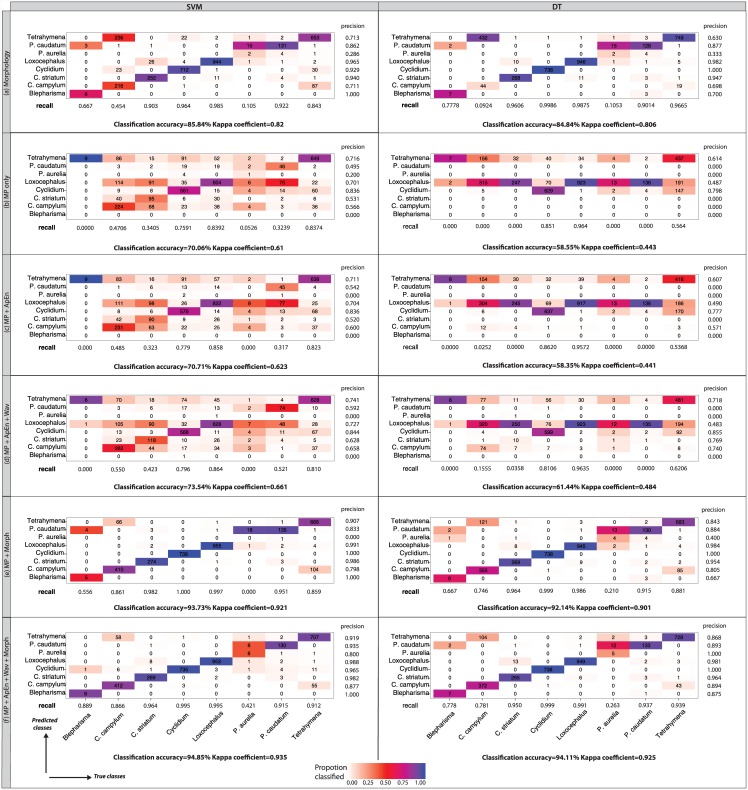
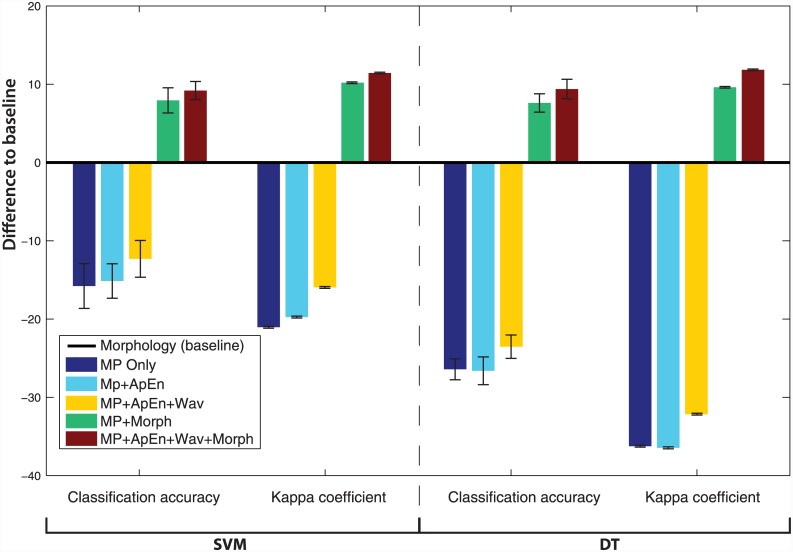
Recent advances in tracking technologies such as GPS or video tracking systems describe the movement paths of individuals in unprecedented details and are increasingly used in different fields, including ecology. However, extracting information from raw movement data requires advanced analysis techniques, for instance to infer behaviors expressed during a certain period of the recorded trajectory, or gender or species identity in case data is obtained from remote tracking. In this paper, we address how different movement features affect the ability to automatically classify the species identity, using a dataset of unicellular microbes (i.e., ciliates). Previously, morphological attributes and simple movement metrics, such as speed, were used for classifying ciliate species. Here, we demonstrate that adding advanced movement features, in particular such based on discrete wavelet transform, to morphological features can improve classification. These results may have practical applications in automated monitoring of waste water facilities as well as environmental monitoring of aquatic systems.
诸如全球定位系统(GPS)或视频跟踪系统等跟踪技术的最新进展以前所未有的细节描述了个体的移动路径,并且越来越多地应用于包括生态学在内的不同领域。然而,从原始移动数据中提取信息需要先进的分析技术,例如推断在记录轨迹的特定时间段内所表现出的行为,或者在通过远程跟踪获得数据的情况下推断性别或物种身份。在本文中,我们使用单细胞微生物(即纤毛虫)数据集探讨了不同的移动特征如何影响自动分类物种身份的能力。以前,形态学属性和简单的移动指标(如速度)被用于纤毛虫物种的分类。在这里,我们证明在形态学特征中加入先进的移动特征,特别是基于离散小波变换的特征,可以提高分类效果。这些结果可能在废水处理设施的自动监测以及水生系统的环境监测中具有实际应用价值。