Leitinger Georg, Ruggenthaler Romed, Hammerle Albin, Lavorel Sandra, Schirpke Uta, Clement Jean-Christophe, Lamarque Pénélope, Obojes Nikolaus, Tappeiner Ulrike
Institute of Ecology, University of Innsbruck, Innsbruck, Austria ; Institute for Alpine Environment, European Academy of Bolzano/Bozen, Bolzano/Bozen, Italy.
Institute of Ecology, University of Innsbruck, Innsbruck, Austria.
Ecohydrology. 2015 Dec 1;8(8):1600-1613. doi: 10.1002/eco.1607.
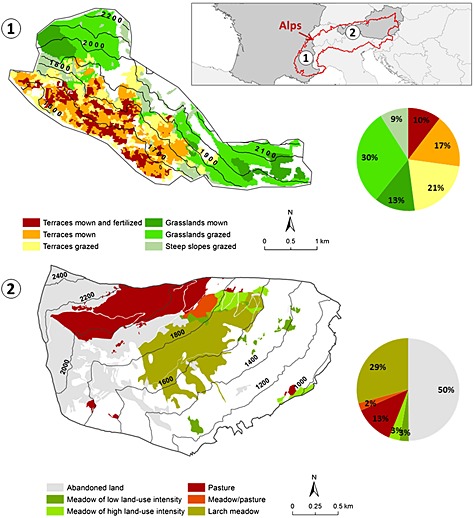
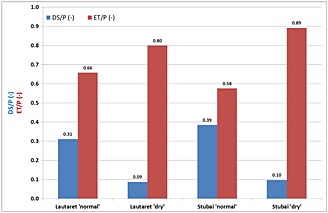
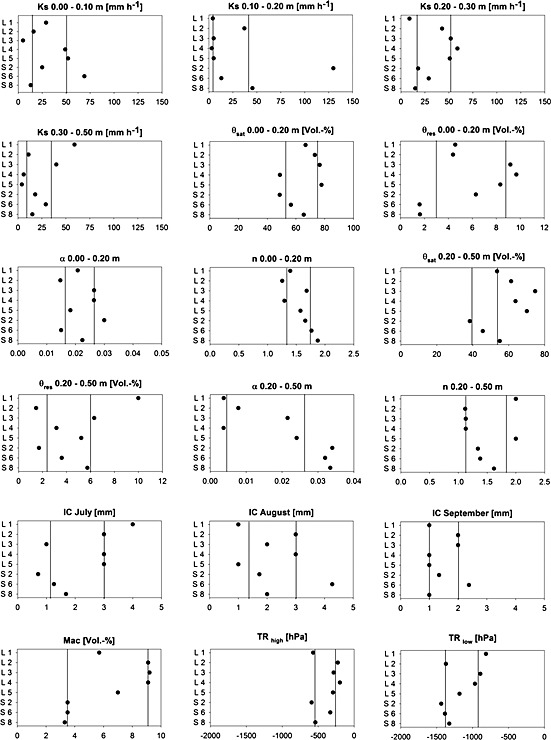
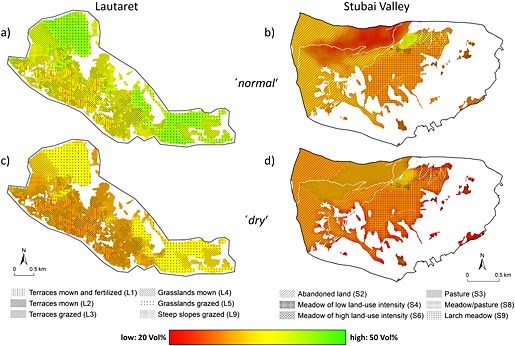
This study analyzes the impact of droughts, compared with average climatic conditions, on the supporting ecosystem service in sub-watersheds in managed alpine grasslands in two climatically different regions of the Alps, Lautaret (French Alps) and Stubai (Austrian Alps). Soil moisture was modelled in the range of 0-0.3 m. At both sites, current patterns showed that the mean seasonal soil moisture was (1) near field capacity for grasslands with low management intensity and (2) below field capacity for grasslands with higher land-use intensity. Soil moisture was significantly reduced by drought at both sites, with lower reductions at the drier Lautaret site. At the sub-watershed scale, soil moisture spatial heterogeneity was reduced by drought. Under drought conditions, the evapotranspiration to precipitation ratios at Stubai was slightly higher than those at Lautaret, indicating a dominant 'water spending' strategy of plant communities. Regarding catchment water balance, deep seepage was reduced by drought at Stubai more strongly than at Lautaret. Hence, the observed 'water spending' strategy at Stubai might have negative consequences for downstream water users. Assessing the water provision service for alpine grasslands provided evidence that, under drought conditions, evapotranspiration was influenced not only by abiotic factors but also by the water-use strategy of established vegetation. These results highlight the importance of 'water-use' strategies in existing plant communities as predictors of the impacts of drought on water provision services and related ecosystem services at both the field and catchment scale.
本研究分析了与平均气候条件相比,干旱对阿尔卑斯山两个气候不同地区(法国阿尔卑斯山的洛塔雷和奥地利阿尔卑斯山的施图拜)管理的高山草甸子流域支持性生态系统服务的影响。对0 - 0.3米范围内的土壤湿度进行了建模。在两个地点,当前模式表明,平均季节性土壤湿度情况为:(1)管理强度低的草地接近田间持水量;(2)土地利用强度高的草地低于田间持水量。两个地点的干旱均显著降低了土壤湿度,在较干燥的洛塔雷地点降低幅度较小。在子流域尺度上,干旱降低了土壤湿度的空间异质性。在干旱条件下,施图拜的蒸散与降水比率略高于洛塔雷,表明植物群落具有占主导地位的“水分消耗”策略。关于集水区水平衡,干旱对施图拜深层渗漏的减少幅度比对洛塔雷的更大。因此,在施图拜观察到的“水分消耗”策略可能会给下游用水户带来负面影响。对高山草甸的供水服务评估表明,在干旱条件下,蒸散不仅受非生物因素影响,还受现有植被用水策略的影响。这些结果凸显了现有植物群落中“用水”策略作为干旱对田间和集水区尺度供水服务及相关生态系统服务影响预测指标的重要性。