Hong Kwangpyo, Kim Hyeyoung, Lee Jeong-Moo, Lee Kwang-Woong, Yi Nam-Joon, Lee Hae Won, Choi YoungRok, Suh Suk-Won, Hong Suk Kyun, Yoon Kyung Chul, Kim Hyo-Sin, Suh Kyung-Suk
Department of Surgery, Seoul National University College of Medicine, Seoul, Korea.
Korean J Hepatobiliary Pancreat Surg. 2015 Nov;19(4):149-53. doi: 10.14701/kjhbps.2015.19.4.149. Epub 2015 Nov 30.
BACKGROUNDS/AIMS: Fatigue is common in chronic hepatitis and end-stage liver disease. However, little is known about fatigue after liver transplantation (LT). We therefore evaluated the prevalence, severity, and related factors of fatigue after LT.
We retrospectively reviewed adult recipients who responded to our survey at outpatient clinics between April and May 2013. Fatigue and its severity were assessed using a questionnaire with the Fatigue Severity Scale (FSS). We defined fatigue as FSS of 4.0 or more and severe fatigue as FSS of 5.1 or more. The related factors including hepatocellular carcinoma and complications were analyzed.
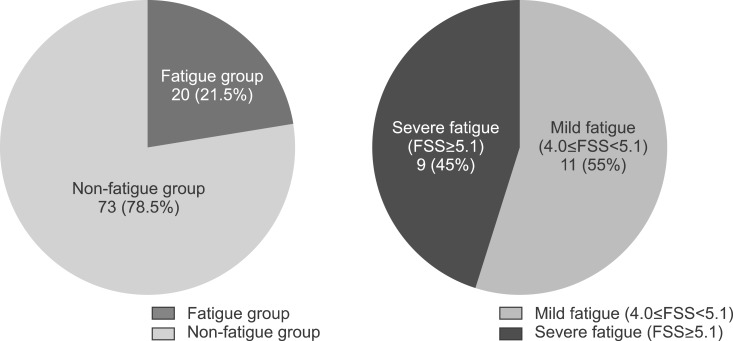
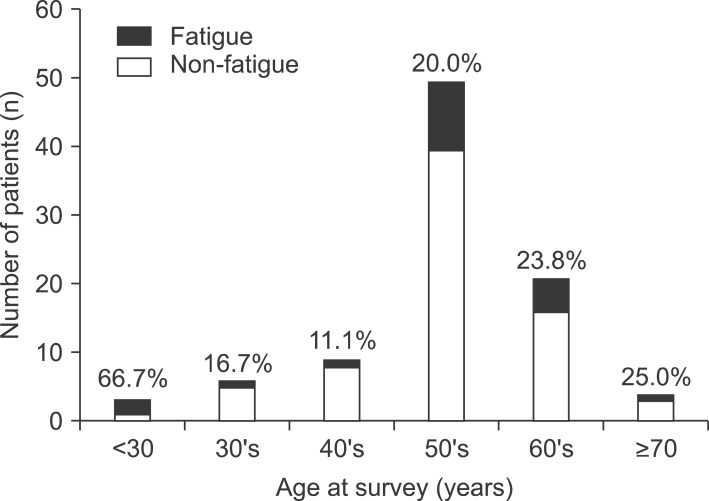
A total of 93 patients were included in this study. The mean age was 54.9 (19-76) years and two-thirds were men (67.7%). Living donor LT was 77.4%. Hepatitis B related liver disease was the main underlying disease (77.4%), with hepatocellular carcinoma accompanied in 33.3%. The mean follow-up period was 66.8±43.2 (2-171) months. The mean FFS was 2.83±1.48 (1.0-6.7) overall and 5.10±0.82 (4.0-6.7) in the fatigue group. Of the 93 adult patients, fatigue was presented in 20 patients (21.5%). Among these, 9 patients (45.0%) showed severe fatigue. Even though post-LT complications tended to be greater in the fatigue group (50.0% vs. 30.1% in the non-fatigue group, p=0.098), there were no significant related factors of fatigue after LT, including hepatocellular carcinoma and major complication.
Fatigue is present in a considerable portion of recipients after LT, and almost half of them have severe fatigue. Further efforts are needed to decrease fatigue in LT recipients.
背景/目的:疲劳在慢性肝炎和终末期肝病中很常见。然而,关于肝移植(LT)后的疲劳情况知之甚少。因此,我们评估了肝移植后疲劳的患病率、严重程度及相关因素。
我们回顾性分析了2013年4月至5月在门诊诊所回复我们调查的成年受者。使用疲劳严重程度量表(FSS)问卷评估疲劳及其严重程度。我们将疲劳定义为FSS为4.0或更高,将严重疲劳定义为FSS为5.1或更高。分析包括肝细胞癌和并发症在内的相关因素。
本研究共纳入93例患者。平均年龄为54.9(19 - 76)岁,三分之二为男性(67.7%)。活体供肝肝移植占77.4%。乙型肝炎相关肝病是主要基础疾病(77.4%),33.3%伴有肝细胞癌。平均随访期为66.8±43.2(2 - 171)个月。总体平均FSS为2.83±1.48(1.0 - 6.7),疲劳组为5.10±0.82(4.0 - 6.7)。在93例成年患者中,20例(21.5%)出现疲劳。其中,9例(45.0%)表现为严重疲劳。尽管疲劳组肝移植后并发症发生率往往更高(50.0%对非疲劳组的30.1%,p = 0.098),但肝移植后疲劳的相关因素均无统计学意义,包括肝细胞癌和主要并发症。
相当一部分肝移植受者存在疲劳,其中近一半有严重疲劳。需要进一步努力减轻肝移植受者的疲劳。