Arnal Laura, Grunert Tom, Cattelan Natalia, de Gouw Daan, Villalba María I, Serra Diego O, Mooi Frits R, Ehling-Schulz Monika, Yantorno Osvaldo M
CINDEFI-Centro Científico Tecnológico CONICET La Plata, Facultad de Ciencias Exactas, Universidad Nacional de La Plata Buenos Aires, Argentina.
Functional Microbiology, Institute of Microbiology, Department of Pathobiology, University of Veterinary Medicine Vienna Vienna, Austria.
Front Microbiol. 2015 Dec 8;6:1352. doi: 10.3389/fmicb.2015.01352. eCollection 2015.
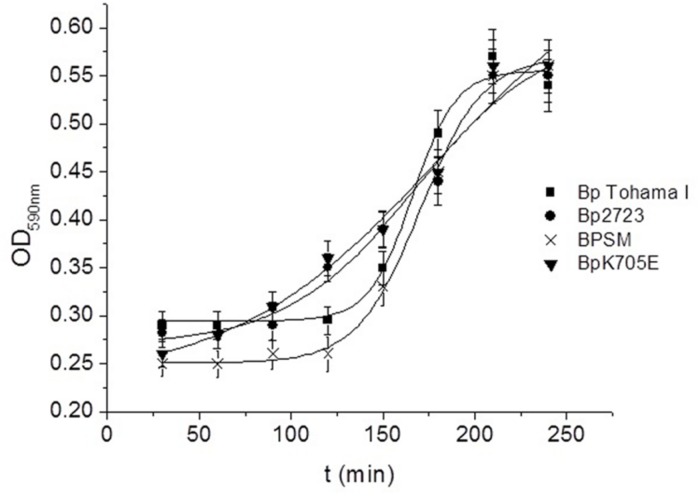
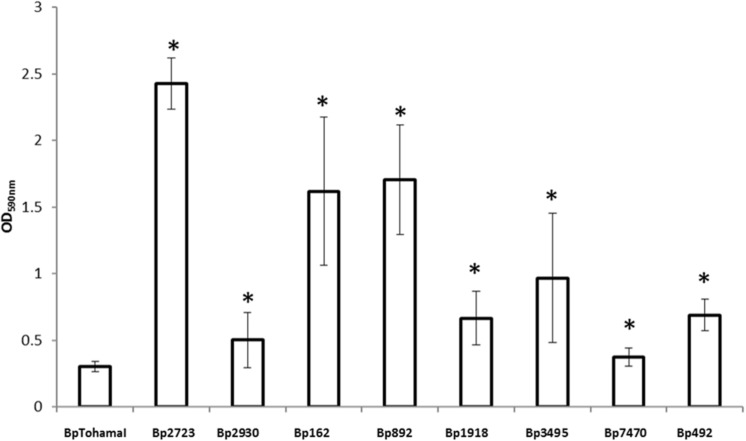
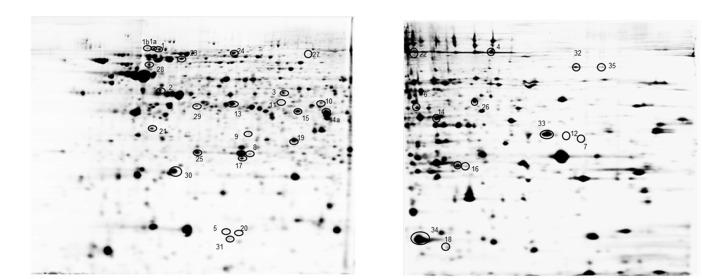
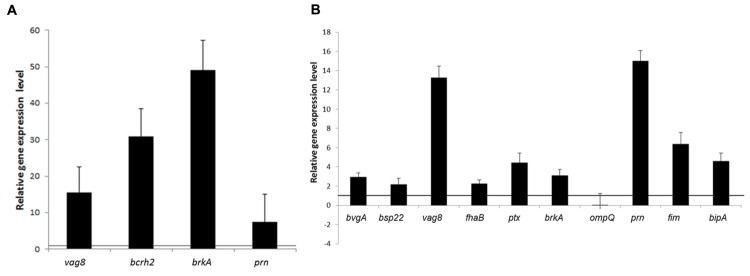
Pertussis is a highly contagious disease mainly caused by Bordetella pertussis. Despite the massive use of vaccines, since the 1950s the disease has become re-emergent in 2000 with a shift in incidence from infants to adolescents and adults. Clearly, the efficacy of current cellular or acellular vaccines, formulated from bacteria grown in stirred bioreactors is limited, presenting a challenge for future vaccine development. For gaining insights into the role of B. pertussis biofilm development for host colonization and persistence within the host, we examined the biofilm forming capacity of eight argentinean clinical isolates recovered from 2001 to 2007. All clinical isolates showed an enhanced potential for biofilm formation compared to the reference strain Tohama I. We further selected the clinical isolate B. pertussis 2723, exhibiting the highest biofilm biomass production, for quantitative proteomic profiling by means of two-dimensional fluorescence difference gel electrophoresis (2D-DIGE) coupled with mass spectrometry, which was accompanied by targeted transcriptional analysis. Results revealed an elevated expression of several virulence factors, including adhesins involved in biofilm development. In addition, we observed a higher expression of energy metabolism enzymes in the clinical isolate compared to the Tohama I strain. Furthermore, all clinical isolates carried a polymorphism in the bvgS gene. This mutation was associated to an increased sensitivity to modulation and a faster rate of adhesion to abiotic surfaces. Thus, the phenotypic biofilm characteristics shown by the clinical isolates might represent an important, hitherto underestimated, adaptive strategy for host colonization and long time persistence within the host.
百日咳是一种主要由百日咳博德特氏菌引起的高度传染性疾病。尽管疫苗被大量使用,但自20世纪50年代以来,该疾病在2000年再度出现,发病率从婴儿转向青少年和成年人。显然,目前由在搅拌式生物反应器中培养的细菌制成的细胞疫苗或无细胞疫苗的效力有限,这给未来疫苗的研发带来了挑战。为了深入了解百日咳博德特氏菌生物膜形成在宿主定植和在宿主体内持续存在中的作用,我们检测了2001年至2007年从阿根廷分离出的8株临床菌株的生物膜形成能力。与参考菌株Tohama I相比,所有临床分离株都显示出更强的生物膜形成潜力。我们进一步选择了生物膜生物量产量最高的临床分离株百日咳博德特氏菌2723,通过二维荧光差异凝胶电泳(2D-DIGE)结合质谱进行定量蛋白质组分析,并进行靶向转录分析。结果显示几种毒力因子的表达升高,包括参与生物膜形成的粘附素。此外,我们观察到临床分离株中能量代谢酶的表达高于Tohama I菌株。此外,所有临床分离株的bvgS基因都存在多态性。这种突变与对调节的敏感性增加以及对非生物表面的粘附速率加快有关。因此,临床分离株所表现出的表型生物膜特征可能代表了一种重要的、迄今被低估的、用于宿主定植和在宿主体内长期持续存在的适应性策略。