Rodriguez Ana M, Zeybek Burak, Asoglu Mehmet R, Sak Muhammet Erdal, Tan Alai, Borahay Mostafa A, Kilic Gokhan S
Department of Obstetrics & Gynecology, The University of Texas Medical Branch at Galveston, TX, USA.
Dicle University, Diyarbakir, Turkey.
Eur J Obstet Gynecol Reprod Biol. 2016 Feb;197:31-5. doi: 10.1016/j.ejogrb.2015.11.009. Epub 2015 Nov 28.
Our objective was to estimate the incidence of uterine leiomyosarcoma in patients with leiomyomas following laparoscopic supracervical hysterectomy and myomectomy procedures.
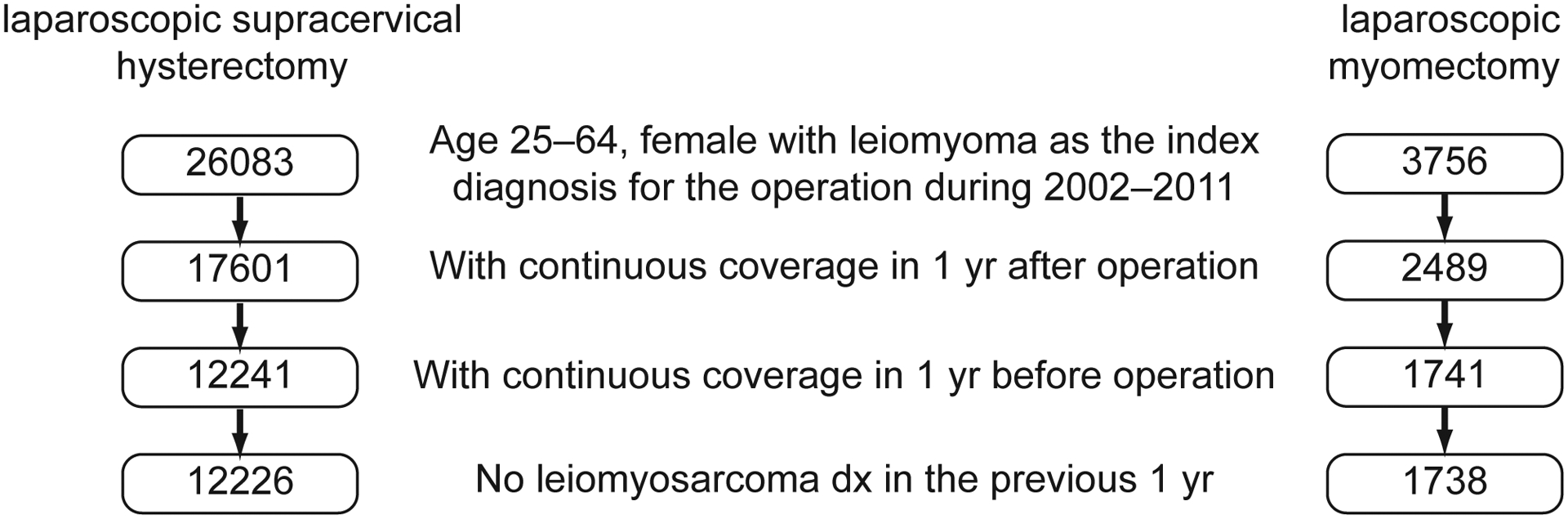
For this study, we analyzed records of 13,964 women aged 25-64 years who underwent laparoscopic supracervical hysterectomies or myomectomies for leiomyomas from 2002 to 2011 using Clinformatics DataMart. Patient records were divided into two groups: history of laparoscopic supracervical hysterectomy and history of myomectomy. Subjects were tracked to identify diagnosis of leiomyosarcoma within 1 year of the procedure. We analyzed data from the 25-39, 40-49, and 50-64 age brackets. Evidence was obtained from a cohort study from national private insurance claims in the US.
Our results showed the incidence of occult leiomyosarcoma developing within 1 year following supracervical hysterectomy using a laparoscopic-assisted approach are 9.8, 10.7, and 33.4 per 10,000 for the 25-39, 40-49, and 50-64 age brackets, respectively; the overall incidence rate is 13.1 per 10,000. The incidence rate of occult leiomyosarcoma developing within 1 year following myomectomy using a laparoscopic-assisted approach are 0.0, 33.8, and 90.1 per 10,000 for the 25-39, 40-49, and 50-64 age brackets, respectively; the overall incidence rate is 17.3 per 10,000.
Our analysis shows the overall risk of being diagnosed with occult leiomyosarcoma is 12.9 per 10,000 in laparoscopic-assisted supracervical hysterectomy and myomectomy for patients younger than 49. There is no evidence of occult leiomyosarcoma 1 year after operation for patients younger than 40 who underwent laparoscopic myomectomy.
我们的目的是评估腹腔镜次全子宫切除术和子宫肌瘤剔除术后子宫肌瘤患者发生子宫平滑肌肉瘤的发生率。
在本研究中,我们使用临床信息数据集市分析了2002年至2011年间13964名年龄在25 - 64岁之间因子宫肌瘤接受腹腔镜次全子宫切除术或子宫肌瘤剔除术的女性的记录。患者记录分为两组:腹腔镜次全子宫切除术史和子宫肌瘤剔除术史。对受试者进行跟踪,以确定在手术后1年内是否诊断为平滑肌肉瘤。我们分析了25 - 39岁、40 - 49岁和50 - 64岁年龄组的数据。证据来自美国全国私人保险索赔的队列研究。
我们的结果显示,采用腹腔镜辅助方法进行次全子宫切除术后1年内发生隐匿性平滑肌肉瘤的发生率,在25 - 39岁、40 - 49岁和50 - 64岁年龄组中分别为每10000人9.8例、10.7例和33.4例;总体发生率为每10000人13.1例。采用腹腔镜辅助方法进行子宫肌瘤剔除术后1年内发生隐匿性平滑肌肉瘤的发生率,在25 - 39岁、40 - 49岁和50 - 64岁年龄组中分别为每10000人0.0例、33.8例和90.1例;总体发生率为每10000人17.3例。
我们的分析表明,对于49岁以下接受腹腔镜辅助次全子宫切除术和子宫肌瘤剔除术的患者,被诊断为隐匿性平滑肌肉瘤的总体风险为每10000人12.9例。对于40岁以下接受腹腔镜子宫肌瘤剔除术的患者,术后1年没有隐匿性平滑肌肉瘤的证据。