Cooperative Institute for Marine and Atmospheric Studies, Rosenstiel School for Marine and Atmospheric Science, University of Miami, 4600 Rickenbacker Causeway, Miami, FL 33149, USA
Unidad Académica Mazatlán, Instituto de Ciencias del Mar y Limnología, Universidad Nacional Autónoma de México, Mazatlán, Sinaloa 82040, Mexico.
Biol Lett. 2015 Dec;11(12):20150596. doi: 10.1098/rsbl.2015.0596. Epub 2015 Dec 23.
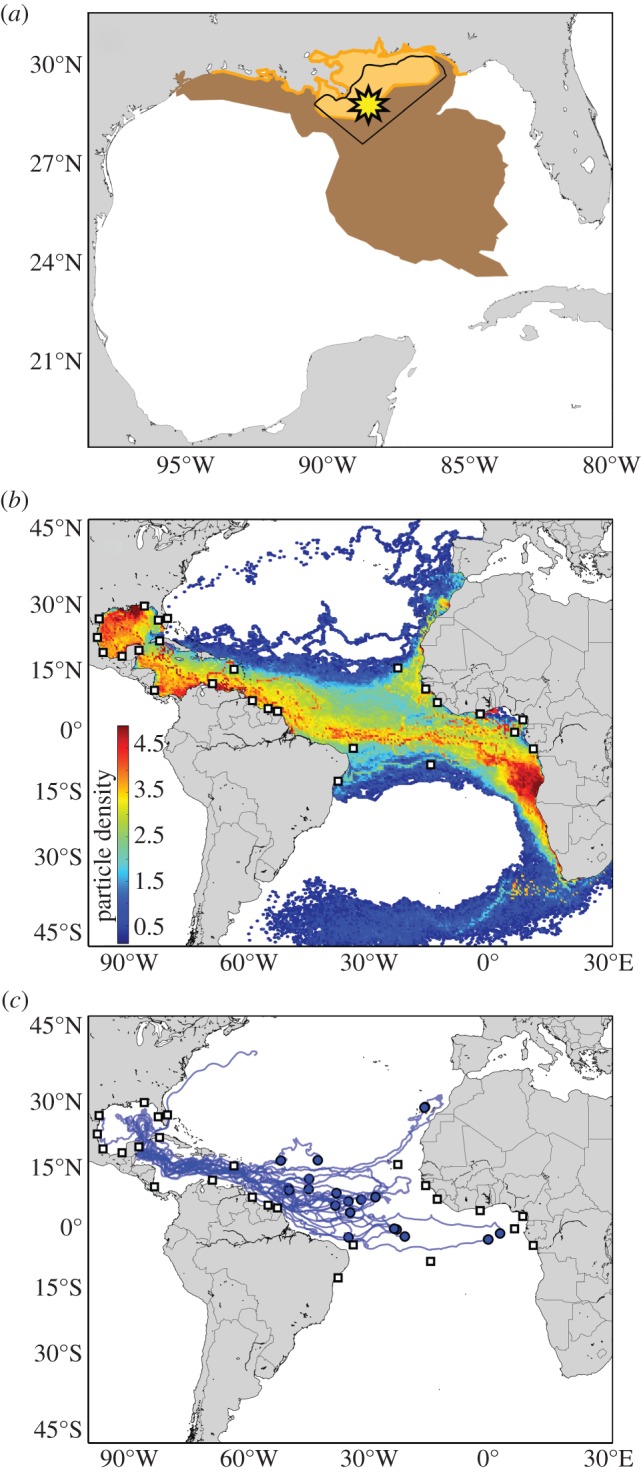
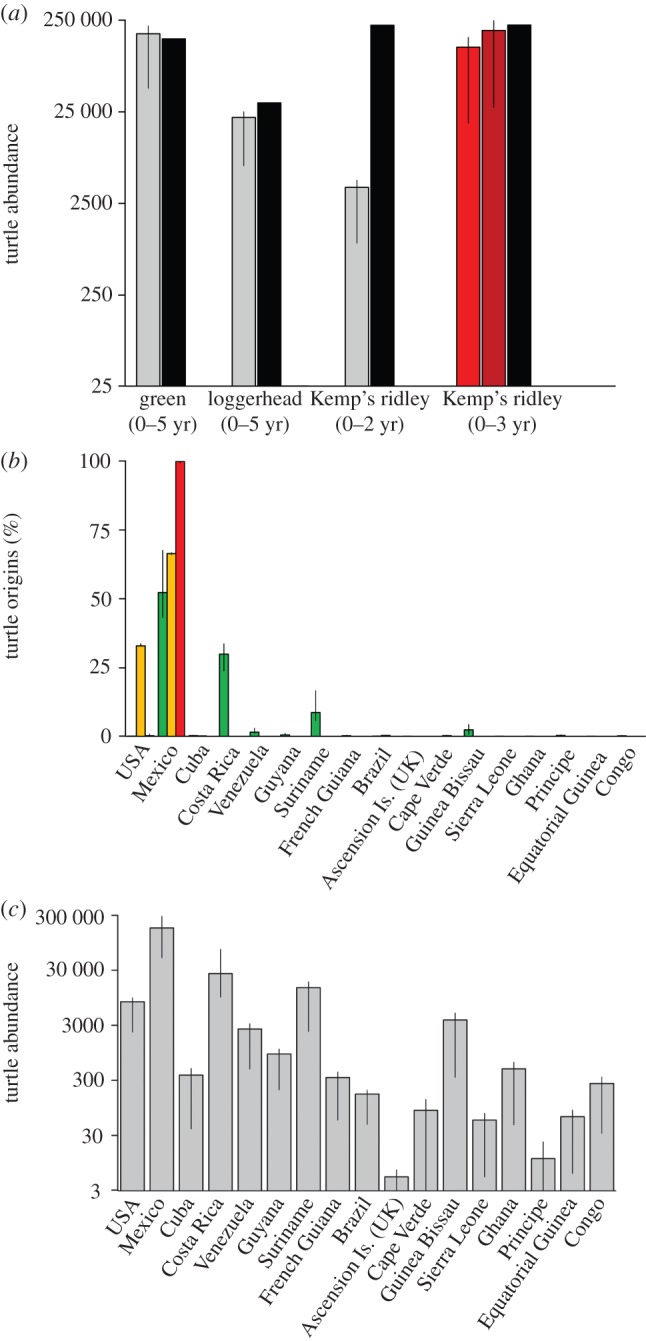
We investigated the extent that the 2010 Deepwater Horizon oil spill potentially affected oceanic-stage sea turtles from populations across the Atlantic. Within an ocean-circulation model, particles were backtracked from the Gulf of Mexico spill site to determine the probability of young turtles arriving in this area from major nesting beaches. The abundance of turtles in the vicinity of the oil spill was derived by forward-tracking particles from focal beaches and integrating population size, oceanic-stage duration and stage-specific survival rates. Simulations indicated that 321 401 (66 199-397 864) green (Chelonia mydas), loggerhead (Caretta caretta) and Kemp's ridley (Lepidochelys kempii) turtles were likely within the spill site. These predictions compared favourably with estimates from in-water observations recently made available to the public (though our initial predictions for Kemp's ridley were substantially lower than in-water estimates, better agreement was obtained with modifications to mimic behaviour of young Kemp's ridley turtles in the northern Gulf). Simulations predicted 75.2% (71.9-76.3%) of turtles came from Mexico, 14.8% (11-18%) from Costa Rica, 5.9% (4.8-7.9%) from countries in northern South America, 3.4% (2.4-3.5%) from the United States and 1.6% (0.6-2.0%) from West African countries. Thus, the spill's impacts may extend far beyond the current focus on the northern Gulf of Mexico.
我们研究了 2010 年深水地平线石油泄漏事件对来自大西洋各地的海洋阶段海龟的潜在影响。在一个海洋环流模型中,从墨西哥湾泄漏点回溯粒子,以确定幼年海龟从主要筑巢海滩到达该地区的概率。通过从重点海滩向前跟踪粒子并整合种群规模、海洋阶段持续时间和特定阶段的存活率,得出了泄漏点附近海龟的丰度。模拟表明,有 321401 只(66199-397864 只)绿海龟(Chelonia mydas)、红海龟(Caretta caretta)和肯普氏丽龟(Lepidochelys kempii)可能在泄漏点内。这些预测与最近向公众公布的水上观测估计值相当(尽管我们对肯普氏丽龟的初步预测远低于水上估计值,但通过对模拟年轻肯普氏丽龟在墨西哥湾北部行为的修改,得到了更好的一致性)。模拟预测,75.2%(71.9-76.3%)的海龟来自墨西哥,14.8%(11-18%)来自哥斯达黎加,5.9%(4.8-7.9%)来自南美洲北部国家,3.4%(2.4-3.5%)来自美国,1.6%(0.6-2.0%)来自西非国家。因此,泄漏的影响可能远远超出目前对墨西哥湾北部的关注。