Baselga García-Escudero Jaime, Miguel Hernández Trillos Pedro
Hospital Ruber International, Madrid, Spain.
PLoS One. 2015 Dec 28;10(12):e0145551. doi: 10.1371/journal.pone.0145551. eCollection 2015.
Autologous conditioned serum (ACS) is an autologous blood product that has shown efficacy against knee osteoarthritis (OA) in randomized controlled trials. However, there are few reports of its effectiveness in everyday practice. Here, we report clinical efficacy results from a two-year prospective observational study of patients with highly symptomatic knee OA who received ACS in conjunction with physiotherapy.
118 patients with unilateral knee OA (Kellgren-Lawrence grades I-IV), who were candidates for surgery but instead chose conservative treatment, were treated with a combination of four intra-articular injections of ACS (2 mL each) once weekly over four weeks and subsequent physiotherapy applied 4 weeks after ACS injection. Main endpoints of the study were pain (Numeric Rating Scale [NRS]) assessed at 0, 3, 6, 12 and 24 months, and Western Ontario and McMaster Universities Osteoarthritis Index (WOMAC) global score, assessed at 0 and 24 months. The effect size (Cohen's d) was calculated for pain and WOMAC outcomes, with effect sizes >0.8 considered large.
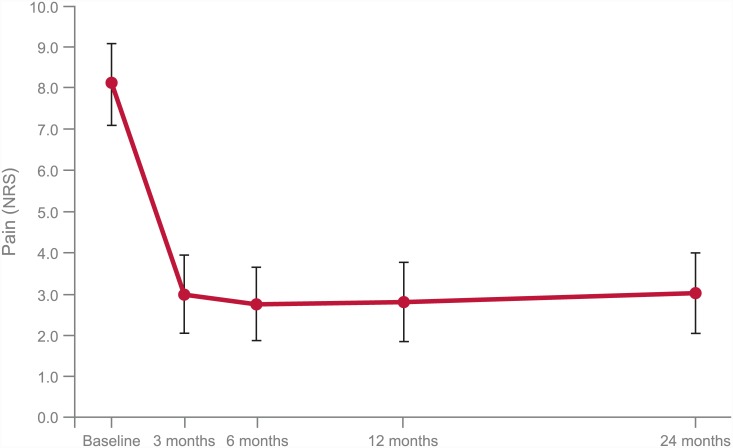
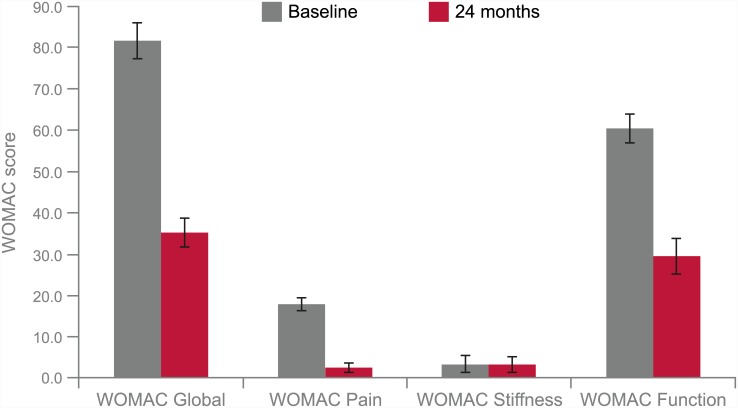
By 3 months, there were significant improvements in pain (NRS) from baseline (-63.0%, p<0.001), which were maintained over 24 months. Mean WOMAC global score was reduced at 24 months compared to baseline (-56.9%, p<0.001), as were WOMAC subscores of pain (-86.0%, p<0.001) and function (-51.3%, p<0.001). Effect sizes for pain (>5) and WOMAC improvement (8.0-13.6) were very large. Only one patient received total knee joint replacement during the study. Clinical improvement did not correlate with gender, age, Kellgren-Lawrence grade, or body mass index.
Treatment with ACS and physiotherapy produced a rapid decline in pain, which was sustained for the entire two years of the study. This was accompanied by a large improvement in WOMAC scores at two years. These results confirm that ACS combined with physiotherapy is an effective treatment for OA of the knee.
自体条件血清(ACS)是一种自体血液制品,在随机对照试验中已显示出对膝关节骨关节炎(OA)有效。然而,关于其在日常临床实践中的有效性报道较少。在此,我们报告一项针对有高度症状性膝关节OA患者的为期两年的前瞻性观察研究的临床疗效结果,这些患者接受了ACS联合物理治疗。
118例单侧膝关节OA(Kellgren-Lawrence分级I-IV级)患者,原本是手术候选者但选择了保守治疗,接受了为期四周、每周一次共四次的关节腔内注射ACS(每次2 mL)联合治疗,随后在ACS注射4周后进行物理治疗。研究的主要终点为在0、3、6、12和24个月时评估的疼痛(数字评分量表[NRS]),以及在0和24个月时评估的西安大略和麦克马斯特大学骨关节炎指数(WOMAC)整体评分。计算疼痛和WOMAC结果的效应量(Cohen's d),效应量>0.8被认为是大效应量。
到3个月时,疼痛(NRS)较基线有显著改善(-63.0%,p<0.001),并在24个月内维持。与基线相比,24个月时WOMAC整体评分降低(-56.9%,p<0.001),WOMAC疼痛亚评分(-86.0%,p<0.001)和功能亚评分(-51.3%,p<0.001)也降低。疼痛的效应量(>5)和WOMAC改善的效应量(8.0 - 13.6)非常大。研究期间只有1例患者接受了全膝关节置换。临床改善与性别、年龄、Kellgren-Lawrence分级或体重指数无关。
ACS联合物理治疗使疼痛迅速下降,在整个两年的研究期间持续存在。同时,两年时WOMAC评分有大幅改善。这些结果证实,ACS联合物理治疗是膝关节OA的有效治疗方法。