Lv Meizhen, Li Ang, Liu Tianli, Zhu Tingshao
Key Lab of Behavioral Science of Chinese Academy of Sciences (CAS), Institute of Psychology, CAS, Beijing, China.
Department of Psychology, Peking University, Beijing, China.
PeerJ. 2015 Dec 15;3:e1455. doi: 10.7717/peerj.1455. eCollection 2015.
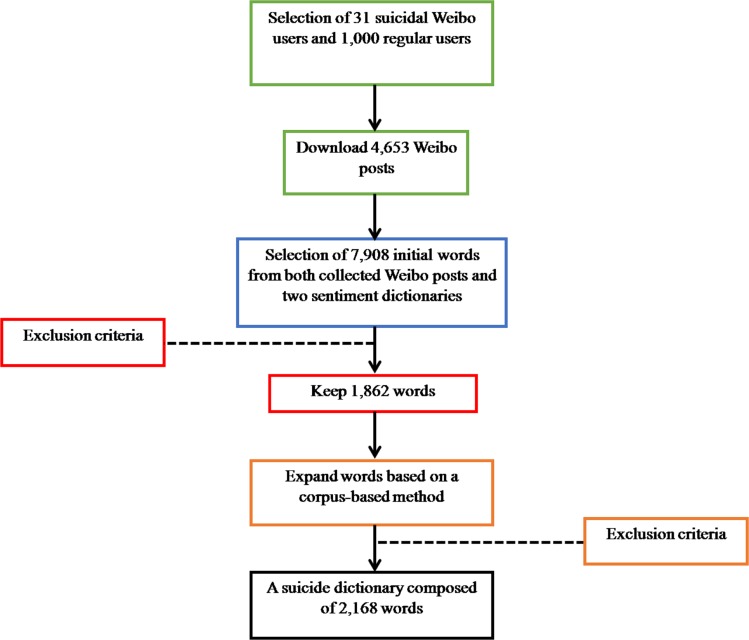
Introduction. Suicide has become a serious worldwide epidemic. Early detection of individual suicide risk in population is important for reducing suicide rates. Traditional methods are ineffective in identifying suicide risk in time, suggesting a need for novel techniques. This paper proposes to detect suicide risk on social media using a Chinese suicide dictionary. Methods. To build the Chinese suicide dictionary, eight researchers were recruited to select initial words from 4,653 posts published on Sina Weibo (the largest social media service provider in China) and two Chinese sentiment dictionaries (HowNet and NTUSD). Then, another three researchers were recruited to filter out irrelevant words. Finally, remaining words were further expanded using a corpus-based method. After building the Chinese suicide dictionary, we tested its performance in identifying suicide risk on Weibo. First, we made a comparison of the performance in both detecting suicidal expression in Weibo posts and evaluating individual levels of suicide risk between the dictionary-based identifications and the expert ratings. Second, to differentiate between individuals with high and non-high scores on self-rating measure of suicide risk (Suicidal Possibility Scale, SPS), we built Support Vector Machines (SVM) models on the Chinese suicide dictionary and the Simplified Chinese Linguistic Inquiry and Word Count (SCLIWC) program, respectively. After that, we made a comparison of the classification performance between two types of SVM models. Results and Discussion. Dictionary-based identifications were significantly correlated with expert ratings in terms of both detecting suicidal expression (r = 0.507) and evaluating individual suicide risk (r = 0.455). For the differentiation between individuals with high and non-high scores on SPS, the Chinese suicide dictionary (t1: F 1 = 0.48; t2: F 1 = 0.56) produced a more accurate identification than SCLIWC (t1: F 1 = 0.41; t2: F 1 = 0.48) on different observation windows. Conclusions. This paper confirms that, using social media, it is possible to implement real-time monitoring individual suicide risk in population. Results of this study may be useful to improve Chinese suicide prevention programs and may be insightful for other countries.
引言。自杀已成为全球范围内的严重问题。在人群中早期发现个体自杀风险对于降低自杀率至关重要。传统方法在及时识别自杀风险方面效果不佳,这表明需要新的技术。本文提出使用中文自杀词典在社交媒体上检测自杀风险。方法。为构建中文自杀词典,招募了八位研究人员从新浪微博(中国最大的社交媒体服务提供商)上发布的4653条帖子以及两部中文情感词典(知网和台湾交通大学情感词典)中挑选初始词汇。然后,又招募了另外三位研究人员筛选出无关词汇。最后,使用基于语料库的方法对剩余词汇进行进一步扩展。构建中文自杀词典后,我们测试了其在识别微博自杀风险方面的性能。首先,我们比较了基于词典的识别方法与专家评级在检测微博帖子中的自杀表达以及评估个体自杀风险水平方面的性能。其次,为区分自杀风险自评量表(SPS)得分高和得分不高的个体,我们分别基于中文自杀词典和简体中文语言查询与字数统计(SCLIWC)程序构建了支持向量机(SVM)模型。之后,我们比较了两种类型的SVM模型的分类性能。结果与讨论。基于词典的识别方法在检测自杀表达(r = 0.507)和评估个体自杀风险(r = 0.455)方面与专家评级显著相关。对于区分SPS得分高和得分不高的个体,在不同观察窗口下,中文自杀词典(t1:F1 = 0.48;t2:F1 = 0.56)比SCLIWC(t1:F1 = 0.41;t2:F1 = 0.48)产生了更准确的识别。结论。本文证实,利用社交媒体可以对人群中的个体自杀风险进行实时监测。本研究结果可能有助于改进中国的自杀预防计划,对其他国家也可能具有启示意义。