Liu Xingyun, Liu Xiaoqian, Sun Jiumo, Yu Nancy Xiaonan, Sun Bingli, Li Qing, Zhu Tingshao
Institute of Psychology, Chinese Academy of Sciences, Beijing, China.
Department of Psychology, University of Chinese Academy of Sciences, Beijing, China.
J Med Internet Res. 2019 May 8;21(5):e11705. doi: 10.2196/11705.
Suicide is a great public health challenge. Two hundred million people attempt suicide in China annually. Existing suicide prevention programs require the help-seeking initiative of suicidal individuals, but many of them have a low motivation to seek the required help. We propose that a proactive and targeted suicide prevention strategy can prompt more people with suicidal thoughts and behaviors to seek help.
The goal of the research was to test the feasibility and acceptability of Proactive Suicide Prevention Online (PSPO), a new approach based on social media that combines proactive identification of suicide-prone individuals with specialized crisis management.
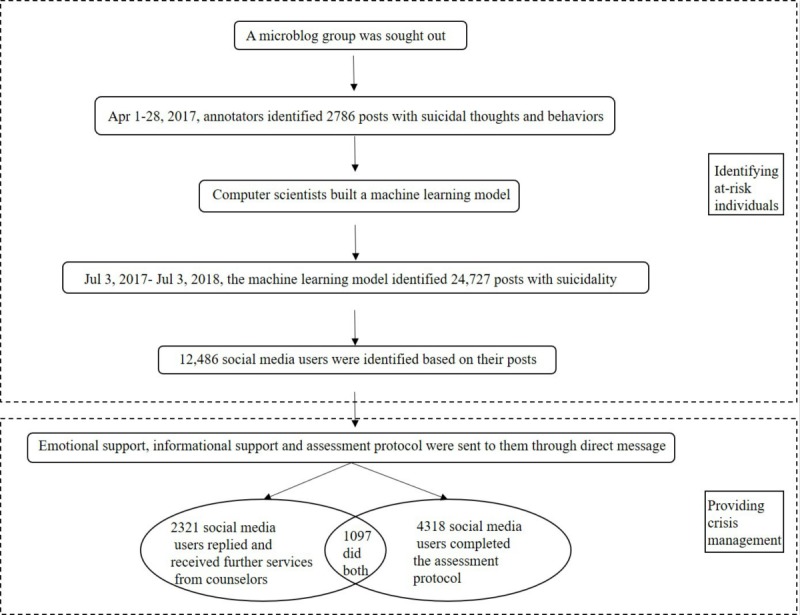
We first located a microblog group online. Their comments on a suicide note were analyzed by experts to provide a training set for the machine learning models for suicide identification. The best-performing model was used to automatically identify posts that suggested suicidal thoughts and behaviors. Next, a microblog direct message containing crisis management information, including measures that covered suicide-related issues, depression, help-seeking behavior and an acceptability test, was sent to users who had been identified by the model to be at risk of suicide. For those who replied to the message, trained counselors provided tailored crisis management. The Simplified Chinese Linguistic Inquiry and Word Count was also used to analyze the users' psycholinguistic texts in 1-month time slots prior to and postconsultation.
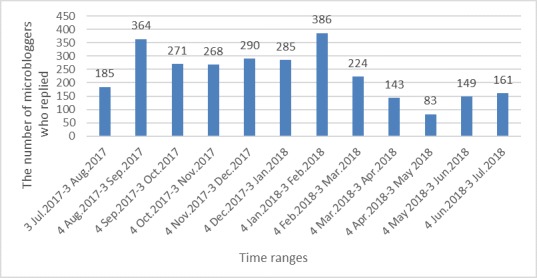
A total of 27,007 comments made in April 2017 were analyzed. Among these, 2786 (10.32%) were classified as indicative of suicidal thoughts and behaviors. The performance of the detection model was good, with high precision (.86), recall (.78), F-measure (.86), and accuracy (.88). Between July 3, 2017, and July 3, 2018, we sent out a total of 24,727 direct messages to 12,486 social media users, and 5542 (44.39%) responded. Over one-third of the users who were contacted completed the questionnaires included in the direct message. Of the valid responses, 89.73% (1259/1403) reported suicidal ideation, but more than half (725/1403, 51.67%) reported that they had not sought help. The 9-Item Patient Health Questionnaire (PHQ-9) mean score was 17.40 (SD 5.98). More than two-thirds of the participants (968/1403, 69.00%) thought the PSPO approach was acceptable. Moreover, 2321 users replied to the direct message. In a comparison of the frequency of word usage in their microblog posts 1-month before and after the consultation, we found that the frequency of death-oriented words significantly declined while the frequency of future-oriented words significantly increased.
The PSPO model is suitable for identifying populations that are at risk of suicide. When followed up with proactive crisis management, it may be a useful supplement to existing prevention programs because it has the potential to increase the accessibility of antisuicide information to people with suicidal thoughts and behaviors but a low motivation to seek help.
自杀是一项重大的公共卫生挑战。中国每年有2亿人尝试自杀。现有的自杀预防项目需要有自杀倾向的个体主动寻求帮助,但他们中的许多人寻求所需帮助的动机很低。我们提出,一种积极主动且有针对性的自杀预防策略可以促使更多有自杀想法和行为的人寻求帮助。
本研究的目的是测试在线主动自杀预防(PSPO)的可行性和可接受性,这是一种基于社交媒体的新方法,将对易自杀个体的主动识别与专门的危机管理相结合。
我们首先在网上找到一个微博群组。专家对他们对一份遗书的评论进行分析,为自杀识别机器学习模型提供一个训练集。使用表现最佳的模型自动识别表明有自杀想法和行为的帖子。接下来,向被该模型识别为有自杀风险的用户发送一条包含危机管理信息的微博私信,这些信息包括涉及自杀相关问题、抑郁、寻求帮助行为以及一项可接受性测试的措施。对于回复该私信的用户,经过培训的咨询师提供量身定制的危机管理。还使用简体中文语言查询与字数统计来分析用户在咨询前和咨询后1个月时间段内的心理语言学文本。
共分析了2017年4月发布的27007条评论。其中,2786条(10.32%)被归类为表明有自杀想法和行为。检测模型表现良好,具有高精度(.86)、召回率(.78)、F值(.86)和准确率(.88)。在2017年7月3日至2018年7月3日期间,我们总共向12486名社交媒体用户发送了24727条私信,5542人(44.39%)回复。超过三分之一被联系的用户完成了私信中包含的问卷。在有效回复中,89.73%(1259/1403)报告有自杀意念,但超过一半(725/1403,51.67%)报告他们未曾寻求帮助。9项患者健康问卷(PHQ - 9)的平均得分是17.40(标准差5.98)。超过三分之二的参与者(968/1403,69.00%)认为PSPO方法是可接受的。此外,2321名用户回复了私信。在比较他们微博帖子咨询前1个月和咨询后1个月的用词频率时,我们发现以死亡为导向的词汇频率显著下降,而以未来为导向的词汇频率显著增加。
PSPO模型适用于识别有自杀风险的人群。当通过积极的危机管理进行跟进时,它可能是现有预防项目的有益补充,因为它有可能增加有自杀想法和行为但寻求帮助动机较低的人群获得反自杀信息的机会。