Natoli Lisa, Guy Rebecca J, Shephard Mark, Causer Louise, Badman Steven G, Hengel Belinda, Tangey Annie, Ward James, Coburn Tony, Anderson David, Kaldor John, Maher Lisa
The Kirby Institute, UNSW Australia, Sydney, NSW, Australia.
The Burnet Institute, Melbourne, VIC, Australia.
PLoS One. 2015 Dec 29;10(12):e0145993. doi: 10.1371/journal.pone.0145993. eCollection 2015.
Point-of-care tests for chlamydia (CT) and gonorrhoea (NG) could increase the uptake and timeliness of testing and treatment, contribute to improved disease control and reduce reproductive morbidity. The GeneXpert (Xpert CT/NG assay), suited to use at the point-of-care, is being used in the TTANGO randomised controlled trial (RCT) in 12 remote Australian health services with a high burden of sexually transmissible infections (STIs). This represents the first ever routine use of a molecular point-of-care diagnostic for STIs in primary care. The purpose of this study was to explore the acceptability of the GeneXpert to primary care staff in remote Australia.
In-depth qualitative interviews were conducted with 16 staff (registered or enrolled nurses and Aboriginal Health Workers/Practitioners) trained and experienced with GeneXpert testing. Interviews were digitally-recorded and transcribed verbatim prior to content analysis.
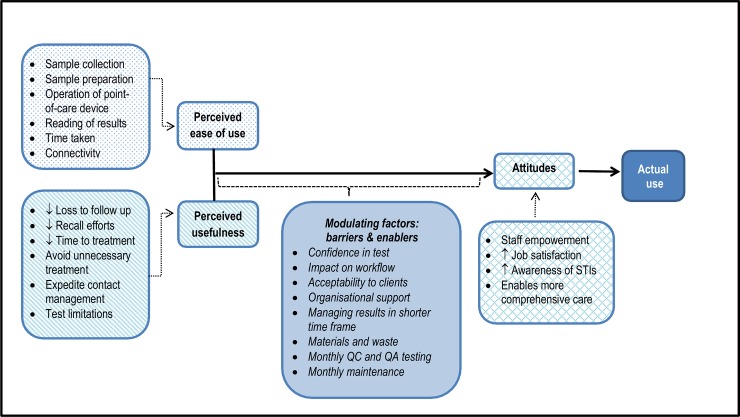
Most participants displayed positive attitudes, indicating the test was both easy to use and useful in their clinical context. Participants indicated that point-of-care testing had improved management of STIs, resulting in more timely and targeted treatment, earlier commencement of partner notification, and reduced follow up efforts associated with client recall. Staff expressed confidence in point-of-care test results and treating patients on this basis, and reported greater job satisfaction. While point-of-care testing did not negatively impact on client flow, several found the manual documentation processes time consuming, suggesting that improved electronic connectivity and test result transfer between the GeneXpert and patient management systems could overcome this. Managing positive test results in a shorter time frame was challenging for some but most found it satisfying to complete episodes of care more quickly.
In the context of a RCT, health professionals working in remote primary care in Australia found the GeneXpert highly acceptable. These findings have implications for use in other primary care settings around the world.
衣原体(CT)和淋病(NG)的即时检测可提高检测和治疗的接受度及及时性,有助于改善疾病控制并降低生殖系统发病率。适用于即时检测的GeneXpert(Xpert CT/NG检测法)正在澳大利亚12个性传播感染(STI)负担较重的偏远卫生服务机构进行的TTANGO随机对照试验(RCT)中使用。这代表了分子即时诊断在初级保健中首次用于STI的常规检测。本研究的目的是探讨GeneXpert在澳大利亚偏远地区初级保健人员中的可接受性。
对16名接受过GeneXpert检测培训且有经验的工作人员(注册护士或登记护士以及原住民卫生工作者/从业者)进行了深入的定性访谈。访谈进行了数字录音,并在内容分析之前逐字转录。
大多数参与者表现出积极态度,表明该检测在临床环境中既易于使用又有用。参与者表示即时检测改善了STI的管理,带来了更及时、更有针对性的治疗,更早开始性伴侣通知,并减少了与客户召回相关的后续工作。工作人员对即时检测结果以及在此基础上治疗患者表示有信心,并报告工作满意度更高。虽然即时检测没有对客户流量产生负面影响,但一些人发现手工记录过程耗时,建议改善GeneXpert与患者管理系统之间的电子连接和检测结果传输可以克服这一问题。对一些人来说,在更短的时间内处理阳性检测结果具有挑战性,但大多数人发现更快完成护理过程令人满意。
在RCT的背景下,澳大利亚偏远地区初级保健机构的卫生专业人员发现GeneXpert非常容易接受。这些发现对在世界其他初级保健环境中的应用具有启示意义。