
周质酸应激增加大肠杆菌的细胞分裂不对称性(极性老化)。
Periplasmic Acid Stress Increases Cell Division Asymmetry (Polar Aging) of Escherichia coli.
作者信息
Clark Michelle W, Yie Anna M, Eder Elizabeth K, Dennis Richard G, Basting Preston J, Martinez Keith A, Jones Brian D, Slonczewski Joan L
机构信息
Department of Biology, Kenyon College, Gambier, Ohio, United States of America.
Department of Mathematics and Statistics, Kenyon College, Gambier, Ohio, United States of America.
出版信息
PLoS One. 2015 Dec 29;10(12):e0144650. doi: 10.1371/journal.pone.0144650. eCollection 2015.
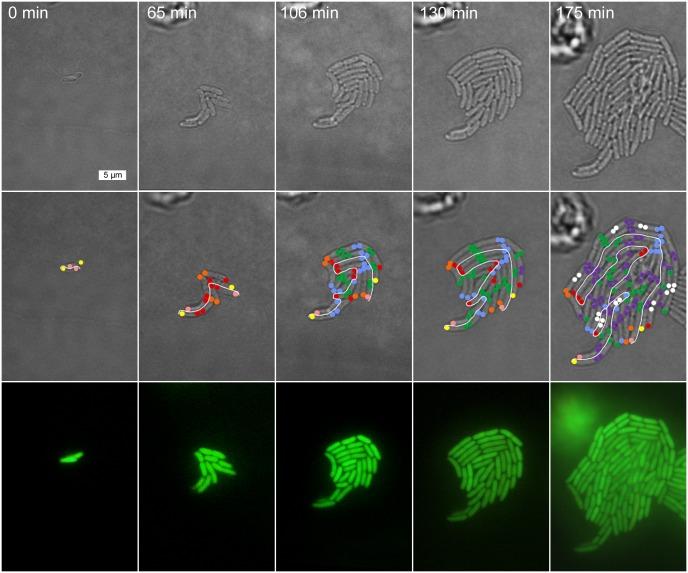
Under certain kinds of cytoplasmic stress, Escherichia coli selectively reproduce by distributing the newer cytoplasmic components to new-pole cells while sequestering older, damaged components in cells inheriting the old pole. This phenomenon is termed polar aging or cell division asymmetry. It is unknown whether cell division asymmetry can arise from a periplasmic stress, such as the stress of extracellular acid, which is mediated by the periplasm. We tested the effect of periplasmic acid stress on growth and division of adherent single cells. We tracked individual cell lineages over five or more generations, using fluorescence microscopy with ratiometric pHluorin to measure cytoplasmic pH. Adherent colonies were perfused continually with LBK medium buffered at pH 6.00 or at pH 7.50; the external pH determines periplasmic pH. In each experiment, cell lineages were mapped to correlate division time, pole age and cell generation number. In colonies perfused at pH 6.0, the cells inheriting the oldest pole divided significantly more slowly than the cells inheriting the newest pole. In colonies perfused at pH 7.50 (near or above cytoplasmic pH), no significant cell division asymmetry was observed. Under both conditions (periplasmic pH 6.0 or pH 7.5) the cells maintained cytoplasmic pH values at 7.2-7.3. No evidence of cytoplasmic protein aggregation was seen. Thus, periplasmic acid stress leads to cell division asymmetry with minimal cytoplasmic stress.
在某些类型的细胞质应激下,大肠杆菌通过将较新的细胞质成分分配到新极细胞中,同时将较旧的、受损的成分隔离在继承旧极的细胞中,从而进行选择性繁殖。这种现象被称为极性老化或细胞分裂不对称。尚不清楚细胞分裂不对称是否会由周质应激引起,例如由周质介导的细胞外酸性应激。我们测试了周质酸性应激对贴壁单细胞生长和分裂的影响。我们使用带有比率型pH荧光蛋白的荧光显微镜跟踪了五个或更多代的单个细胞谱系,以测量细胞质pH值。向贴壁菌落持续灌注pH值为6.00或7.50的LBK缓冲培养基;外部pH值决定周质pH值。在每个实验中,绘制细胞谱系以关联分裂时间、极龄和细胞代数。在pH值为6.0的灌注菌落中,继承最老极的细胞比继承最新极的细胞分裂明显更慢。在pH值为7.50(接近或高于细胞质pH值)的灌注菌落中,未观察到明显的细胞分裂不对称。在两种条件下(周质pH值为6.0或7.5),细胞都将细胞质pH值维持在7.2 - 7.3。未发现细胞质蛋白聚集的证据。因此,周质酸性应激导致细胞分裂不对称,同时细胞质应激最小。




 Zotero 插件